FNT 2 :
1)mini
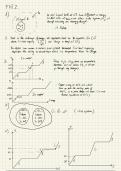
ke and Liquid both at O'C have different inenergy
In that case Ethern is not affect will
System, Ep
to the
change indicating an
energy change
↑
i ---
>
-
False
.
2 Heat is the
exchange of energy .
We
represents heat as the equation G= CAT
where Cis heat temp T CK
(1) change
and in
capacity
of heat because or heat capacity
An C
object can contain a kind
certain
represent the
ability to absorb heat until its temperature start to
charge
C In water
a
3 Since H2O will down as temperature
&
9 go
I
100% decrease but not below 0
%, it will not
60 %
go through any changes
GC ... - -
S
E
·
n
-
Copper is
only at 20 % and will not
2568 heat up past the point of
-
- - - - - - -
melting
1000 phase change will (in
°
C so no occur case
,
In copper thermal equilibrium at 60
°
C)
1000o
&
Energy
·OQE
Close
C C
·
9
i
9
100-------- L
⑨
60 -
-
-- ·
-
-
b
68 -
----
O
-
S
20-
S
E
E
, ⑫
⑪change
in thermal E
= Heat
H20
2) aT an
L
↓s
G·
·
>
E
1)mini
ke and Liquid both at O'C have different inenergy
In that case Ethern is not affect will
System, Ep
to the
change indicating an
energy change
↑
i ---
>
-
False
.
2 Heat is the
exchange of energy .
We
represents heat as the equation G= CAT
where Cis heat temp T CK
(1) change
and in
capacity
of heat because or heat capacity
An C
object can contain a kind
certain
represent the
ability to absorb heat until its temperature start to
charge
C In water
a
3 Since H2O will down as temperature
&
9 go
I
100% decrease but not below 0
%, it will not
60 %
go through any changes
GC ... - -
S
E
·
n
-
Copper is
only at 20 % and will not
2568 heat up past the point of
-
- - - - - - -
melting
1000 phase change will (in
°
C so no occur case
,
In copper thermal equilibrium at 60
°
C)
1000o
&
Energy
·OQE
Close
C C
·
9
i
9
100-------- L
⑨
60 -
-
-- ·
-
-
b
68 -
----
O
-
S
20-
S
E
E
, ⑫
⑪change
in thermal E
= Heat
H20
2) aT an
L
↓s
G·
·
>
E