

OAE Comprehensive Integrated Social
Studies Exam Questions and Answers with
Verified Solutions | Latest Updated 2026
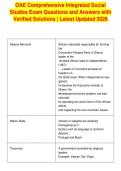
Kwame Nkrumah African nationalist responsible for forming
the
Convention Peoples Party in Ghana;
leader of the
1st black African state to independence
(1957).
..., Leader of nonviolent protests for
freedom on
the Gold Coast. When independence was
gained,
he became the first prime minister of
Ghana. He
develpoped economic projects, but was
criticized
for spending too much time on Pan-African
efforts,
and neglecting his own countries' issues
Nation State citizens or subjects are relatively
homogeneous in
factors such as language or common
descent.
Portugal and Brazil
Theocracy A government controlled by religious
leaders
Example: Vatican City- Pope
,Dynastic Cycle the historical pattern of the rise, decline,
and
replacement
example: China
Collectivization Creation of large, state-run farms rather
than
individual holdings; allowed more efficient
control
over peasants; part of Stalin's economic
and
political planning; often adopted in other
Communist regimes. Used in U.S.S.R and
China.
Globalization Actions or processes that involve the entire
world
and result in making something worldwide
in scope
Modernization The process of reforming political, military,
economic, social, and cultural traditions in
imitation
of the early success of Western societies,
often
with regard for accommodating local
traditions in
non-Western societies.
Periodization/Chronology Historian's attempt to break down history
into
managable segments
, Fredrick Jackson Turner- Frontier Historian during the 1890s who wrote
Thesis _____ which
argued that the continuous existence of
the
American
_____ had shaped the character of the
nation, and
the end of this _____marked the end the
first chapter
in American history.
Charles Beards historian who argued that the Founders
were
largely motivated by the economic
advantage of
their class in writing the Constitution
Karl Marx 1818-1883. 19th century philosopher,
political
economist, sociologist, humanist, political
theorist,
and revolutionary. Often recognized as the
father
of communism. Analysis of history led to
his belief
that communism would replace capitalism
as it
replaced feudalism. Believed in a classless
society.
Studies Exam Questions and Answers with
Verified Solutions | Latest Updated 2026
Kwame Nkrumah African nationalist responsible for forming
the
Convention Peoples Party in Ghana;
leader of the
1st black African state to independence
(1957).
..., Leader of nonviolent protests for
freedom on
the Gold Coast. When independence was
gained,
he became the first prime minister of
Ghana. He
develpoped economic projects, but was
criticized
for spending too much time on Pan-African
efforts,
and neglecting his own countries' issues
Nation State citizens or subjects are relatively
homogeneous in
factors such as language or common
descent.
Portugal and Brazil
Theocracy A government controlled by religious
leaders
Example: Vatican City- Pope
,Dynastic Cycle the historical pattern of the rise, decline,
and
replacement
example: China
Collectivization Creation of large, state-run farms rather
than
individual holdings; allowed more efficient
control
over peasants; part of Stalin's economic
and
political planning; often adopted in other
Communist regimes. Used in U.S.S.R and
China.
Globalization Actions or processes that involve the entire
world
and result in making something worldwide
in scope
Modernization The process of reforming political, military,
economic, social, and cultural traditions in
imitation
of the early success of Western societies,
often
with regard for accommodating local
traditions in
non-Western societies.
Periodization/Chronology Historian's attempt to break down history
into
managable segments
, Fredrick Jackson Turner- Frontier Historian during the 1890s who wrote
Thesis _____ which
argued that the continuous existence of
the
American
_____ had shaped the character of the
nation, and
the end of this _____marked the end the
first chapter
in American history.
Charles Beards historian who argued that the Founders
were
largely motivated by the economic
advantage of
their class in writing the Constitution
Karl Marx 1818-1883. 19th century philosopher,
political
economist, sociologist, humanist, political
theorist,
and revolutionary. Often recognized as the
father
of communism. Analysis of history led to
his belief
that communism would replace capitalism
as it
replaced feudalism. Believed in a classless
society.


