

NUTR 4210 Exam Questions and Answers
with Verified Solutions | Latest Updated 2026
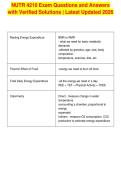
Resting Energy Expenditure BMR or RMR
- what we need for basic metabolic
demands
-affected by genetics, age, size, body
composition,
temperature, exercise, diet, etc.
Thermic Effect of Food -energy we need to burn off food
Total Daily Energy Expenditure -all the energy we need in a day
REE + TEF + Physical Activity = TDEE
Calorimetry Direct - measure change in water
temperature
surrounding a chamber, proportional to
energy
expended
Indirect - measure O2 consumption, CO2
production to estimate energy expenditure
,Respiratory Exchange Ratio - reflects ratio of carbs to fats being
oxidized.
Ignores protein b/c it provides little energy,
assumes requirements of mitochondria =
whole
body
- used determining table, 1.0 = carbs, 0.7 =
fats
RER = VCO2 / VO2
VO2 Max -maximum O2 consumption and aerobic
capacity
Factors Affecting VO2 Max 1. Central Circulation - CO, O2 extraction,
O2
carrying capacity
2. Respiration - arterial O2 saturation
3. Skeletal Muscle - oxidative
mitochondrial
enzymes
Catecholamines Epinephrine, Norepinephrine
- increase glycogenolysis,gluconeogenesis
= HGP
-increase lipolysis = FFA
-increase GLUT 4 transporters
-increase sweat, renin, decrease blood Q
to skin
-increase HR, SV, vasoconstriction
, Insulin -decreases during exercise to inhibit
storage,
promote utilization
Systemically, inhibitting insulin:
-decrease GLUT 4 transporters
-inhibit TCA
-decrease blood Q to tissues
= more glucose in the blood to be pushed
to
tissues with high metabolic demand
Locally
-increases local blood Q via H+, K+, CO2
Glucagon -increases gluconeogensis = HGP
-increases lipolysis = FFA release
Cortisol, Growth Hormone -fuel mobilization, unclear
-may have redundant functions
Renin, Aldosterone, ADH -conserve Na+, H20 therefore regulates
plasma
volume and blood pressure
IL-6 -released later in exercise by contracting
muscle
-increase HGP
-increase lipolysis = FFA release
-increase FA B-oxidation = FFA release
with Verified Solutions | Latest Updated 2026
Resting Energy Expenditure BMR or RMR
- what we need for basic metabolic
demands
-affected by genetics, age, size, body
composition,
temperature, exercise, diet, etc.
Thermic Effect of Food -energy we need to burn off food
Total Daily Energy Expenditure -all the energy we need in a day
REE + TEF + Physical Activity = TDEE
Calorimetry Direct - measure change in water
temperature
surrounding a chamber, proportional to
energy
expended
Indirect - measure O2 consumption, CO2
production to estimate energy expenditure
,Respiratory Exchange Ratio - reflects ratio of carbs to fats being
oxidized.
Ignores protein b/c it provides little energy,
assumes requirements of mitochondria =
whole
body
- used determining table, 1.0 = carbs, 0.7 =
fats
RER = VCO2 / VO2
VO2 Max -maximum O2 consumption and aerobic
capacity
Factors Affecting VO2 Max 1. Central Circulation - CO, O2 extraction,
O2
carrying capacity
2. Respiration - arterial O2 saturation
3. Skeletal Muscle - oxidative
mitochondrial
enzymes
Catecholamines Epinephrine, Norepinephrine
- increase glycogenolysis,gluconeogenesis
= HGP
-increase lipolysis = FFA
-increase GLUT 4 transporters
-increase sweat, renin, decrease blood Q
to skin
-increase HR, SV, vasoconstriction
, Insulin -decreases during exercise to inhibit
storage,
promote utilization
Systemically, inhibitting insulin:
-decrease GLUT 4 transporters
-inhibit TCA
-decrease blood Q to tissues
= more glucose in the blood to be pushed
to
tissues with high metabolic demand
Locally
-increases local blood Q via H+, K+, CO2
Glucagon -increases gluconeogensis = HGP
-increases lipolysis = FFA release
Cortisol, Growth Hormone -fuel mobilization, unclear
-may have redundant functions
Renin, Aldosterone, ADH -conserve Na+, H20 therefore regulates
plasma
volume and blood pressure
IL-6 -released later in exercise by contracting
muscle
-increase HGP
-increase lipolysis = FFA release
-increase FA B-oxidation = FFA release


