Chemistry
Particulate nature of matter
Behaviours of particles:
● Solid:
○ Held tightly together in a fixed position
○ Have definite shape
○ Vibrates
● Liquid:
○ Have enough energy to move around
○ No definite shape , takes shape if the container holding it
● Gas:
○ Particles are further apart
○ Constantly moving
○ Spread to fill container they are in
How substances change from one state to another:
Heat energy must be applied as it provides the particles with enough energy to overcome the
attraction.(Solid>liquid>gas)
By removing hear to make particles closer (gas>liquid>solid)
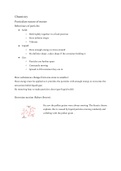
Brownian motion (Robert Brown):
He saw the pollen grains were always moving. The kinetic theory
explains this is caused by liquid particles moving randomly and
colliding with the pollen grain .
, Experimental techniques
Measurement:
● Mass: electronic balance
● Temperature: thermometer
● Volume of gas: gas syringe
● Volume of liquid :
○ Measuring cylinder(accuracy of ~1 cm3
○ Burette- accuracy if 0.1 cm3
○ Pipette- measure fixed volume
Importance of purification :
Chemicals used in food and medicines can potentially poison people.
How to know purity of substance:
● Melting point:
○ pure solid have sharp melting point
○ Pure liquid has steady temperatures at boiling point
● Chromatography: pure substance has one well defined spot
● Impure solid have lower melting point than pure solid
● Impure liquid have higher boiling point than pure solvent
Chromatography
Identify amounts of substance that are dissolved in solvent .
The substances move up the paper at different speed . They separate because
substances have different solubilities in the solvent and are absorbed to
different degrees by the chromatography paper.
Substances can be identified by retention factor :
Distance lived by dissolved substance / distance moved by solvent
*locating agent :make colorless spot visible
Particulate nature of matter
Behaviours of particles:
● Solid:
○ Held tightly together in a fixed position
○ Have definite shape
○ Vibrates
● Liquid:
○ Have enough energy to move around
○ No definite shape , takes shape if the container holding it
● Gas:
○ Particles are further apart
○ Constantly moving
○ Spread to fill container they are in
How substances change from one state to another:
Heat energy must be applied as it provides the particles with enough energy to overcome the
attraction.(Solid>liquid>gas)
By removing hear to make particles closer (gas>liquid>solid)
Brownian motion (Robert Brown):
He saw the pollen grains were always moving. The kinetic theory
explains this is caused by liquid particles moving randomly and
colliding with the pollen grain .
, Experimental techniques
Measurement:
● Mass: electronic balance
● Temperature: thermometer
● Volume of gas: gas syringe
● Volume of liquid :
○ Measuring cylinder(accuracy of ~1 cm3
○ Burette- accuracy if 0.1 cm3
○ Pipette- measure fixed volume
Importance of purification :
Chemicals used in food and medicines can potentially poison people.
How to know purity of substance:
● Melting point:
○ pure solid have sharp melting point
○ Pure liquid has steady temperatures at boiling point
● Chromatography: pure substance has one well defined spot
● Impure solid have lower melting point than pure solid
● Impure liquid have higher boiling point than pure solvent
Chromatography
Identify amounts of substance that are dissolved in solvent .
The substances move up the paper at different speed . They separate because
substances have different solubilities in the solvent and are absorbed to
different degrees by the chromatography paper.
Substances can be identified by retention factor :
Distance lived by dissolved substance / distance moved by solvent
*locating agent :make colorless spot visible