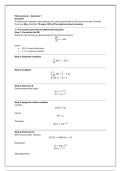
Memorandum – Question 1
Question
A radioactive substance decomposes at a rate proportional to the amount present. Initially
there are 40 g, and after 15 years, 80% of the original amount remains.
1.1 Formulate and solve the differential equation
Step 1: Formulate the DE
Since the rate of decay is proportional to the amount present,
𝑑𝑀
= −𝑘𝑀
𝑑𝑡
where
• 𝑀(𝑡)= mass after time 𝑡
• 𝑘 > 0= decay constant.
Step 2: Separate variables
1
𝑑𝑀 = −𝑘 𝑑𝑡
𝑀
Step 3: Integrate
1
∫ 𝑑𝑀 = ∫ − 𝑘 𝑑𝑡
𝑀
ln ∣ 𝑀 ∣= −𝑘𝑡 + 𝐶
Step 4: Solve for 𝑴
Exponentiate both sides:
𝑀 = 𝑒 −𝑘𝑡+𝐶
𝑀 = 𝐶1 𝑒 −𝑘𝑡
Step 5: Apply the initial condition
Initially,
𝑀(0) = 40
Hence,
40 = 𝐶1
Therefore,
𝑀(𝑡) = 40𝑒 −𝑘𝑡
Step 6: Determine 𝒌
80% remains after 15 years.
𝑀(15) = 0.80(40) = 32
Substitute:
32 = 40𝑒 −15𝑘
0.8 = 𝑒 −15𝑘
Take logarithms:
, ln(0.8) = −15𝑘
ln(0.8)
𝑘=−
15
𝑘 = 0.01488
Final Model
𝑀(𝑡) = 40𝑒 −0.01488𝑡
Assumptions
• Decay rate is proportional to the amount present.
• No additional material is added.
• Environmental conditions remain constant.
• The decay constant remains constant.
1.2 Amount after 25 years
𝑀(25) = 40𝑒 −0.01488(25)
= 40𝑒 −0.3719
= 40(0.6895)
𝑀(25) = 27.58 g
Memorandum – Question 2
Initially 120 g.
After 10 years, 15% has decomposed.
Therefore,
85% remains
2.1
Step 1
𝑑𝑀
= −𝑘𝑀
𝑑𝑡
Step 2
𝑑𝑀
= −𝑘𝑑𝑡
𝑀
Step 3
ln ∣ 𝑀 ∣= −𝑘𝑡 + 𝐶
Step 4
𝑀 = 𝐶1 𝑒 −𝑘𝑡
Step 5
𝑀(0) = 120
, Therefore,
𝐶1 = 120
𝑀(𝑡) = 120𝑒 −𝑘𝑡
Step 6
After 10 years,
𝑀(10) = 120(0.85) = 102
Substitute:
102 = 120𝑒 −10𝑘
0.85 = 𝑒 −10𝑘
ln(0.85) = −10𝑘
ln(0.85)
𝑘=−
10
𝑘 = 0.01625
Final Model
𝑀(𝑡) = 120𝑒 −0.01625𝑡
2.2 Remaining after 18 years
𝑀(18) = 120𝑒 −0.01625(18)
= 120𝑒 −0.2925
= 120(0.7464)
𝑀(18) = 89.57 g
Memorandum – Question 3
Initially 90 g.
After 6 days, 65% remains.
3.1
Step 1
𝑑𝑀
= −𝑘𝑀
𝑑𝑡
Step 2
𝑑𝑀
= −𝑘𝑑𝑡
𝑀
Step 3
ln ∣ 𝑀 ∣= −𝑘𝑡 + 𝐶
Step 4
𝑀 = 𝐶1 𝑒 −𝑘𝑡
Question
A radioactive substance decomposes at a rate proportional to the amount present. Initially
there are 40 g, and after 15 years, 80% of the original amount remains.
1.1 Formulate and solve the differential equation
Step 1: Formulate the DE
Since the rate of decay is proportional to the amount present,
𝑑𝑀
= −𝑘𝑀
𝑑𝑡
where
• 𝑀(𝑡)= mass after time 𝑡
• 𝑘 > 0= decay constant.
Step 2: Separate variables
1
𝑑𝑀 = −𝑘 𝑑𝑡
𝑀
Step 3: Integrate
1
∫ 𝑑𝑀 = ∫ − 𝑘 𝑑𝑡
𝑀
ln ∣ 𝑀 ∣= −𝑘𝑡 + 𝐶
Step 4: Solve for 𝑴
Exponentiate both sides:
𝑀 = 𝑒 −𝑘𝑡+𝐶
𝑀 = 𝐶1 𝑒 −𝑘𝑡
Step 5: Apply the initial condition
Initially,
𝑀(0) = 40
Hence,
40 = 𝐶1
Therefore,
𝑀(𝑡) = 40𝑒 −𝑘𝑡
Step 6: Determine 𝒌
80% remains after 15 years.
𝑀(15) = 0.80(40) = 32
Substitute:
32 = 40𝑒 −15𝑘
0.8 = 𝑒 −15𝑘
Take logarithms:
, ln(0.8) = −15𝑘
ln(0.8)
𝑘=−
15
𝑘 = 0.01488
Final Model
𝑀(𝑡) = 40𝑒 −0.01488𝑡
Assumptions
• Decay rate is proportional to the amount present.
• No additional material is added.
• Environmental conditions remain constant.
• The decay constant remains constant.
1.2 Amount after 25 years
𝑀(25) = 40𝑒 −0.01488(25)
= 40𝑒 −0.3719
= 40(0.6895)
𝑀(25) = 27.58 g
Memorandum – Question 2
Initially 120 g.
After 10 years, 15% has decomposed.
Therefore,
85% remains
2.1
Step 1
𝑑𝑀
= −𝑘𝑀
𝑑𝑡
Step 2
𝑑𝑀
= −𝑘𝑑𝑡
𝑀
Step 3
ln ∣ 𝑀 ∣= −𝑘𝑡 + 𝐶
Step 4
𝑀 = 𝐶1 𝑒 −𝑘𝑡
Step 5
𝑀(0) = 120
, Therefore,
𝐶1 = 120
𝑀(𝑡) = 120𝑒 −𝑘𝑡
Step 6
After 10 years,
𝑀(10) = 120(0.85) = 102
Substitute:
102 = 120𝑒 −10𝑘
0.85 = 𝑒 −10𝑘
ln(0.85) = −10𝑘
ln(0.85)
𝑘=−
10
𝑘 = 0.01625
Final Model
𝑀(𝑡) = 120𝑒 −0.01625𝑡
2.2 Remaining after 18 years
𝑀(18) = 120𝑒 −0.01625(18)
= 120𝑒 −0.2925
= 120(0.7464)
𝑀(18) = 89.57 g
Memorandum – Question 3
Initially 90 g.
After 6 days, 65% remains.
3.1
Step 1
𝑑𝑀
= −𝑘𝑀
𝑑𝑡
Step 2
𝑑𝑀
= −𝑘𝑑𝑡
𝑀
Step 3
ln ∣ 𝑀 ∣= −𝑘𝑡 + 𝐶
Step 4
𝑀 = 𝐶1 𝑒 −𝑘𝑡