NRNP 6645 - Psychotherapy with Multiple Modalities - Final Exam Walden University PMHNP - 3 Versions - 300 Verified Questions
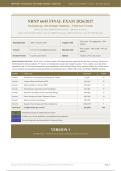
NRNP 6645 FINAL EXAM 2026/2027
Psychotherapy with Multiple Modalities - 3 Different Versions
Walden University PMHNP Final Examination - Questions & Answers
Aligned with 2026-2027 Walden University PMHNP Curriculum, DSM-5-TR Criteria, and AACN DNP Essentials
25% recall - 55% application - 20%
Total Questions 300 (3 versions x 100) Cognitive Mix
analysis
70% scenario - 20% recall - 10% case
Versions V1, V2, V3 (no duplicate questions) Question Style
analysis
Sections/Version 8 sections (see below) Options 4 options (A-D), one correct
Exam Structure Overview - Each of the 3 versions contains 100 unique questions organized into the same 8 sections. Versions are
differentiated by clinical emphasis: V1 focuses on foundational concepts and standard scenarios, V2 on complex cases and diverse
populations, and V3 on advanced integration, special populations, and treatment failures. Every question includes the verified correct
answer (marked) and a detailed rationale grounded in psychotherapy theory, DSM-5-TR criteria, and Walden PMHNP standards.
Section Topic Area Questions Count
Section 1 Foundations of Psychotherapy and Therapeutic Alliance Q1-Q15 15
Section 2 Cognitive Behavioral Therapy (CBT) Q16-Q35 20
Section 3 Dialectical Behavior Therapy (DBT) Q36-Q50 15
Section 4 Psychodynamic and Interpersonal Psychotherapy Q51-Q65 15
Section 5 Humanistic-Existential, Gestalt, and Family Therapy Q66-Q80 15
Section 6 Group Therapy and Yalom's Therapeutic Factors Q81-Q90 10
Section 7 Ethical and Legal Considerations Q91-Q95 5
Section 8 Integrated Case Scenarios and Clinical Application Q96-Q100 5
All Sections Complete Exam (per version) Q1-Q100 100
V1 Foundational concepts & standard clinical scenarios
V2 Complex cases, diverse populations & psychopharmacology integration
V3 Advanced integration, special populations & treatment failures
VERSION 1
100 Questions - Foundational Concepts & Standard Clinical Scenarios
Aligned with 2026-2027 Walden NRNP 6645 Curriculum, DSM-5-TR, and AACN DNP Essentials Page 1
,NRNP 6645 - Psychotherapy with Multiple Modalities - Final Exam Walden University PMHNP - 3 Versions - 300 Verified Questions
Section 1: Foundations of Psychotherapy and Therapeutic Alliance
Therapeutic Frame, Alliance, Phases, Benner's Model | Q1-15
Q1. A PMHNP candidate asks why the therapist does not voice personal opinions about a patient's decision to
divorce. Which component of the therapeutic frame is this practice primarily preserving?
A. Neutrality, which keeps the therapist from imposing values and allows the patient's own meaning to emerge [✓
CORRECT]
B. Anonymity, which requires the therapist to hide all credentials from the patient
C. Non-intrusiveness, which forbids any direct question during sessions
D. Confidentiality, which prevents disclosure to third parties
Correct Answer: A
Rationale: Neutrality means the therapist refrains from imposing personal values or taking sides, allowing the patient's own meaning
to emerge; withholding opinions about the divorce preserves this neutrality. Anonymity concerns limiting personal self-disclosure
rather than hiding credentials (B), non-intrusiveness does not forbid all direct questions (C), and confidentiality governs outside
disclosure rather than in-session value imposition (D).
Q2. A 34-year-old with major depressive disorder tells the PMHNP, 'You actually listen to me instead of just
pushing pills.' Which element of the therapeutic alliance is the patient most directly describing?
A. The agreed-upon goals of treatment
B. The affective bond of trust and feeling understood [✓ CORRECT]
C. The structured tasks and homework assigned each week
D. The pharmacologic management of symptoms
Correct Answer: B
Rationale: Bordin's therapeutic alliance consists of bond, goals, and tasks; the patient's statement that the therapist 'actually listens'
reflects the affective bond of trust and feeling understood. Goals (A) and tasks (C) refer to what the pair agrees to accomplish and
do, while pharmacologic management (D) is outside the alliance construct.
Q3. During the final month of a 16-week course of psychotherapy, a patient brings gifts, misses a session, and
says, 'I guess I never really needed this anyway.' The PMHNP recognizes these behaviors as most
characteristic of which phase?
A. The initial phase, when the frame is being established
B. The working phase, when core conflicts are interpreted
C. The termination phase, when loss and autonomy are negotiated [✓ CORRECT]
D. The pretreatment engagement phase
Correct Answer: C
Rationale: Bringing gifts, missed sessions, and devaluing the work are classic signs of the termination phase, in which the patient
negotiates loss, separation, and growing autonomy. These are not initial-phase frame-setting (A) or working-phase conflict
interpretation (B), and pretreatment engagement (D) precedes the formal contract.
Q4. According to Benner's model of skill acquisition, a PMHNP who can no longer articulate explicit rules but
intuitively reads a suicidal patient's subtle shifts in risk is functioning at which level?
A. Novice
B. Advanced beginner
C. Competent
D. Expert [✓ CORRECT]
Correct Answer: D
Rationale: Benner's expert operates from a deep intuitive grasp of the situation, having moved past reliance on explicit rules and
principles. The novice (A) follows rigid rules, the advanced beginner (B) uses guidelines but lacks prioritization, and the competent
(C) clinician consciously plans using rules but lacks the fluid intuition of the expert.
Q5. A patient with panic disorder asks whether therapy can help 'if the problem is really just a chemical
imbalance.' A psychosocial framework would respond that:
Aligned with 2026-2027 Walden NRNP 6645 Curriculum, DSM-5-TR, and AACN DNP Essentials Page 2
,NRNP 6645 - Psychotherapy with Multiple Modalities - Final Exam Walden University PMHNP - 3 Versions - 300 Verified Questions
A. Meaning, relationships, and learned patterns of responding are central to understanding and changing
symptoms, alongside biology [✓ CORRECT]
B. Symptoms are purely biochemical and require medication alone
C. The therapist should defer entirely to the prescribing provider
D. Psychosocial factors are irrelevant once a biological diagnosis is made
Correct Answer: A
Rationale: A psychosocial framework holds that meaning, relationships, and learned patterns of responding are central to symptoms
and their modification, complementing rather than excluding biology. Purely biochemical reduction (B), deferring entirely to the
prescriber (C), and dismissing psychosocial factors (D) all reflect a narrow biomedical model inconsistent with PMHNP
psychotherapy practice.
Q6. A psychodynamic PMHNP notes that a patient's lateness could reflect anxiety about the material, a test of
the therapist, and identification with a chronically late parent all at once. This clinical stance best illustrates
which concept?
A. Free association
B. Overdeterminism [✓ CORRECT]
C. Cognitive restructuring
D. Systematic desensitization
Correct Answer: B
Rationale: Overdeterminism is the psychodynamic principle that a single symptom or behavior can be determined by multiple motives
and meanings simultaneously. Free association (A) is a technique, cognitive restructuring (C) is a CBT method, and systematic
desensitization (D) is a behavioral exposure technique, none of which describe multiple determinants of one behavior.
Q7. When assessing a patient's capacity for self-soothing, impulse control, and mood regulation, the PMHNP is
primarily evaluating:
A. External resources such as family support and finances
B. The patient's pharmacologic response
C. Internal resources that allow the patient to manage distress between sessions [✓ CORRECT]
D. The therapeutic alliance only
Correct Answer: C
Rationale: Self-soothing, impulse control, and mood regulation are internal resources that allow a patient to manage distress between
sessions and tolerate the work of therapy. External resources (A) refer to environmental supports, pharmacologic response (B) is
biological, and the alliance (D) is a relational factor rather than an internal capacity.
Q8. A patient agrees with every interpretation the PMHNP offers yet changes nothing between sessions and
reports that 'nothing applies.' The PMHNP conceptualizes this most accurately as:
A. A sign that the diagnosis is wrong
B. Healthy adaptation that should be reinforced
C. A contraindication to any psychotherapy
D. Resistance operating through intellectualization and compliance [✓ CORRECT]
Correct Answer: D
Rationale: Agreeable but unproductive intellectualized compliance, with no behavioral change, is a form of resistance in which the
patient defends against the affective work of therapy. It does not indicate a wrong diagnosis (A), is not healthy adaptation to
reinforce (B), and is not an absolute contraindication to psychotherapy (C) but rather material to be worked with.
Q9. Which therapist behavior best demonstrates active listening during an intake?
A. Reflecting both the content and the affect of the patient's statement, then briefly summarizing [✓ CORRECT]
B. Taking detailed verbatim notes without looking up
C. Offering immediate advice based on the first complaint
D. Redirecting the patient whenever the topic shifts
Correct Answer: A
Rationale: Active listening involves reflecting both content and affect and periodically summarizing to confirm understanding and
convey presence. Verbatim notetaking without eye contact (B), premature advice (C), and frequent redirection (D) all undermine the
Aligned with 2026-2027 Walden NRNP 6645 Curriculum, DSM-5-TR, and AACN DNP Essentials Page 3
, NRNP 6645 - Psychotherapy with Multiple Modalities - Final Exam Walden University PMHNP - 3 Versions - 300 Verified Questions
attentive, non-intrusive stance central to active listening.
Q10. A patient asks the PMHNP, 'Are you married? Do you have kids? You'd understand me better if you did.'
The most frame-consistent response is to:
A. Answer fully to build rapport and demonstrate authenticity
B. Explore the question's meaning while limiting self-disclosure to preserve anonymity [✓ CORRECT]
C. Refuse to answer and end the session
D. Refer the patient to another provider immediately
Correct Answer: B
Rationale: Anonymity within the frame is preserved by limiting personal self-disclosure and exploring the patient's question as
clinically meaningful. Full disclosure to build rapport (A) erodes the frame, abruptly ending the session (C) is punitive, and
immediate referral (D) is unwarranted because the question itself is useful clinical material.
Q11. Which task is most central to the termination phase of time-limited psychotherapy?
A. Establishing the treatment frame and contract
B. Identifying the core conflict to be addressed
C. Reviewing progress, consolidating gains, and anticipating future challenges [✓ CORRECT]
D. Conducting the diagnostic evaluation
Correct Answer: C
Rationale: Termination centers on reviewing progress, consolidating gains, and anticipating future challenges including relapse
triggers. Establishing the frame and contract (A), identifying the core conflict (B), and conducting the diagnostic evaluation (D) are
tasks of the initial or early working phase, not termination.
Q12. A first-semester PMHNP student follows a manualized protocol step-by-step and becomes distressed when a
patient deviates from the expected sequence. This performance best fits which Benner level?
A. Expert
B. Proficient
C. Competent
D. Novice [✓ CORRECT]
Correct Answer: D
Rationale: The novice relies on context-free rules and struggles when situations deviate from taught protocols, as this student does.
Expert (A), proficient (B), and competent (C) practitioners all incorporate situational context and flexible judgment that the novice
has not yet developed.
Q13. A patient describes a humiliating work incident and begins to cry. Which therapist response best illustrates
empathy rather than sympathy?
A. 'It sounds like you felt exposed and small in that moment; help me understand what that was like for you.' [✓
CORRECT]
B. 'I feel so terrible for you; that would have ruined my whole week.'
C. 'Don't worry, things will get better soon.'
D. 'You really should report your boss to HR.'
Correct Answer: A
Rationale: Empathy enters the patient's phenomenological world and articulates the patient's felt experience without merging with it,
as in option A. Sympathy (B) centers the clinician's own feelings, reassurance (C) dismisses the affect, and directive advice (D)
bypasses empathic understanding.
Q14. In planning discharge for a patient with recurrent depression, the PMHNP maps external resources. Which
of the following is an external resource?
A. The patient's capacity to delay impulsive urges
B. A supportive partner willing to attend a safety planning session [✓ CORRECT]
C. The patient's ability to label and tolerate sadness
D. The patient's self-soothing repertoire
Correct Answer: B
Aligned with 2026-2027 Walden NRNP 6645 Curriculum, DSM-5-TR, and AACN DNP Essentials Page 4
NRNP 6645 FINAL EXAM 2026/2027
Psychotherapy with Multiple Modalities - 3 Different Versions
Walden University PMHNP Final Examination - Questions & Answers
Aligned with 2026-2027 Walden University PMHNP Curriculum, DSM-5-TR Criteria, and AACN DNP Essentials
25% recall - 55% application - 20%
Total Questions 300 (3 versions x 100) Cognitive Mix
analysis
70% scenario - 20% recall - 10% case
Versions V1, V2, V3 (no duplicate questions) Question Style
analysis
Sections/Version 8 sections (see below) Options 4 options (A-D), one correct
Exam Structure Overview - Each of the 3 versions contains 100 unique questions organized into the same 8 sections. Versions are
differentiated by clinical emphasis: V1 focuses on foundational concepts and standard scenarios, V2 on complex cases and diverse
populations, and V3 on advanced integration, special populations, and treatment failures. Every question includes the verified correct
answer (marked) and a detailed rationale grounded in psychotherapy theory, DSM-5-TR criteria, and Walden PMHNP standards.
Section Topic Area Questions Count
Section 1 Foundations of Psychotherapy and Therapeutic Alliance Q1-Q15 15
Section 2 Cognitive Behavioral Therapy (CBT) Q16-Q35 20
Section 3 Dialectical Behavior Therapy (DBT) Q36-Q50 15
Section 4 Psychodynamic and Interpersonal Psychotherapy Q51-Q65 15
Section 5 Humanistic-Existential, Gestalt, and Family Therapy Q66-Q80 15
Section 6 Group Therapy and Yalom's Therapeutic Factors Q81-Q90 10
Section 7 Ethical and Legal Considerations Q91-Q95 5
Section 8 Integrated Case Scenarios and Clinical Application Q96-Q100 5
All Sections Complete Exam (per version) Q1-Q100 100
V1 Foundational concepts & standard clinical scenarios
V2 Complex cases, diverse populations & psychopharmacology integration
V3 Advanced integration, special populations & treatment failures
VERSION 1
100 Questions - Foundational Concepts & Standard Clinical Scenarios
Aligned with 2026-2027 Walden NRNP 6645 Curriculum, DSM-5-TR, and AACN DNP Essentials Page 1
,NRNP 6645 - Psychotherapy with Multiple Modalities - Final Exam Walden University PMHNP - 3 Versions - 300 Verified Questions
Section 1: Foundations of Psychotherapy and Therapeutic Alliance
Therapeutic Frame, Alliance, Phases, Benner's Model | Q1-15
Q1. A PMHNP candidate asks why the therapist does not voice personal opinions about a patient's decision to
divorce. Which component of the therapeutic frame is this practice primarily preserving?
A. Neutrality, which keeps the therapist from imposing values and allows the patient's own meaning to emerge [✓
CORRECT]
B. Anonymity, which requires the therapist to hide all credentials from the patient
C. Non-intrusiveness, which forbids any direct question during sessions
D. Confidentiality, which prevents disclosure to third parties
Correct Answer: A
Rationale: Neutrality means the therapist refrains from imposing personal values or taking sides, allowing the patient's own meaning
to emerge; withholding opinions about the divorce preserves this neutrality. Anonymity concerns limiting personal self-disclosure
rather than hiding credentials (B), non-intrusiveness does not forbid all direct questions (C), and confidentiality governs outside
disclosure rather than in-session value imposition (D).
Q2. A 34-year-old with major depressive disorder tells the PMHNP, 'You actually listen to me instead of just
pushing pills.' Which element of the therapeutic alliance is the patient most directly describing?
A. The agreed-upon goals of treatment
B. The affective bond of trust and feeling understood [✓ CORRECT]
C. The structured tasks and homework assigned each week
D. The pharmacologic management of symptoms
Correct Answer: B
Rationale: Bordin's therapeutic alliance consists of bond, goals, and tasks; the patient's statement that the therapist 'actually listens'
reflects the affective bond of trust and feeling understood. Goals (A) and tasks (C) refer to what the pair agrees to accomplish and
do, while pharmacologic management (D) is outside the alliance construct.
Q3. During the final month of a 16-week course of psychotherapy, a patient brings gifts, misses a session, and
says, 'I guess I never really needed this anyway.' The PMHNP recognizes these behaviors as most
characteristic of which phase?
A. The initial phase, when the frame is being established
B. The working phase, when core conflicts are interpreted
C. The termination phase, when loss and autonomy are negotiated [✓ CORRECT]
D. The pretreatment engagement phase
Correct Answer: C
Rationale: Bringing gifts, missed sessions, and devaluing the work are classic signs of the termination phase, in which the patient
negotiates loss, separation, and growing autonomy. These are not initial-phase frame-setting (A) or working-phase conflict
interpretation (B), and pretreatment engagement (D) precedes the formal contract.
Q4. According to Benner's model of skill acquisition, a PMHNP who can no longer articulate explicit rules but
intuitively reads a suicidal patient's subtle shifts in risk is functioning at which level?
A. Novice
B. Advanced beginner
C. Competent
D. Expert [✓ CORRECT]
Correct Answer: D
Rationale: Benner's expert operates from a deep intuitive grasp of the situation, having moved past reliance on explicit rules and
principles. The novice (A) follows rigid rules, the advanced beginner (B) uses guidelines but lacks prioritization, and the competent
(C) clinician consciously plans using rules but lacks the fluid intuition of the expert.
Q5. A patient with panic disorder asks whether therapy can help 'if the problem is really just a chemical
imbalance.' A psychosocial framework would respond that:
Aligned with 2026-2027 Walden NRNP 6645 Curriculum, DSM-5-TR, and AACN DNP Essentials Page 2
,NRNP 6645 - Psychotherapy with Multiple Modalities - Final Exam Walden University PMHNP - 3 Versions - 300 Verified Questions
A. Meaning, relationships, and learned patterns of responding are central to understanding and changing
symptoms, alongside biology [✓ CORRECT]
B. Symptoms are purely biochemical and require medication alone
C. The therapist should defer entirely to the prescribing provider
D. Psychosocial factors are irrelevant once a biological diagnosis is made
Correct Answer: A
Rationale: A psychosocial framework holds that meaning, relationships, and learned patterns of responding are central to symptoms
and their modification, complementing rather than excluding biology. Purely biochemical reduction (B), deferring entirely to the
prescriber (C), and dismissing psychosocial factors (D) all reflect a narrow biomedical model inconsistent with PMHNP
psychotherapy practice.
Q6. A psychodynamic PMHNP notes that a patient's lateness could reflect anxiety about the material, a test of
the therapist, and identification with a chronically late parent all at once. This clinical stance best illustrates
which concept?
A. Free association
B. Overdeterminism [✓ CORRECT]
C. Cognitive restructuring
D. Systematic desensitization
Correct Answer: B
Rationale: Overdeterminism is the psychodynamic principle that a single symptom or behavior can be determined by multiple motives
and meanings simultaneously. Free association (A) is a technique, cognitive restructuring (C) is a CBT method, and systematic
desensitization (D) is a behavioral exposure technique, none of which describe multiple determinants of one behavior.
Q7. When assessing a patient's capacity for self-soothing, impulse control, and mood regulation, the PMHNP is
primarily evaluating:
A. External resources such as family support and finances
B. The patient's pharmacologic response
C. Internal resources that allow the patient to manage distress between sessions [✓ CORRECT]
D. The therapeutic alliance only
Correct Answer: C
Rationale: Self-soothing, impulse control, and mood regulation are internal resources that allow a patient to manage distress between
sessions and tolerate the work of therapy. External resources (A) refer to environmental supports, pharmacologic response (B) is
biological, and the alliance (D) is a relational factor rather than an internal capacity.
Q8. A patient agrees with every interpretation the PMHNP offers yet changes nothing between sessions and
reports that 'nothing applies.' The PMHNP conceptualizes this most accurately as:
A. A sign that the diagnosis is wrong
B. Healthy adaptation that should be reinforced
C. A contraindication to any psychotherapy
D. Resistance operating through intellectualization and compliance [✓ CORRECT]
Correct Answer: D
Rationale: Agreeable but unproductive intellectualized compliance, with no behavioral change, is a form of resistance in which the
patient defends against the affective work of therapy. It does not indicate a wrong diagnosis (A), is not healthy adaptation to
reinforce (B), and is not an absolute contraindication to psychotherapy (C) but rather material to be worked with.
Q9. Which therapist behavior best demonstrates active listening during an intake?
A. Reflecting both the content and the affect of the patient's statement, then briefly summarizing [✓ CORRECT]
B. Taking detailed verbatim notes without looking up
C. Offering immediate advice based on the first complaint
D. Redirecting the patient whenever the topic shifts
Correct Answer: A
Rationale: Active listening involves reflecting both content and affect and periodically summarizing to confirm understanding and
convey presence. Verbatim notetaking without eye contact (B), premature advice (C), and frequent redirection (D) all undermine the
Aligned with 2026-2027 Walden NRNP 6645 Curriculum, DSM-5-TR, and AACN DNP Essentials Page 3
, NRNP 6645 - Psychotherapy with Multiple Modalities - Final Exam Walden University PMHNP - 3 Versions - 300 Verified Questions
attentive, non-intrusive stance central to active listening.
Q10. A patient asks the PMHNP, 'Are you married? Do you have kids? You'd understand me better if you did.'
The most frame-consistent response is to:
A. Answer fully to build rapport and demonstrate authenticity
B. Explore the question's meaning while limiting self-disclosure to preserve anonymity [✓ CORRECT]
C. Refuse to answer and end the session
D. Refer the patient to another provider immediately
Correct Answer: B
Rationale: Anonymity within the frame is preserved by limiting personal self-disclosure and exploring the patient's question as
clinically meaningful. Full disclosure to build rapport (A) erodes the frame, abruptly ending the session (C) is punitive, and
immediate referral (D) is unwarranted because the question itself is useful clinical material.
Q11. Which task is most central to the termination phase of time-limited psychotherapy?
A. Establishing the treatment frame and contract
B. Identifying the core conflict to be addressed
C. Reviewing progress, consolidating gains, and anticipating future challenges [✓ CORRECT]
D. Conducting the diagnostic evaluation
Correct Answer: C
Rationale: Termination centers on reviewing progress, consolidating gains, and anticipating future challenges including relapse
triggers. Establishing the frame and contract (A), identifying the core conflict (B), and conducting the diagnostic evaluation (D) are
tasks of the initial or early working phase, not termination.
Q12. A first-semester PMHNP student follows a manualized protocol step-by-step and becomes distressed when a
patient deviates from the expected sequence. This performance best fits which Benner level?
A. Expert
B. Proficient
C. Competent
D. Novice [✓ CORRECT]
Correct Answer: D
Rationale: The novice relies on context-free rules and struggles when situations deviate from taught protocols, as this student does.
Expert (A), proficient (B), and competent (C) practitioners all incorporate situational context and flexible judgment that the novice
has not yet developed.
Q13. A patient describes a humiliating work incident and begins to cry. Which therapist response best illustrates
empathy rather than sympathy?
A. 'It sounds like you felt exposed and small in that moment; help me understand what that was like for you.' [✓
CORRECT]
B. 'I feel so terrible for you; that would have ruined my whole week.'
C. 'Don't worry, things will get better soon.'
D. 'You really should report your boss to HR.'
Correct Answer: A
Rationale: Empathy enters the patient's phenomenological world and articulates the patient's felt experience without merging with it,
as in option A. Sympathy (B) centers the clinician's own feelings, reassurance (C) dismisses the affect, and directive advice (D)
bypasses empathic understanding.
Q14. In planning discharge for a patient with recurrent depression, the PMHNP maps external resources. Which
of the following is an external resource?
A. The patient's capacity to delay impulsive urges
B. A supportive partner willing to attend a safety planning session [✓ CORRECT]
C. The patient's ability to label and tolerate sadness
D. The patient's self-soothing repertoire
Correct Answer: B
Aligned with 2026-2027 Walden NRNP 6645 Curriculum, DSM-5-TR, and AACN DNP Essentials Page 4