

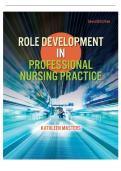
, TESTBANK FOR Role Development in Professional Nursing Practice
Seventh Edition Masters
Important Notes
The file includes the complete test bank, organized chapter by chapter.
A sample of selected pages has been provided for preview.
All available appendices and Excel files (if included in the original resources) are
provided.
Quizzes, Midterm and final exams are included (if available in the original resources).
We continuously update our files to ensure you receive the latest and most accurate
editions.
New editions are added regularly – stay connected for updates!
⚠️Note on Answer Keys: If the answer key is not included within the chapter
questions, you will find the complete answers and solutions at the end of each
chapter.
✅ Why Buy From Us?
📚 Complete & organized chapter-by-chapter – no missing content, no guessing.
⚡ Instant digital delivery – get your file the moment you pay, no waiting.
📅 Always up to date – we track new editions so you always get the latest version.
💬 Friendly support – real humans ready to help, anytime you need us.
🔒 Safe & secure – thousands of satisfied students trust us every semester.
🛡️Our Guarantees
💰 Money-Back Guarantee: Not satisfied? We offer a full refund – no questions asked.
🔄 Wrong File? No Problem: Contact us and we will replace it immediately with the
correct version, free of charge.
⏰ 24/7 Support: We are always here – reach out anytime and expect a fast response.
,Role Development in Professional Nursing Practice – Test Bank
Masters_Ch01-Role Development in Professional Nursing Practice
1. Who compiled remedies in a textbook and is considered the father of medicine?
✓ a. Hippocrates
b. Aristotle
c. Socrates
d. Plato
2. Who or what most helped to publicize the plight of children and the poor in the United
States during the Industrial Revolution?
a. Margaret Sanger
b. Charles Dickens
c. Plato
✓ d. Shattuck Report
3. Which report advocated for university schools of nursing to train nurse leaders?
✓ a. Goldmark Report
b. Shattuck Report
c. Brown Report
d. Chadwick Report
4. Who established the Henry Street Settlement?
a. Mary Brewster
b. Margaret Sanger
c. Lillian Wald
✓ d. Mary Brewster and Lillian Wald
e. Margaret Sanger and Mary Brewster
5. Which nurse founded the Frontier Nursing Service and the Frontier Graduate School of
Nurse Midwifery in the Appalachian Mountains of Kentucky?
a. Dorothea Dix
b. Clara Barton
✓ c. Mary Breckenridge
d. Mary Osborne
6. What was the primary purpose of the first hospitals in the United States?
a. To care for wealthy patients
b. To provide treatment for the poor
c. To care for patients after surgical procedures
✓ d. To protect the public from patients with contagious diseases
, e. To treat patients with chronic disease
7. Why was Nurse of the Future: Nursing Core Competencies developed?
a. To create a seamless progression through all levels of nursing education
b. To establish a vision for nursing education for the 21st century
c. To develop consensus on competencies
d. To create a seamless progression through all levels of nursing education and establish a vision for
nursing education for the 21st century
✓ e. To create a seamless progression through all levels of nursing education and develop consensus on
competencies
8. Which of the following is a key area of competency for graduates of nursing as developed
by the Quality and Safety Education for Nurses (QSEN) initiative?
a. Nurse-centered care
b. Transitional education so nurses can become physicians
c. Working solo
✓ d. Evidence-based practice
9. A large part of U.S. healthcare reform continues to:
a. be dominated by the political debate.
b. be ignored by professional nursing associations.
c. involve only physicians' groups.
✓ d. focus on federal coverage, access, and control of healthcare costs.
10. Which of the following is a recommendation of The Future of Nursing: Leading Change,
Advancing Health ?
a. Separating nursing education from other medical education
✓ b. Decreasing barriers to nursing scope of practice
c. Moderating educational levels of nurses
d. Requiring all nurses to become APNs
Masters_Ch02-Role Development in Professional Nursing Practice
1. Which nurse theorist believed that “the beauty of medicine and nursing is the combination
of your heart, your head and your hands and where you separate them, you diminish them”?
a. Florence Nightingale
✓ b. Virginia Henderson
c. Dorothea Orem
d. Nola Pender
e. Jean Watson
2. Which of the following is included in general system theory?
a. System dominance
✓ b. Input and output processes
, c. System fluidity
d. Environmental superiority
3. Using a theoretical framework to guide nursing practice will assist the nurse in which of the
following?
✓ a. Organizing patient data
b. Protecting patient data
c. Reducing patient care time
d. Ameliorating administrative reactions to outcomes
4. Which theorist developed a model with a focus on the client system in relationship to
stressors?
a. Imogene King
b. Patricia Benner
✓ c. Betty Neuman
d. Nola Pender
5. Which of the following is a patient characteristic identified in the AACN synergy model?
✓ a. Resiliency
b. Advocacy
c. Response to diversity
d. Systems thinking
6. Which of the following is a nurse characteristic identified in the AACN synergy model?
a. Complexity
b. Predictability
✓ c. Collaboration
d. Stability
7. When assessing a woman who has recently given birth, the nurse using Beck's theory
should assess for indicators of which of the following?
a. Enabling
b. Postpartum mood disorder
c. Loss of control
d. Enabling and loss of control
✓ e. Postpartum mood disorder and loss of control
8. Which of the following is one of the central concepts of the discipline of nursing?
a. Personality
b. Compensation
✓ c. Health
d. Progressivism
9. According to Orem, why do people need help through nursing?
a. Federal mandates
, b. Social needs
c. Professional knowledge
✓ d. Help with self-care deficits
10. What environments are in constant interaction with Roy's adaptation model?
a. Internal
b. External
c. Mental
✓ d. Internal and external
e. Mental and external
Masters_Ch03-Role Development in Professional Nursing Practice
1. Which statement best describes the stability of a philosophy of nursing?
a. Although the world may change, our philosophy of nursing remains constant and unwavering.
✓ b. As society and individuals change, our philosophy of nursing changes to be congruent with new
understanding.
c. Our system of values does not change in response to societal pressure.
d. Our philosophy of nursing is intrinsic and private, and there is no need to communicate these values to
others.
2. Which Greek philosopher said that “All is in flux”?
✓ a. Heraclitus
b. Socrates
c. Aristotle
d. Parmenides
3. Which of the following steps is included in the process of valuing?
a. Mixing values
b. Placing values
✓ c. Acting on values
d. Altering values
4. Which of the following is a goal of values clarification exercises?
a. Redistribute values
✓ b. Discern values
c. Acquire new values
d. Abandon values
5. Which question should the nurse consider in writing a personal philosophy of nursing?
a. What is nursing?
b. Why does nursing exist?
c. What is nursing theory?
, d. What is nursing, and what is nursing theory?
✓ e. What is nursing, and why does nursing exist?
6. Which of the following describes nursing core competencies related to values?
a. Understands ethical principles, values, concepts, and decision making that apply to nursing and patient
care
b. Clarifies personal and professional values and recognizes their impact on decision making and
professional behavior
c. Justifies clinical decisions
d. Clarifies personal and professional values and recognizes their impact on decision making and
professional behavior and justifies clinical decisions
✓ e. Understands ethical principles, values, concepts, and decision making that apply to nursing and
patient care and clarifies personal and professional values and recognizes their impact on decision making
and professional behavior
7. Which of the following nurse behaviors demonstrates the competencies related to
professionalism?
a. Suppresses expression of personal values
✓ b. Promotes policies that uphold altruistic principles
c. Encourages discreet responses to ethical concerns
d. Suppresses expression of personal values and promotes policies that uphold altruistic principles
e. Suppresses expression of personal values and encourages discreet responses to ethical concerns
8. What must be possible for an existential belief?
✓ a. It is true or false.
b. It is appealing.
c. It is comforting.
d. It is popular.
9. Which of the following best demonstrates a worldview based in realism?
a. The world is static.
b. Seeing is believing.
c. The social world is created.
d. The world is static and the social world is created.
✓ e. The world is static and seeing is believing.
10. Which actions demonstrate the inclusion of fundamental aspects of nursing in the
definition of nursing?
a. Assessment of objective data and the subjective experience of the patient
b. Provision of nursing care that facilitates the patient's healing of the patient
c. Medical diagnosis of the patient
d. Provision of nursing care that facilitates healing of the patient and medical diagnosis of the patient
✓ e. Assessment of objective data and subjective experience of the patient and provision of nursing care
that facilitates healing of the patient
,Masters_Ch04-Role Development in Professional Nursing Practice
1. Which of the following should a nurse meeting the Nurse of the Future: Nursing Core
Competencies manifest?
a. Informalism
b. Cost-driven care
c. Intuitive practice
✓ d. Teamwork and collaboration
2. Which competency was identified during the Quality and Safety Education for Nurses
(QSEN) project?
a. Administrator dominance
b. Informed decision making
✓ c. Safety
d. Quality maintenance
3. Which of the following learning domains are reflected in the KSAs of the QSEN Project and
the Nurse of the Future model?
a. Control-oriented
b. Psychological
✓ c. Affective
d. Kindness
4. What lies outside of the core competencies for nurses in the KSAs?
✓ a. Practice environment
b. Professionalism
c. Administration
d. Compensation
5. Which of the following behaviors of the nurse demonstrates clinical judgment?
a. Critical analysis of other nurses
b. Problem avoidance
✓ c. Ethical reasoning
d. Decisive speech
6. The nurse who is administering medications should take measures to avoid interruptions to
prevent which type of error?
✓ a. Skill-based
b. Rule-based
c. Knowledge-based
d. Competence-based
7. Which description best illustrates Tanner's conclusions about thinking like a nurse?
a. It should occur as a detached objective exercise.
, ✓ b. It is a form of engaged moral reasoning.
c. It is most influenced by objective data about the situation.
d. It must involve complex solutions.
8. Compared to a generation ago, the work of RNs:
✓ a. involves significantly more responsibilities.
b. is the same.
c. is more like that of physicians.
d. requires less time.
9. Which of the following characteristics is indicative of critical thinking?
a. Critical thinking is rational.
b. Critical thinking if reflective.
c. Critical thinking is based on preferences.
d. Critical thinking requires reflection and is based on preferences.
✓ e. Critical thinking is rational and requires reflection.
10. Which of the following characteristics is observed in nurses who are critical thinkers?
a. Rigidity
b. Tendency to oversimplify
✓ c. Empathy
d. Tendency to base judgments on personal feelings
Masters_Ch05-Role Development in Professional Nursing Practice
1. During the formation into any profession, the novice has to adopt what about the
profession?
a. Its compensation
b. Its jargon
c. Its heart
✓ d. Its culture
2. The nurse is caring for five patients on a busy surgical floor. The shift begins with an
assessment of the patients and analysis of problems and prioritization of care. Choose the
stage that is characterized by this ability.
a. Novice
b. Advanced beginner
✓ c. Competent
d. Proficient
e. Expert
3. Which of the following terms refers to the good conduct of the nurse born out of an
individualized relationship with the patient that involves engagement in a situation?
, ✓ a. Ethical comportment
b. Salience
c. Socialization
d. Formation
4. The student nurse throughout the educational experience has observed the development of
the ability to draw on knowledge and skilled know-how and a way of being and acting in
nursing practice. Which term describes this phenomenon?
a. Socialization
b. Values clarification
✓ c. Formation
d. Role transition
5. When, during professional formation, should a nurse focus on rules and guidelines?
✓ a. Novice
b. Advanced beginner
c. Competent
d. Expert
6. The goal in the formation of nurses today and in the future is:
a. to accommodate a select few individuals.
b. challenging the profession.
c. capitalizing on their individual strength.
✓ d. achieve caring with autonomy.
7. Professional formation of nurses includes the internalization of what has been referred to
as the five Cs. Which of the following options embodies the caring for self and others
espoused by the profession of nursing?
✓ a. Compassion, competence, confidence, conscience, and commitment
b. Caring, competence, confidence, character, and commitment
c. Compassion, capability, confidence, conscience, and commitment
d. Caring, capability, confidence, character, and commitment
8. The new graduate nurse is finding it difficult to integrate the ideal and the actual performed
role into the professional role. Select the phenomenon described.
a. Reality shock
✓ b. Role conflict
c. Role transition shock
d. Reality shock and role conflict
e. Reality shock and role transition shock
9. The student nurse has enrolled in an optional residency program during the summer after
graduation. Choose the primary purpose of this type of program.
a. Guarantee of a job after graduation
✓ b. Assistance with transition into practice
Seventh Edition Masters
Important Notes
The file includes the complete test bank, organized chapter by chapter.
A sample of selected pages has been provided for preview.
All available appendices and Excel files (if included in the original resources) are
provided.
Quizzes, Midterm and final exams are included (if available in the original resources).
We continuously update our files to ensure you receive the latest and most accurate
editions.
New editions are added regularly – stay connected for updates!
⚠️Note on Answer Keys: If the answer key is not included within the chapter
questions, you will find the complete answers and solutions at the end of each
chapter.
✅ Why Buy From Us?
📚 Complete & organized chapter-by-chapter – no missing content, no guessing.
⚡ Instant digital delivery – get your file the moment you pay, no waiting.
📅 Always up to date – we track new editions so you always get the latest version.
💬 Friendly support – real humans ready to help, anytime you need us.
🔒 Safe & secure – thousands of satisfied students trust us every semester.
🛡️Our Guarantees
💰 Money-Back Guarantee: Not satisfied? We offer a full refund – no questions asked.
🔄 Wrong File? No Problem: Contact us and we will replace it immediately with the
correct version, free of charge.
⏰ 24/7 Support: We are always here – reach out anytime and expect a fast response.
,Role Development in Professional Nursing Practice – Test Bank
Masters_Ch01-Role Development in Professional Nursing Practice
1. Who compiled remedies in a textbook and is considered the father of medicine?
✓ a. Hippocrates
b. Aristotle
c. Socrates
d. Plato
2. Who or what most helped to publicize the plight of children and the poor in the United
States during the Industrial Revolution?
a. Margaret Sanger
b. Charles Dickens
c. Plato
✓ d. Shattuck Report
3. Which report advocated for university schools of nursing to train nurse leaders?
✓ a. Goldmark Report
b. Shattuck Report
c. Brown Report
d. Chadwick Report
4. Who established the Henry Street Settlement?
a. Mary Brewster
b. Margaret Sanger
c. Lillian Wald
✓ d. Mary Brewster and Lillian Wald
e. Margaret Sanger and Mary Brewster
5. Which nurse founded the Frontier Nursing Service and the Frontier Graduate School of
Nurse Midwifery in the Appalachian Mountains of Kentucky?
a. Dorothea Dix
b. Clara Barton
✓ c. Mary Breckenridge
d. Mary Osborne
6. What was the primary purpose of the first hospitals in the United States?
a. To care for wealthy patients
b. To provide treatment for the poor
c. To care for patients after surgical procedures
✓ d. To protect the public from patients with contagious diseases
, e. To treat patients with chronic disease
7. Why was Nurse of the Future: Nursing Core Competencies developed?
a. To create a seamless progression through all levels of nursing education
b. To establish a vision for nursing education for the 21st century
c. To develop consensus on competencies
d. To create a seamless progression through all levels of nursing education and establish a vision for
nursing education for the 21st century
✓ e. To create a seamless progression through all levels of nursing education and develop consensus on
competencies
8. Which of the following is a key area of competency for graduates of nursing as developed
by the Quality and Safety Education for Nurses (QSEN) initiative?
a. Nurse-centered care
b. Transitional education so nurses can become physicians
c. Working solo
✓ d. Evidence-based practice
9. A large part of U.S. healthcare reform continues to:
a. be dominated by the political debate.
b. be ignored by professional nursing associations.
c. involve only physicians' groups.
✓ d. focus on federal coverage, access, and control of healthcare costs.
10. Which of the following is a recommendation of The Future of Nursing: Leading Change,
Advancing Health ?
a. Separating nursing education from other medical education
✓ b. Decreasing barriers to nursing scope of practice
c. Moderating educational levels of nurses
d. Requiring all nurses to become APNs
Masters_Ch02-Role Development in Professional Nursing Practice
1. Which nurse theorist believed that “the beauty of medicine and nursing is the combination
of your heart, your head and your hands and where you separate them, you diminish them”?
a. Florence Nightingale
✓ b. Virginia Henderson
c. Dorothea Orem
d. Nola Pender
e. Jean Watson
2. Which of the following is included in general system theory?
a. System dominance
✓ b. Input and output processes
, c. System fluidity
d. Environmental superiority
3. Using a theoretical framework to guide nursing practice will assist the nurse in which of the
following?
✓ a. Organizing patient data
b. Protecting patient data
c. Reducing patient care time
d. Ameliorating administrative reactions to outcomes
4. Which theorist developed a model with a focus on the client system in relationship to
stressors?
a. Imogene King
b. Patricia Benner
✓ c. Betty Neuman
d. Nola Pender
5. Which of the following is a patient characteristic identified in the AACN synergy model?
✓ a. Resiliency
b. Advocacy
c. Response to diversity
d. Systems thinking
6. Which of the following is a nurse characteristic identified in the AACN synergy model?
a. Complexity
b. Predictability
✓ c. Collaboration
d. Stability
7. When assessing a woman who has recently given birth, the nurse using Beck's theory
should assess for indicators of which of the following?
a. Enabling
b. Postpartum mood disorder
c. Loss of control
d. Enabling and loss of control
✓ e. Postpartum mood disorder and loss of control
8. Which of the following is one of the central concepts of the discipline of nursing?
a. Personality
b. Compensation
✓ c. Health
d. Progressivism
9. According to Orem, why do people need help through nursing?
a. Federal mandates
, b. Social needs
c. Professional knowledge
✓ d. Help with self-care deficits
10. What environments are in constant interaction with Roy's adaptation model?
a. Internal
b. External
c. Mental
✓ d. Internal and external
e. Mental and external
Masters_Ch03-Role Development in Professional Nursing Practice
1. Which statement best describes the stability of a philosophy of nursing?
a. Although the world may change, our philosophy of nursing remains constant and unwavering.
✓ b. As society and individuals change, our philosophy of nursing changes to be congruent with new
understanding.
c. Our system of values does not change in response to societal pressure.
d. Our philosophy of nursing is intrinsic and private, and there is no need to communicate these values to
others.
2. Which Greek philosopher said that “All is in flux”?
✓ a. Heraclitus
b. Socrates
c. Aristotle
d. Parmenides
3. Which of the following steps is included in the process of valuing?
a. Mixing values
b. Placing values
✓ c. Acting on values
d. Altering values
4. Which of the following is a goal of values clarification exercises?
a. Redistribute values
✓ b. Discern values
c. Acquire new values
d. Abandon values
5. Which question should the nurse consider in writing a personal philosophy of nursing?
a. What is nursing?
b. Why does nursing exist?
c. What is nursing theory?
, d. What is nursing, and what is nursing theory?
✓ e. What is nursing, and why does nursing exist?
6. Which of the following describes nursing core competencies related to values?
a. Understands ethical principles, values, concepts, and decision making that apply to nursing and patient
care
b. Clarifies personal and professional values and recognizes their impact on decision making and
professional behavior
c. Justifies clinical decisions
d. Clarifies personal and professional values and recognizes their impact on decision making and
professional behavior and justifies clinical decisions
✓ e. Understands ethical principles, values, concepts, and decision making that apply to nursing and
patient care and clarifies personal and professional values and recognizes their impact on decision making
and professional behavior
7. Which of the following nurse behaviors demonstrates the competencies related to
professionalism?
a. Suppresses expression of personal values
✓ b. Promotes policies that uphold altruistic principles
c. Encourages discreet responses to ethical concerns
d. Suppresses expression of personal values and promotes policies that uphold altruistic principles
e. Suppresses expression of personal values and encourages discreet responses to ethical concerns
8. What must be possible for an existential belief?
✓ a. It is true or false.
b. It is appealing.
c. It is comforting.
d. It is popular.
9. Which of the following best demonstrates a worldview based in realism?
a. The world is static.
b. Seeing is believing.
c. The social world is created.
d. The world is static and the social world is created.
✓ e. The world is static and seeing is believing.
10. Which actions demonstrate the inclusion of fundamental aspects of nursing in the
definition of nursing?
a. Assessment of objective data and the subjective experience of the patient
b. Provision of nursing care that facilitates the patient's healing of the patient
c. Medical diagnosis of the patient
d. Provision of nursing care that facilitates healing of the patient and medical diagnosis of the patient
✓ e. Assessment of objective data and subjective experience of the patient and provision of nursing care
that facilitates healing of the patient
,Masters_Ch04-Role Development in Professional Nursing Practice
1. Which of the following should a nurse meeting the Nurse of the Future: Nursing Core
Competencies manifest?
a. Informalism
b. Cost-driven care
c. Intuitive practice
✓ d. Teamwork and collaboration
2. Which competency was identified during the Quality and Safety Education for Nurses
(QSEN) project?
a. Administrator dominance
b. Informed decision making
✓ c. Safety
d. Quality maintenance
3. Which of the following learning domains are reflected in the KSAs of the QSEN Project and
the Nurse of the Future model?
a. Control-oriented
b. Psychological
✓ c. Affective
d. Kindness
4. What lies outside of the core competencies for nurses in the KSAs?
✓ a. Practice environment
b. Professionalism
c. Administration
d. Compensation
5. Which of the following behaviors of the nurse demonstrates clinical judgment?
a. Critical analysis of other nurses
b. Problem avoidance
✓ c. Ethical reasoning
d. Decisive speech
6. The nurse who is administering medications should take measures to avoid interruptions to
prevent which type of error?
✓ a. Skill-based
b. Rule-based
c. Knowledge-based
d. Competence-based
7. Which description best illustrates Tanner's conclusions about thinking like a nurse?
a. It should occur as a detached objective exercise.
, ✓ b. It is a form of engaged moral reasoning.
c. It is most influenced by objective data about the situation.
d. It must involve complex solutions.
8. Compared to a generation ago, the work of RNs:
✓ a. involves significantly more responsibilities.
b. is the same.
c. is more like that of physicians.
d. requires less time.
9. Which of the following characteristics is indicative of critical thinking?
a. Critical thinking is rational.
b. Critical thinking if reflective.
c. Critical thinking is based on preferences.
d. Critical thinking requires reflection and is based on preferences.
✓ e. Critical thinking is rational and requires reflection.
10. Which of the following characteristics is observed in nurses who are critical thinkers?
a. Rigidity
b. Tendency to oversimplify
✓ c. Empathy
d. Tendency to base judgments on personal feelings
Masters_Ch05-Role Development in Professional Nursing Practice
1. During the formation into any profession, the novice has to adopt what about the
profession?
a. Its compensation
b. Its jargon
c. Its heart
✓ d. Its culture
2. The nurse is caring for five patients on a busy surgical floor. The shift begins with an
assessment of the patients and analysis of problems and prioritization of care. Choose the
stage that is characterized by this ability.
a. Novice
b. Advanced beginner
✓ c. Competent
d. Proficient
e. Expert
3. Which of the following terms refers to the good conduct of the nurse born out of an
individualized relationship with the patient that involves engagement in a situation?
, ✓ a. Ethical comportment
b. Salience
c. Socialization
d. Formation
4. The student nurse throughout the educational experience has observed the development of
the ability to draw on knowledge and skilled know-how and a way of being and acting in
nursing practice. Which term describes this phenomenon?
a. Socialization
b. Values clarification
✓ c. Formation
d. Role transition
5. When, during professional formation, should a nurse focus on rules and guidelines?
✓ a. Novice
b. Advanced beginner
c. Competent
d. Expert
6. The goal in the formation of nurses today and in the future is:
a. to accommodate a select few individuals.
b. challenging the profession.
c. capitalizing on their individual strength.
✓ d. achieve caring with autonomy.
7. Professional formation of nurses includes the internalization of what has been referred to
as the five Cs. Which of the following options embodies the caring for self and others
espoused by the profession of nursing?
✓ a. Compassion, competence, confidence, conscience, and commitment
b. Caring, competence, confidence, character, and commitment
c. Compassion, capability, confidence, conscience, and commitment
d. Caring, capability, confidence, character, and commitment
8. The new graduate nurse is finding it difficult to integrate the ideal and the actual performed
role into the professional role. Select the phenomenon described.
a. Reality shock
✓ b. Role conflict
c. Role transition shock
d. Reality shock and role conflict
e. Reality shock and role transition shock
9. The student nurse has enrolled in an optional residency program during the summer after
graduation. Choose the primary purpose of this type of program.
a. Guarantee of a job after graduation
✓ b. Assistance with transition into practice


