

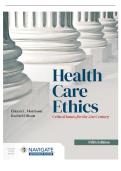
,TESTBANK FOR Health Care Ethics Critical Issues for the 21st Century Fifth
Edition Morrison
Important Notes
The file includes the complete test bank, organized chapter by chapter.
A sample of selected pages has been provided for preview.
All available appendices and Excel files (if included in the original resources) are
provided.
Quizzes, Midterm and final exams are included (if available in the original resources).
We continuously update our files to ensure you receive the latest and most accurate
editions.
New editions are added regularly – stay connected for updates!
⚠️Note on Answer Keys: If the answer key is not included within the chapter
questions, you will find the complete answers and solutions at the end of each
chapter.
✅ Why Buy From Us?
📚 Complete & organized chapter-by-chapter – no missing content, no guessing.
⚡ Instant digital delivery – get your file the moment you pay, no waiting.
📅 Always up to date – we track new editions so you always get the latest version.
💬 Friendly support – real humans ready to help, anytime you need us.
🔒 Safe & secure – thousands of satisfied students trust us every semester.
🛡️Our Guarantees
💰 Money-Back Guarantee: Not satisfied? We offer a full refund – no questions asked.
🔄 Wrong File? No Problem: Contact us and we will replace it immediately with the
correct version, free of charge.
⏰ 24/7 Support: We are always here – reach out anytime and expect a fast response.
,Multiple Choice
1. Which theory speaks of the maximization of pleasure or happiness?
A) Deontology
B) Natural law
C) Classical utilitarianism
D) Rule consequentialism
Ans: C
Ahead: Ethical Theories
Subject: Chapter 1
Title: Theory of Healthcare Ethics
Complexity: Easy
Taxonomy: Remembering
2. Who opposed the forced redistribution of benefits and burdens?
A) John Rawls
B) Aristotle
C) Robert Nozick
D) Immanuel Kant
Ans: C
Ahead: Ethical Theories
Subject: Chapter 1
Title: Theory of Healthcare Ethics
Complexity: Easy
Taxonomy: Remembering
3. Identify the correct statement according to the principle of distributive justice.
A) A person is entitled to a holding only if it benefits society.
B) If a person is entitled to a holding and transfers the holding, the person to whom it is
transferred is now entitled to it.
C) Everyone should have an equal share of all holdings, regardless of acquisition.
D) A person who acquires a holding in accordance with the principle of need is entitled to that
holding.
Ans: B
Ahead: Ethical Theories
Subject: Chapter 1
Title: Theory of Healthcare Ethics
,Complexity: Easy
Taxonomy: Remembering
4. Identify the correct statement, according to John Rawls, about the principle of justice.
A) Each person is to have an equal right to the most extensive basic liberty.
B) The veil of ignorance does not take away liberties.
C) It maximizes the position of the most well off.
D) People are a means to an end.
Ans: A
Ahead: Ethical Theories
Subject: Chapter 1
Title: Theory of Healthcare Ethics
Complexity: Moderate
Taxonomy: Understanding
5. What does the term eudaimonia, used by Aristotle, typically translate to?
A) Envy
B) Happiness
C) Resentment
D) Tranquility
Ans: B
Ahead: Ethical Theories
Subject: Chapter 1
Title: Theory of Healthcare Ethics
Complexity: Easy
Taxonomy: Remembering
,Multiple Choice
1. According to the principle of nonmaleficence, which type of ethical theorist would describe
harm as being “what prevents one from carrying out duty or that which is opposed to the
conditions of moral law”?
A) A natural law ethicist
B) An ethical egoist
C) A consequentialist
D) A deontologist
Ans: D
Ahead: Nonmaleficence
Subject: Chapter 2
Title: Principles of Healthcare Ethics
Complexity: Easy
Taxonomy: Remembering
2. What is the main concern of distributive justice?
A) Reviewing current policies.
B) Uniformity in procedure.
C) Fairness of resource allocation.
D) Implementing legal decisions.
Ans: C
Ahead: Theories of Justice
Subject: Chapter 2
Title: Principles of Healthcare Ethics
Complexity: Easy
Taxonomy: Remembering
3. Which of the following is an example of substance rights?
A) Bill of Rights
B) Health care
C) Due process
D) Privacy under HIPAA
Ans: B
Ahead: Theories of Justice
Subject: Chapter 2
Title: Principles of Healthcare Ethics
,Complexity: Easy
Taxonomy: Remembering
Multiple Selection
4. What are the two important conditions that must be met for autonomy? Choose all that apply.
A) Financial resources
B) Competency to make decisions
C) Having named a healthcare surrogate
D) Being free of coercion for making medical decisions
Ans: A, B
Ahead: Autonomy
Subject: Chapter 2
Title: Principles of Healthcare Ethics
Complexity: Easy
Taxonomy: Remembering
True/False
5. The greatest good for the greatest number is a statement of beneficence.
Ans: True
Ahead: Beneficence
Subject: Chapter 2
Title: Principles of Healthcare Ethics
Complexity: Easy
Taxonomy: Remembering
,Multiple Choice
1. Which of the following defines a genetic mother?
A) A mother in whose uterus the fetus develops
B) A mother who contributes germ cells, perhaps for in vitro fertilization
C) The technician who delivers the sperm to the ovum
D) The mother who cares for the child after its birth
Ans: B
Ahead: Introduction
Subject: Chapter 3
Title: The Moral Status of Gametes and Embryos: Storage and Surrogacy
Complexity: Easy
Taxonomy: Remembering
2. Under moral reference groups, which scope is labeled as “all and only living entities”?
A) Personalism
B) Universalism
C) Humanism
D) Vitalism
Ans: D
Ahead: The Moral Community
Subject: Chapter 3
Title: The Moral Status of Gametes and Embryos: Storage and Surrogacy
Complexity: Easy
Taxonomy: Remembering
3. At which transition point does identification of personal identity and/or potentiality with
genetic integrity occur?
A) Quickening
B) Ensoulment
C) Birth
D) Conception
Ans: D
Ahead: Making Decisions
Subject: Chapter 3
Title: The Moral Status of Gametes and Embryos: Storage and Surrogacy
Complexity: Easy
,Taxonomy: Remembering
4. Which of the following best summarizes the surrogate mother’s rights and obligations?
A) The surrogate mother must always continue the pregnancy regardless of any threats to her
health.
B) The surrogate mother has fiduciary duties to the contracting parties but also special
obligations to the life she carries.
C) The surrogate mother has no right to elective abortion under any circumstances.
D) The surrogate mother can end the pregnancy for any reason without ethical criticism.
Ans: B
Ahead: Surrogacy
Subject: Chapter 3
Title: The Moral Status of Gametes and Embryos: Storage and Surrogacy
Complexity: Moderate
Taxonomy: Understanding
5. What impact does the Supreme Court’s 2022 decision have on the provision and use of
assisted reproductive technology (ART)?
A) It guarantees the safety and legality of ART services.
B) It permits states to impose criminal penalties on the provision and use of ART.
C) It makes ART services more accessible and affordable.
D) It encourages states to promote the use of ART.
Ans: B
Ahead: The End of Roe v. Wade and Reproduction Technology
Subject: Chapter 3
Title: The Moral Status of Gametes and Embryos: Storage and Surrogacy
Complexity: Moderate
Taxonomy: Understanding
,Multiple Choice
1.What of the following functions refer to activities of daily living (ADLs)?
A) Taking medications, preparing meals, managing finances, doing light housework
B) Driving and operating machinery
C) Getting in and out of bed, toileting, bathing, dressing, and eating
D) Planning outing and social events
Ans: C
Ahead: The Growing Population Needing Care
Subject: Chapter 4
Title: Ethics and Aging in America
Complexity: Easy
Taxonomy: Remembering
2. Which racial group over the age of 65 had the highest rate of poverty in 2021?
A) Hispanics
B) African Americans
C) Asians
D) White non-Hispanics
Ans: A
Ahead: The Growing Population Needing Care
Subject: Chapter 4
Title: Ethics and Aging in America
Complexity: Easy
Taxonomy: Remembering
3. What practice, used to gain Medicaid eligibility, has become a source of considerable concern
to the federal and state government?
A) Spend down
B) Asset sheltering
C) Income sheltering
D) Adhering to income guidelines
Ans: B
Ahead: Issues of Access
Subject: Chapter 4
Title: Ethics and Aging in America
Complexity: Easy
, Taxonomy: Remembering
4. Which of the following is a principal reason why predicting long-term health and palliative
care needs among people younger than 65 is difficult?
A) The prevalence of disability is declining at older ages.
B) Reliable databases for making projections are limited.
C) The number of older Americans needing care is decreasing.
D) Technological advancements are slowing down.
Ans: B
Ahead: The Growing Population Needing Care
Subject: Chapter 4
Title: Ethics and Aging in America
Complexity: Easy
Taxonomy: Understanding
True/False
5. Continuing care retirement communities (CCRCs) offer unlimited healthcare services to all
their members.
Ans: False
Ahead: Issues of Access
Subject: Chapter 4
Title: Ethics and Aging in America
Complexity: Easy
Taxonomy: Remembering
Edition Morrison
Important Notes
The file includes the complete test bank, organized chapter by chapter.
A sample of selected pages has been provided for preview.
All available appendices and Excel files (if included in the original resources) are
provided.
Quizzes, Midterm and final exams are included (if available in the original resources).
We continuously update our files to ensure you receive the latest and most accurate
editions.
New editions are added regularly – stay connected for updates!
⚠️Note on Answer Keys: If the answer key is not included within the chapter
questions, you will find the complete answers and solutions at the end of each
chapter.
✅ Why Buy From Us?
📚 Complete & organized chapter-by-chapter – no missing content, no guessing.
⚡ Instant digital delivery – get your file the moment you pay, no waiting.
📅 Always up to date – we track new editions so you always get the latest version.
💬 Friendly support – real humans ready to help, anytime you need us.
🔒 Safe & secure – thousands of satisfied students trust us every semester.
🛡️Our Guarantees
💰 Money-Back Guarantee: Not satisfied? We offer a full refund – no questions asked.
🔄 Wrong File? No Problem: Contact us and we will replace it immediately with the
correct version, free of charge.
⏰ 24/7 Support: We are always here – reach out anytime and expect a fast response.
,Multiple Choice
1. Which theory speaks of the maximization of pleasure or happiness?
A) Deontology
B) Natural law
C) Classical utilitarianism
D) Rule consequentialism
Ans: C
Ahead: Ethical Theories
Subject: Chapter 1
Title: Theory of Healthcare Ethics
Complexity: Easy
Taxonomy: Remembering
2. Who opposed the forced redistribution of benefits and burdens?
A) John Rawls
B) Aristotle
C) Robert Nozick
D) Immanuel Kant
Ans: C
Ahead: Ethical Theories
Subject: Chapter 1
Title: Theory of Healthcare Ethics
Complexity: Easy
Taxonomy: Remembering
3. Identify the correct statement according to the principle of distributive justice.
A) A person is entitled to a holding only if it benefits society.
B) If a person is entitled to a holding and transfers the holding, the person to whom it is
transferred is now entitled to it.
C) Everyone should have an equal share of all holdings, regardless of acquisition.
D) A person who acquires a holding in accordance with the principle of need is entitled to that
holding.
Ans: B
Ahead: Ethical Theories
Subject: Chapter 1
Title: Theory of Healthcare Ethics
,Complexity: Easy
Taxonomy: Remembering
4. Identify the correct statement, according to John Rawls, about the principle of justice.
A) Each person is to have an equal right to the most extensive basic liberty.
B) The veil of ignorance does not take away liberties.
C) It maximizes the position of the most well off.
D) People are a means to an end.
Ans: A
Ahead: Ethical Theories
Subject: Chapter 1
Title: Theory of Healthcare Ethics
Complexity: Moderate
Taxonomy: Understanding
5. What does the term eudaimonia, used by Aristotle, typically translate to?
A) Envy
B) Happiness
C) Resentment
D) Tranquility
Ans: B
Ahead: Ethical Theories
Subject: Chapter 1
Title: Theory of Healthcare Ethics
Complexity: Easy
Taxonomy: Remembering
,Multiple Choice
1. According to the principle of nonmaleficence, which type of ethical theorist would describe
harm as being “what prevents one from carrying out duty or that which is opposed to the
conditions of moral law”?
A) A natural law ethicist
B) An ethical egoist
C) A consequentialist
D) A deontologist
Ans: D
Ahead: Nonmaleficence
Subject: Chapter 2
Title: Principles of Healthcare Ethics
Complexity: Easy
Taxonomy: Remembering
2. What is the main concern of distributive justice?
A) Reviewing current policies.
B) Uniformity in procedure.
C) Fairness of resource allocation.
D) Implementing legal decisions.
Ans: C
Ahead: Theories of Justice
Subject: Chapter 2
Title: Principles of Healthcare Ethics
Complexity: Easy
Taxonomy: Remembering
3. Which of the following is an example of substance rights?
A) Bill of Rights
B) Health care
C) Due process
D) Privacy under HIPAA
Ans: B
Ahead: Theories of Justice
Subject: Chapter 2
Title: Principles of Healthcare Ethics
,Complexity: Easy
Taxonomy: Remembering
Multiple Selection
4. What are the two important conditions that must be met for autonomy? Choose all that apply.
A) Financial resources
B) Competency to make decisions
C) Having named a healthcare surrogate
D) Being free of coercion for making medical decisions
Ans: A, B
Ahead: Autonomy
Subject: Chapter 2
Title: Principles of Healthcare Ethics
Complexity: Easy
Taxonomy: Remembering
True/False
5. The greatest good for the greatest number is a statement of beneficence.
Ans: True
Ahead: Beneficence
Subject: Chapter 2
Title: Principles of Healthcare Ethics
Complexity: Easy
Taxonomy: Remembering
,Multiple Choice
1. Which of the following defines a genetic mother?
A) A mother in whose uterus the fetus develops
B) A mother who contributes germ cells, perhaps for in vitro fertilization
C) The technician who delivers the sperm to the ovum
D) The mother who cares for the child after its birth
Ans: B
Ahead: Introduction
Subject: Chapter 3
Title: The Moral Status of Gametes and Embryos: Storage and Surrogacy
Complexity: Easy
Taxonomy: Remembering
2. Under moral reference groups, which scope is labeled as “all and only living entities”?
A) Personalism
B) Universalism
C) Humanism
D) Vitalism
Ans: D
Ahead: The Moral Community
Subject: Chapter 3
Title: The Moral Status of Gametes and Embryos: Storage and Surrogacy
Complexity: Easy
Taxonomy: Remembering
3. At which transition point does identification of personal identity and/or potentiality with
genetic integrity occur?
A) Quickening
B) Ensoulment
C) Birth
D) Conception
Ans: D
Ahead: Making Decisions
Subject: Chapter 3
Title: The Moral Status of Gametes and Embryos: Storage and Surrogacy
Complexity: Easy
,Taxonomy: Remembering
4. Which of the following best summarizes the surrogate mother’s rights and obligations?
A) The surrogate mother must always continue the pregnancy regardless of any threats to her
health.
B) The surrogate mother has fiduciary duties to the contracting parties but also special
obligations to the life she carries.
C) The surrogate mother has no right to elective abortion under any circumstances.
D) The surrogate mother can end the pregnancy for any reason without ethical criticism.
Ans: B
Ahead: Surrogacy
Subject: Chapter 3
Title: The Moral Status of Gametes and Embryos: Storage and Surrogacy
Complexity: Moderate
Taxonomy: Understanding
5. What impact does the Supreme Court’s 2022 decision have on the provision and use of
assisted reproductive technology (ART)?
A) It guarantees the safety and legality of ART services.
B) It permits states to impose criminal penalties on the provision and use of ART.
C) It makes ART services more accessible and affordable.
D) It encourages states to promote the use of ART.
Ans: B
Ahead: The End of Roe v. Wade and Reproduction Technology
Subject: Chapter 3
Title: The Moral Status of Gametes and Embryos: Storage and Surrogacy
Complexity: Moderate
Taxonomy: Understanding
,Multiple Choice
1.What of the following functions refer to activities of daily living (ADLs)?
A) Taking medications, preparing meals, managing finances, doing light housework
B) Driving and operating machinery
C) Getting in and out of bed, toileting, bathing, dressing, and eating
D) Planning outing and social events
Ans: C
Ahead: The Growing Population Needing Care
Subject: Chapter 4
Title: Ethics and Aging in America
Complexity: Easy
Taxonomy: Remembering
2. Which racial group over the age of 65 had the highest rate of poverty in 2021?
A) Hispanics
B) African Americans
C) Asians
D) White non-Hispanics
Ans: A
Ahead: The Growing Population Needing Care
Subject: Chapter 4
Title: Ethics and Aging in America
Complexity: Easy
Taxonomy: Remembering
3. What practice, used to gain Medicaid eligibility, has become a source of considerable concern
to the federal and state government?
A) Spend down
B) Asset sheltering
C) Income sheltering
D) Adhering to income guidelines
Ans: B
Ahead: Issues of Access
Subject: Chapter 4
Title: Ethics and Aging in America
Complexity: Easy
, Taxonomy: Remembering
4. Which of the following is a principal reason why predicting long-term health and palliative
care needs among people younger than 65 is difficult?
A) The prevalence of disability is declining at older ages.
B) Reliable databases for making projections are limited.
C) The number of older Americans needing care is decreasing.
D) Technological advancements are slowing down.
Ans: B
Ahead: The Growing Population Needing Care
Subject: Chapter 4
Title: Ethics and Aging in America
Complexity: Easy
Taxonomy: Understanding
True/False
5. Continuing care retirement communities (CCRCs) offer unlimited healthcare services to all
their members.
Ans: False
Ahead: Issues of Access
Subject: Chapter 4
Title: Ethics and Aging in America
Complexity: Easy
Taxonomy: Remembering


