Chapter 1 Customer-supplier relationships
The word “relationship” evokes thoughts of mutual attraction, respect, consideration and
dependency between two or more people. These aspects will only appear if certain
conditions are met.
• Interactions must take place between at least two parties
o Characteristic of interactions is that the activities of one of the parties
influence those of the other.
• A certain degree of continuity must be present in a relationship
o Interactions from the past influence present and future actions
• The effects of interactions are dependent upon the actual events and the subjective
approach to these events.
Primary relationships involve basic long-term interpersonal relationships which are based
primarily on emotional bonds and the feeling of mutual obligation towards one another.
Primary relationships are rather diffuse and comprise many roles, behaviours and situations.
They are usually not limited by strict rules governing contact, and the people involved
generally know each other very well, one person cannot automatically be replaced by
another.
Secondary relationships, such as those between customer and supplier, are relatively short-
term interpersonal relationships with a limited degree of social interaction, fairly clear rules
of etiquette and reasonably well-defined social roles. Deep emotional involvement rarely
occurs; the various players may be more easily replaced in general.
The relationship between customer and supplier may be present at a variety of levels and in
various compositions.
The type of relationship between customer and supplier depends on various factors:
• Whether or not a transaction has already been completed
o From prospect to customer
• If a long-term orientation is present which extents further than one transaction
o From customer to client
• To what degree the relationship is felt by both parties
o From supporter to ambassador
• To what degree both parties take an active
position in the relationship
o From ambassador to partner
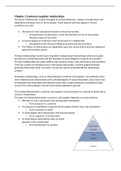
,The categories of the pyramid of relationships describe to what degree the following are
present:
• Cooperation or competition
• Equal or unequal distribution of power
• Dependence or independence
• A task or social-emotional orientation
• A formal or informal form of contact
In analysing the quality of a relationship, it is also important to look at commitment,
fairness, loyalty and trust. Some relationships are just continued because there are no
better alternatives and terminating the relationship would end up with problems.
Reciprocity forms the basis for relationships and assumes the following:
• A moral norm exists to give something back when something is received
• A precise return is not desirable
o Exchanges do not need to be in balance immediately as long as a balance is
created in the long run
• Reciprocity occurs in all cultures; it is universal
• Reciprocity makes interaction possible because the norm of return applies
o People are willing to take a chance with someone because of the valid norm
Emotions occur in many different ways and there are many subtle nuances. However, 7
basic emotions can be described:
• Surprise
• Fear
• Anger
• Sorrow
• Loathing
• Contempt
• Happiness
People rarely experience a basic emotion, but rather a mix of almost simultaneous
emotions. Emotions influence the physical and mental behaviour.
The exchange of resources, and the emotional response this solicits will influence the trust
in the relationship. Trust in a relationship can be defined as the willingness to rely on an
exchange partner in whom one has confidence.
,Commitment is the ultimate goal one can set for mutually beneficial relations. Commitment
can be defined as an enduring desire to maintain a valued relationship.
3 forms of commitment:
• Personal commitment: displayed desire to continue a relationship
• Moral commitment: feel a sense of obligation
• Structural commitment: perception that there is no escaping it
Loyalty is a deeply held commitment to rebuy or repatronise a preferred product/service
consistently in the future, thereby causing repetitive same-brand or same-brand-set
purchasing, despite situational influences and marketing efforts having the potential to
cause switching behaviour.
Relationship life cycle:
1. Awareness: both parties become aware of one another
2. Exploration: more interaction takes place and negotiations will be conducted
3. Growth: parties continue to attract the other, negotiations will continue, norms and
expectations are outlined in more detail
4. Saturation: relationship reaches its maximum level of commitment, mutual
dependency, trust and respect.
5. Decline: directness and a focus on others may indicate that the continuity of the
relationship is at issue
The term social network is loosely used to refer to a group of customers and suppliers who
interact with one another, without the need to analyse the connection within the social
structure.
Being social refers to people’s tendency to want to belong to or form groups. It is a basic
human trait. Contact may arise around defined interests, products or other people.
, The honeycomb framework consists of 7 social media blocks; each addressing a special facet
of the socialisation process on the web.
Research into the influence of social networks on bilateral relationships between customer
and supplier is focused on:
• Interaction patterns
o How do conversations spread and develop through a network both in the
quantitative and qualitative sense?
• Group formation
o The possible meaning of group formation as a consequence of social
identification, exercise of social pressure, commitment and sense of
belonging to the organisation.
The word “relationship” evokes thoughts of mutual attraction, respect, consideration and
dependency between two or more people. These aspects will only appear if certain
conditions are met.
• Interactions must take place between at least two parties
o Characteristic of interactions is that the activities of one of the parties
influence those of the other.
• A certain degree of continuity must be present in a relationship
o Interactions from the past influence present and future actions
• The effects of interactions are dependent upon the actual events and the subjective
approach to these events.
Primary relationships involve basic long-term interpersonal relationships which are based
primarily on emotional bonds and the feeling of mutual obligation towards one another.
Primary relationships are rather diffuse and comprise many roles, behaviours and situations.
They are usually not limited by strict rules governing contact, and the people involved
generally know each other very well, one person cannot automatically be replaced by
another.
Secondary relationships, such as those between customer and supplier, are relatively short-
term interpersonal relationships with a limited degree of social interaction, fairly clear rules
of etiquette and reasonably well-defined social roles. Deep emotional involvement rarely
occurs; the various players may be more easily replaced in general.
The relationship between customer and supplier may be present at a variety of levels and in
various compositions.
The type of relationship between customer and supplier depends on various factors:
• Whether or not a transaction has already been completed
o From prospect to customer
• If a long-term orientation is present which extents further than one transaction
o From customer to client
• To what degree the relationship is felt by both parties
o From supporter to ambassador
• To what degree both parties take an active
position in the relationship
o From ambassador to partner
,The categories of the pyramid of relationships describe to what degree the following are
present:
• Cooperation or competition
• Equal or unequal distribution of power
• Dependence or independence
• A task or social-emotional orientation
• A formal or informal form of contact
In analysing the quality of a relationship, it is also important to look at commitment,
fairness, loyalty and trust. Some relationships are just continued because there are no
better alternatives and terminating the relationship would end up with problems.
Reciprocity forms the basis for relationships and assumes the following:
• A moral norm exists to give something back when something is received
• A precise return is not desirable
o Exchanges do not need to be in balance immediately as long as a balance is
created in the long run
• Reciprocity occurs in all cultures; it is universal
• Reciprocity makes interaction possible because the norm of return applies
o People are willing to take a chance with someone because of the valid norm
Emotions occur in many different ways and there are many subtle nuances. However, 7
basic emotions can be described:
• Surprise
• Fear
• Anger
• Sorrow
• Loathing
• Contempt
• Happiness
People rarely experience a basic emotion, but rather a mix of almost simultaneous
emotions. Emotions influence the physical and mental behaviour.
The exchange of resources, and the emotional response this solicits will influence the trust
in the relationship. Trust in a relationship can be defined as the willingness to rely on an
exchange partner in whom one has confidence.
,Commitment is the ultimate goal one can set for mutually beneficial relations. Commitment
can be defined as an enduring desire to maintain a valued relationship.
3 forms of commitment:
• Personal commitment: displayed desire to continue a relationship
• Moral commitment: feel a sense of obligation
• Structural commitment: perception that there is no escaping it
Loyalty is a deeply held commitment to rebuy or repatronise a preferred product/service
consistently in the future, thereby causing repetitive same-brand or same-brand-set
purchasing, despite situational influences and marketing efforts having the potential to
cause switching behaviour.
Relationship life cycle:
1. Awareness: both parties become aware of one another
2. Exploration: more interaction takes place and negotiations will be conducted
3. Growth: parties continue to attract the other, negotiations will continue, norms and
expectations are outlined in more detail
4. Saturation: relationship reaches its maximum level of commitment, mutual
dependency, trust and respect.
5. Decline: directness and a focus on others may indicate that the continuity of the
relationship is at issue
The term social network is loosely used to refer to a group of customers and suppliers who
interact with one another, without the need to analyse the connection within the social
structure.
Being social refers to people’s tendency to want to belong to or form groups. It is a basic
human trait. Contact may arise around defined interests, products or other people.
, The honeycomb framework consists of 7 social media blocks; each addressing a special facet
of the socialisation process on the web.
Research into the influence of social networks on bilateral relationships between customer
and supplier is focused on:
• Interaction patterns
o How do conversations spread and develop through a network both in the
quantitative and qualitative sense?
• Group formation
o The possible meaning of group formation as a consequence of social
identification, exercise of social pressure, commitment and sense of
belonging to the organisation.