
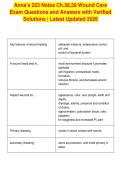
Anna's 223 Notes Ch.38,39 Wound Care
Exam Questions and Answers with Verified
Solutions | Latest Updated 2026
Key features of wound healing adequate moisture, temperature control,
pH, and
control of bacterial burden
A wound heals best in... moist environment because it promotes
epithelial
cell migration, extracellular matrix
formation,
reduces fibrosis, and decreases wound
infection
Inspect wounds for... appearance, color, size (length, width and
depth),
drainage, edema, presence and condition
of drains,
approximation, granulation tissue, odor,
palpation
for bogginess and increased Pt. pain
Primary dressing comes in direct contact with wound
secondary dressing serve as protection, and holds primary in
place
, Pressure dressings applied to control bleeding - promote
clotting
Alginate or foam manages wound drainage - moderate to
heavy
exudate, partial and full thickness
Hydrocolloid dressings used in a non-infected wound that are
draining a
moderate amount of exudate.
Recommended for
clean stage II ulcers, and noninfected
shallow
stage III ulcers. When in contact with
wound
drainage, forms a gel that promotes moist
environment & enzymatic debridement.
Good
choice for painful wounds since they do
not adhere
to wound base.
Dry dressings for wounds healing by primary intention, do
not
interact with wound tissues, frequent
changes are
needed, increased infection rates when
compared
with semiocclusive. Commonly used for
abrasions,
and non-draining postoperative incisions.
Not
appropriate for debriding wounds.
Exam Questions and Answers with Verified
Solutions | Latest Updated 2026
Key features of wound healing adequate moisture, temperature control,
pH, and
control of bacterial burden
A wound heals best in... moist environment because it promotes
epithelial
cell migration, extracellular matrix
formation,
reduces fibrosis, and decreases wound
infection
Inspect wounds for... appearance, color, size (length, width and
depth),
drainage, edema, presence and condition
of drains,
approximation, granulation tissue, odor,
palpation
for bogginess and increased Pt. pain
Primary dressing comes in direct contact with wound
secondary dressing serve as protection, and holds primary in
place
, Pressure dressings applied to control bleeding - promote
clotting
Alginate or foam manages wound drainage - moderate to
heavy
exudate, partial and full thickness
Hydrocolloid dressings used in a non-infected wound that are
draining a
moderate amount of exudate.
Recommended for
clean stage II ulcers, and noninfected
shallow
stage III ulcers. When in contact with
wound
drainage, forms a gel that promotes moist
environment & enzymatic debridement.
Good
choice for painful wounds since they do
not adhere
to wound base.
Dry dressings for wounds healing by primary intention, do
not
interact with wound tissues, frequent
changes are
needed, increased infection rates when
compared
with semiocclusive. Commonly used for
abrasions,
and non-draining postoperative incisions.
Not
appropriate for debriding wounds.


