

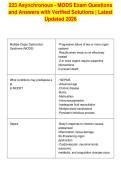
223 Asynchronous - MODS Exam Questions
and Answers with Verified Solutions | Latest
Updated 2026
Multiple Organ Dysfunction -Progressive failure of two or more organ
Syndrome (MODS) systems
-Results when shock is not effectively
treated
-2 or more organs require supportive
interventions
to prevent death
What conditions may predispose a -*SEPSIS
pt -Advanced age
to MODS? -Chronic disease
-Burns
-Malnutrition
-Immunosuppression
-Inadequate fluid resuscitation
-Multiple blood transfusions
-Persistent infectious process
Sepsis -Body's response to infection causes
widespread
inflammation, tissue damage,
life-threatening organ
dysfunction
-Cardiovascular, neurohormonal,
autonomic,
metabolic, and coagulation changes occur
, Multiple Organ Dysfunction -Infection/trauma/etc activates
Syndrome (MODS) - inflammatory
Pathophysiology response --> increased vasodilation and
vascular
permeability
-Fluids and proteins leak into tissues,
causing
edema and impaired perfusion
-Inflammation also cause microthrombi to
form
-Cells switch to anaerobic metabolism,
causing
lactic acidosis and further tissue damage
-Unregulated cell apoptosis increases
infection
risks and prolongs the inflammatory
response
-Dysfunction in one organ system
exacerbates
stress on others
Sequential Organ Failure -Used to assess the severity of organ
Assessment dysfunction
(SOFA) score -Six major organ systems are each scored
from 0
(normal function) to 4 (severe dysfunction)
-A score of 2 or more = mortality greater
than 10%
-A change in SOFA score ≥2 points from
baseline is
a key criterion for sepsis diagnosis
and Answers with Verified Solutions | Latest
Updated 2026
Multiple Organ Dysfunction -Progressive failure of two or more organ
Syndrome (MODS) systems
-Results when shock is not effectively
treated
-2 or more organs require supportive
interventions
to prevent death
What conditions may predispose a -*SEPSIS
pt -Advanced age
to MODS? -Chronic disease
-Burns
-Malnutrition
-Immunosuppression
-Inadequate fluid resuscitation
-Multiple blood transfusions
-Persistent infectious process
Sepsis -Body's response to infection causes
widespread
inflammation, tissue damage,
life-threatening organ
dysfunction
-Cardiovascular, neurohormonal,
autonomic,
metabolic, and coagulation changes occur
, Multiple Organ Dysfunction -Infection/trauma/etc activates
Syndrome (MODS) - inflammatory
Pathophysiology response --> increased vasodilation and
vascular
permeability
-Fluids and proteins leak into tissues,
causing
edema and impaired perfusion
-Inflammation also cause microthrombi to
form
-Cells switch to anaerobic metabolism,
causing
lactic acidosis and further tissue damage
-Unregulated cell apoptosis increases
infection
risks and prolongs the inflammatory
response
-Dysfunction in one organ system
exacerbates
stress on others
Sequential Organ Failure -Used to assess the severity of organ
Assessment dysfunction
(SOFA) score -Six major organ systems are each scored
from 0
(normal function) to 4 (severe dysfunction)
-A score of 2 or more = mortality greater
than 10%
-A change in SOFA score ≥2 points from
baseline is
a key criterion for sepsis diagnosis


