

NURS 223 test 1 Exam Questions and
Answers with Verified Solutions | Latest
Updated 2026
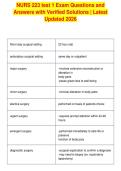
Short stay surgical setting 23 hour stat
ambulatory surgical setting same day or outpatient
major surgery -involves extensive reconstruction or
alteration in
body parts
-poses great risks to well-being
minor surgery -minimal alteration in body parts
elective surgery performed on basis of patients choice
urgent surgery -requires prompt attention within 24-48
hours
emergent surgery -performed immediately to safe life or
preserve
function of body pary
diagnositic surgery -surgical exploration to confirm a diagnosis
-may need to biopsy (ex. exploratory
laparotomy)
,ablative surgery amputation or removal of diseased body
part
palliative surgery -removes or reduces intensity of disease
symptoms
-does not cure
reconstructive surgery restores function or appearance to
traumatized
tissues
transplant -removal of organs and/or tissues from
person
pronounced brain dead for transplant into
another
person
constructive surgery -restores function lost or reduced as a
result of
congenital
cosmetic surgery improves personal appearance
surgical risk factors -smoking
-age
-nutrition
-obesity
-obstructive sleep apnea
-immunocompetence
-fluid and electrolyte balance
-depression
-pregnancy
, ectomy -removal
-ex. appendectomy
oscopy -to look inside
-ex. colonoscopy
otomy -to open something
-ex. fasciotomy
properative phase -begins when patient is informed they are
having
surgery
intraoperative phase -begins when patient enters OR and ends
when
patient leaves OR
postoperative phase -begins when patient leaves OR and goes
into
PACU
Answers with Verified Solutions | Latest
Updated 2026
Short stay surgical setting 23 hour stat
ambulatory surgical setting same day or outpatient
major surgery -involves extensive reconstruction or
alteration in
body parts
-poses great risks to well-being
minor surgery -minimal alteration in body parts
elective surgery performed on basis of patients choice
urgent surgery -requires prompt attention within 24-48
hours
emergent surgery -performed immediately to safe life or
preserve
function of body pary
diagnositic surgery -surgical exploration to confirm a diagnosis
-may need to biopsy (ex. exploratory
laparotomy)
,ablative surgery amputation or removal of diseased body
part
palliative surgery -removes or reduces intensity of disease
symptoms
-does not cure
reconstructive surgery restores function or appearance to
traumatized
tissues
transplant -removal of organs and/or tissues from
person
pronounced brain dead for transplant into
another
person
constructive surgery -restores function lost or reduced as a
result of
congenital
cosmetic surgery improves personal appearance
surgical risk factors -smoking
-age
-nutrition
-obesity
-obstructive sleep apnea
-immunocompetence
-fluid and electrolyte balance
-depression
-pregnancy
, ectomy -removal
-ex. appendectomy
oscopy -to look inside
-ex. colonoscopy
otomy -to open something
-ex. fasciotomy
properative phase -begins when patient is informed they are
having
surgery
intraoperative phase -begins when patient enters OR and ends
when
patient leaves OR
postoperative phase -begins when patient leaves OR and goes
into
PACU


