
OB - NICU 2 Exam Questions and Answers
with Verified Solutions | Latest Updated 2026
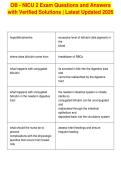
hyperbilirubinemia excessive level of bilirubin (bile pigment) in
the
blood
where does bilirubin come from breakdown of RBCs
what happens with conjugated its excreted in bile into the digestive tract
bilirubin and
cannot be reabsorbed by the digestive
tract
what happens with conjugated the newborn intestinal system is initially
bilirubin in the newborn digestive sterile so
tract conjugated bilirubin can be unconjugated
and
reabsorbed through the intestinal
epithelium and
deposited back into the circulatory system
what should the nurse do to assess infant feedings and ensure
prevent frequent feeding
complications with the physiologic
jaundice that occurs from breast
milk
, acute bilirubin encephalopathy lethargy
clinical presentation fever
irritability
jitteriness
hypotonia
poor feeding
apnea
seizures
high-pitched cry
when should the nurse assess the every 8-12 hours
infant for jaundice
why are infants who are jaundice ABO or Rh(O) incompatibility
after 24 hours at higher risk for
severe hyperbilirubinemia
treatment for jaundice phototherapy
what should nurses monitor for infants temperature, serum bilirubin,
during phototherapy hydration
status, and exposure time during therapy
symptoms of RDS tachypnea, nasal flaring, expiratory,
retractions,
cyanosis, pallor
conditions that cause RDS bronchopulmonary dysplasia
persistant pulmonary HTN
transient tachypnea
meconium aspiration syndrome
with Verified Solutions | Latest Updated 2026
hyperbilirubinemia excessive level of bilirubin (bile pigment) in
the
blood
where does bilirubin come from breakdown of RBCs
what happens with conjugated its excreted in bile into the digestive tract
bilirubin and
cannot be reabsorbed by the digestive
tract
what happens with conjugated the newborn intestinal system is initially
bilirubin in the newborn digestive sterile so
tract conjugated bilirubin can be unconjugated
and
reabsorbed through the intestinal
epithelium and
deposited back into the circulatory system
what should the nurse do to assess infant feedings and ensure
prevent frequent feeding
complications with the physiologic
jaundice that occurs from breast
milk
, acute bilirubin encephalopathy lethargy
clinical presentation fever
irritability
jitteriness
hypotonia
poor feeding
apnea
seizures
high-pitched cry
when should the nurse assess the every 8-12 hours
infant for jaundice
why are infants who are jaundice ABO or Rh(O) incompatibility
after 24 hours at higher risk for
severe hyperbilirubinemia
treatment for jaundice phototherapy
what should nurses monitor for infants temperature, serum bilirubin,
during phototherapy hydration
status, and exposure time during therapy
symptoms of RDS tachypnea, nasal flaring, expiratory,
retractions,
cyanosis, pallor
conditions that cause RDS bronchopulmonary dysplasia
persistant pulmonary HTN
transient tachypnea
meconium aspiration syndrome


