

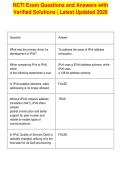
NCTI Exam Questions and Answers with
Verified Solutions | Latest Updated 2026
Question Answer
What was the primary driver for To address the issue of IPv4 address
development of IPv6? exhaustion.
When comparing IPv4 to IPv6, IPv4 uses a 32-bit address scheme, while
which IPv6 uses
of the following statements is true a 128-bit address scheme.
In IPv6-enabled networks, static FALSE
addressing is no longer allowed.
Without IPv4's network address TRUE
translation (NAT), IPv6 offers
simpler
packet construction and better
support for peer-to-peer and
mobile-to-mobile types of
communications.
In IPv6, Quality of Service (QoS) is FALSE
radically changed, utilizing only the
flow label for all QoS provisioning.
,Unfortunately, only RIP (Routing FALSE
Information Protocol) and OSPF
(Open Shortest Path First) are
capable of routing IPv6.
What size are IPv4 and IPv6 32-bits, 128-bits.
addresses, respectively?
IPv4 addresses are written in Hexadecimal notation, dropping leading
dotted- zeros in
decimal. Which of these best each hextet, using the "::" notation to
describes how IPv6 addresses are represent
written? missing all-zero hextets.
IPv6 addresses are written in FALSE
Binary
Coded Decimal (BCD).
An example of a single 16-bit :54a2:.
"hextet"
in an IPv6 address could be
shown
like this:
What is an "IID"? Interface Identifier.
How large is a typical user-centric /64
IPv6 subnet size, for a single
subnet,
using CIDR notation?
, What does the notation "2000::/3" That global unicast addresses always start
mean, in terms of the initial IETF with the
allocation for IPv6 global unicast first three bits "001" (first 3 bits of the
space? address per
the "/3" notation).
Which of these prefix lengths /32
would
be a reasonable assignment for a
service provider?
Which of these prefix lengths /48.
would
be a reasonable assignment for a
small single-homed commercial
enterprise with no more than 15 or
20 networks?
What is a unique aspect of an It is an address typically assigned to more
"anycast" address? than one
interface, typically on different nodes.
The leftmost 64-bits of an IPv6 The location in the IPv6 routing hierarchy
unicast address typically describe: of a
particular subnet.
The rightmost 64-bits of an IPv6 The specific interface on the subnet.
unicast address typically describe:
The main types of IPv6 addresses Unicast, anycast, and multicast.
are:
Verified Solutions | Latest Updated 2026
Question Answer
What was the primary driver for To address the issue of IPv4 address
development of IPv6? exhaustion.
When comparing IPv4 to IPv6, IPv4 uses a 32-bit address scheme, while
which IPv6 uses
of the following statements is true a 128-bit address scheme.
In IPv6-enabled networks, static FALSE
addressing is no longer allowed.
Without IPv4's network address TRUE
translation (NAT), IPv6 offers
simpler
packet construction and better
support for peer-to-peer and
mobile-to-mobile types of
communications.
In IPv6, Quality of Service (QoS) is FALSE
radically changed, utilizing only the
flow label for all QoS provisioning.
,Unfortunately, only RIP (Routing FALSE
Information Protocol) and OSPF
(Open Shortest Path First) are
capable of routing IPv6.
What size are IPv4 and IPv6 32-bits, 128-bits.
addresses, respectively?
IPv4 addresses are written in Hexadecimal notation, dropping leading
dotted- zeros in
decimal. Which of these best each hextet, using the "::" notation to
describes how IPv6 addresses are represent
written? missing all-zero hextets.
IPv6 addresses are written in FALSE
Binary
Coded Decimal (BCD).
An example of a single 16-bit :54a2:.
"hextet"
in an IPv6 address could be
shown
like this:
What is an "IID"? Interface Identifier.
How large is a typical user-centric /64
IPv6 subnet size, for a single
subnet,
using CIDR notation?
, What does the notation "2000::/3" That global unicast addresses always start
mean, in terms of the initial IETF with the
allocation for IPv6 global unicast first three bits "001" (first 3 bits of the
space? address per
the "/3" notation).
Which of these prefix lengths /32
would
be a reasonable assignment for a
service provider?
Which of these prefix lengths /48.
would
be a reasonable assignment for a
small single-homed commercial
enterprise with no more than 15 or
20 networks?
What is a unique aspect of an It is an address typically assigned to more
"anycast" address? than one
interface, typically on different nodes.
The leftmost 64-bits of an IPv6 The location in the IPv6 routing hierarchy
unicast address typically describe: of a
particular subnet.
The rightmost 64-bits of an IPv6 The specific interface on the subnet.
unicast address typically describe:
The main types of IPv6 addresses Unicast, anycast, and multicast.
are:


