
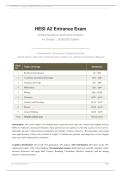
HESI A2 Entrance Exam | 2026/2027 Edition | A+ Graded
HESI A2 Entrance Exam
Verified Questions and Correct Answers
A+ Graded | 2026/2027 Edition
Comprehensive 150-Question Practice Examination
Aligned with the 2026–2027 Health Education Systems, Inc. Admission Assessment Blueprint
Secti
Topic Coverage Questions
on
1 Reading Comprehension Q1 – Q20
2 Vocabulary and General Knowledge Q21 – Q40
3 Grammar and Usage Q41 – Q60
4 Mathematics Q61 – Q80
5 Biology Q81 – Q100
6 Chemistry Q101 – Q115
7 Anatomy and Physiology Q116 – Q135
8 Physics Q136 – Q145
9 Critical Thinking Q146 – Q150
Total All nine content areas 150 Questions
Instructions: This exam contains 150 multiple-choice questions across nine core content areas aligned with the
HESI A2 Admission Assessment blueprint. Each question has four options (A–D) with exactly one best answer.
Rationales provide evidence-based explanations and identify common distractors. Recommended total testing
time: approximately 4 hours. Pace yourself at roughly 1.5 minutes per question, reserving time to review flagged
items and verify mathematical calculations.
Cognitive distribution: 35% recall, 45% application, 20% analysis. Style distribution: 60% direct recall, 30%
application/scenario, 10% critical thinking. Recommended strategy: Read each stem carefully, eliminate clearly
incorrect distractors, and apply ABC (Airway, Breathing, Circulation), Maslow's hierarchy, and the nursing
process to clinical scenarios.
Z.ai | Verified Questions Page 1
,HESI A2 Entrance Exam | 2026/2027 Edition | A+ Graded
Section 1: Reading Comprehension
Questions Q1–Q20 • Main Ideas, Supporting Details, Inferences, Vocabulary in Context, Author's
Purpose
This section contains 20 questions testing main ideas, supporting details, inferences, vocabulary in
context, author's purpose. Allocate approximately 30 minutes for this section.
Q1: Passage — The Role of Hand Hygiene in Infection Control
Hospital-acquired infections (HAIs) affect approximately one in thirty-one hospitalized patients on any
given day in the United States. Among the simplest, most cost-effective interventions to reduce HAIs is
proper hand hygiene. Despite decades of public health campaigns, studies show that healthcare workers
comply with handwashing protocols less than half of the time. The World Health Organization
recommends alcohol-based handrubs as the gold standard in most clinical settings because they are faster,
less irritating to skin, and more effective against many pathogens than soap and water. However, when
hands are visibly soiled or after caring for a patient with Clostridioides difficile, soap-and-water washing
remains essential, since alcohol does not destroy spores. Effective infection prevention, therefore, requires
not only knowledge but also consistent behavioral commitment from every member of the care team.
What is the main idea of the passage?
A. Hospital-acquired infections are unavoidable in modern healthcare.
B. Hand hygiene is a critical, evidence-based measure to reduce hospital infections but is underused.
[CORRECT]
C. Alcohol-based handrubs should replace soap and water in all clinical situations.
D. Clostridioides difficile is the most common cause of HAIs.
Correct Answer: B
Rationale: The passage emphasizes hand hygiene as a simple yet underutilized tool against HAIs. It supports alcohol rubs
as the standard while acknowledging soap-and-water limits (spores). Choice A is too pessimistic, C is an
overgeneralization the passage explicitly refutes, and D is unsupported by the text. The correct answer captures both the
importance and the compliance gap.
Q2: Passage — The Role of Hand Hygiene in Infection Control
Hospital-acquired infections (HAIs) affect approximately one in thirty-one hospitalized patients on any
given day in the United States. Among the simplest, most cost-effective interventions to reduce HAIs is
proper hand hygiene. Despite decades of public health campaigns, studies show that healthcare workers
comply with handwashing protocols less than half of the time. The World Health Organization
recommends alcohol-based handrubs as the gold standard in most clinical settings because they are faster,
less irritating to skin, and more effective against many pathogens than soap and water. However, when
hands are visibly soiled or after caring for a patient with Clostridioides difficile, soap-and-water washing
remains essential, since alcohol does not destroy spores. Effective infection prevention, therefore, requires
not only knowledge but also consistent behavioral commitment from every member of the care team.
According to the passage, why does the WHO recommend alcohol-based handrubs as the gold standard?
A. They are cheaper than soap.
B. They kill C. difficile spores faster than soap.
Z.ai | Verified Questions Page 2
,HESI A2 Entrance Exam | 2026/2027 Edition | A+ Graded
C. They are faster, gentler on skin, and more effective against many pathogens. [CORRECT]
D. They eliminate the need for any handwashing.
Correct Answer: C
Rationale: The text states alcohol-based rubs are 'faster, less irritating to skin, and more effective against many
pathogens than soap and water.' Choice B is wrong because the passage notes alcohol does NOT destroy spores. Choice A
is unsupported and D directly contradicts the passage's exception for visibly soiled hands and C. difficile.
Q3: Passage — The Role of Hand Hygiene in Infection Control
Hospital-acquired infections (HAIs) affect approximately one in thirty-one hospitalized patients on any
given day in the United States. Among the simplest, most cost-effective interventions to reduce HAIs is
proper hand hygiene. Despite decades of public health campaigns, studies show that healthcare workers
comply with handwashing protocols less than half of the time. The World Health Organization
recommends alcohol-based handrubs as the gold standard in most clinical settings because they are faster,
less irritating to skin, and more effective against many pathogens than soap and water. However, when
hands are visibly soiled or after caring for a patient with Clostridioides difficile, soap-and-water washing
remains essential, since alcohol does not destroy spores. Effective infection prevention, therefore, requires
not only knowledge but also consistent behavioral commitment from every member of the care team.
Which statement can be inferred from the passage?
A. All pathogens are equally resistant to alcohol-based handrubs.
B. Behavioral commitment matters as much as knowledge in infection control. [CORRECT]
C. C. difficile is harmless to hospitalized patients.
D. Soap and water are no longer used in hospitals.
Correct Answer: B
Rationale: The closing sentence stresses that infection prevention 'requires not only knowledge but also consistent
behavioral commitment,' directly supporting this inference. Choice A contradicts the spore exception; C is false given C.
difficile causes serious illness; D is wrong because soap and water remain essential in specific cases.
Q4: Passage — The Role of Hand Hygiene in Infection Control
Hospital-acquired infections (HAIs) affect approximately one in thirty-one hospitalized patients on any
given day in the United States. Among the simplest, most cost-effective interventions to reduce HAIs is
proper hand hygiene. Despite decades of public health campaigns, studies show that healthcare workers
comply with handwashing protocols less than half of the time. The World Health Organization
recommends alcohol-based handrubs as the gold standard in most clinical settings because they are faster,
less irritating to skin, and more effective against many pathogens than soap and water. However, when
hands are visibly soiled or after caring for a patient with Clostridioides difficile, soap-and-water washing
remains essential, since alcohol does not destroy spores. Effective infection prevention, therefore, requires
not only knowledge but also consistent behavioral commitment from every member of the care team.
In context, the word 'interventions' most nearly means:
A. Surgical procedures
B. Deliberate actions taken to improve a situation [CORRECT]
C. Hospital billing codes
D. Patient satisfaction surveys
Correct Answer: B
Z.ai | Verified Questions Page 3
, HESI A2 Entrance Exam | 2026/2027 Edition | A+ Graded
Rationale: In infection-control literature, 'interventions' refers to deliberate actions designed to produce a beneficial
outcome, such as hand hygiene protocols. Choice A is too narrow, C and D are unrelated to infection prevention. The
context clue 'reduce HAIs' indicates a preventive action.
Q5: Passage — The Role of Hand Hygiene in Infection Control
Hospital-acquired infections (HAIs) affect approximately one in thirty-one hospitalized patients on any
given day in the United States. Among the simplest, most cost-effective interventions to reduce HAIs is
proper hand hygiene. Despite decades of public health campaigns, studies show that healthcare workers
comply with handwashing protocols less than half of the time. The World Health Organization
recommends alcohol-based handrubs as the gold standard in most clinical settings because they are faster,
less irritating to skin, and more effective against many pathogens than soap and water. However, when
hands are visibly soiled or after caring for a patient with Clostridioides difficile, soap-and-water washing
remains essential, since alcohol does not destroy spores. Effective infection prevention, therefore, requires
not only knowledge but also consistent behavioral commitment from every member of the care team.
The author's primary purpose is to:
A. Compare brands of hand sanitizer
B. Explain why hand hygiene matters and clarify when each method is appropriate [CORRECT]
C. Argue that HAIs cannot be prevented
D. Criticize healthcare workers for poor compliance
Correct Answer: B
Rationale: The passage educates readers about the importance of hand hygiene and clarifies that both alcohol rubs and
soap have specific, evidence-based uses. Choices A and C are unsupported, and while the author notes poor compliance,
the purpose is not to criticize but to inform.
Q6: Passage — Sleep and Healing in Postoperative Patients
Adequate sleep is essential for tissue repair, immune function, and cognitive recovery, particularly after
surgery. Researchers have found that postoperative patients who experience uninterrupted sleep cycles
demonstrate shorter hospital stays, reduced perception of pain, and lower rates of complication.
Unfortunately, the hospital environment—frequent vital-sign checks, alarms, bright lighting, and noisy
hallways—often fragments sleep into brief, non-restorative episodes. Interventions such as clustering
nursing care, dimming lights at night, and minimizing nonessential awakenings have been shown to
improve both patient satisfaction and physiological outcomes. Recognizing sleep as a clinical priority,
rather than a passive byproduct of hospitalization, may be one of the most underused tools in
postoperative care.
What is the main idea of this passage?
A. Hospital alarms are the leading cause of complications after surgery.
B. Sleep is clinically important to postoperative recovery but is often disrupted by the hospital
environment. [CORRECT]
C. Patients prefer home recovery to hospital stays.
D. Pain perception is unrelated to sleep quality.
Correct Answer: B
Rationale: The passage argues sleep is essential to healing yet frequently interrupted by hospital routines. It supports this
with physiological outcomes and concrete interventions. Choice A overstates one detail; C is unsupported; D contradicts
Z.ai | Verified Questions Page 4
HESI A2 Entrance Exam
Verified Questions and Correct Answers
A+ Graded | 2026/2027 Edition
Comprehensive 150-Question Practice Examination
Aligned with the 2026–2027 Health Education Systems, Inc. Admission Assessment Blueprint
Secti
Topic Coverage Questions
on
1 Reading Comprehension Q1 – Q20
2 Vocabulary and General Knowledge Q21 – Q40
3 Grammar and Usage Q41 – Q60
4 Mathematics Q61 – Q80
5 Biology Q81 – Q100
6 Chemistry Q101 – Q115
7 Anatomy and Physiology Q116 – Q135
8 Physics Q136 – Q145
9 Critical Thinking Q146 – Q150
Total All nine content areas 150 Questions
Instructions: This exam contains 150 multiple-choice questions across nine core content areas aligned with the
HESI A2 Admission Assessment blueprint. Each question has four options (A–D) with exactly one best answer.
Rationales provide evidence-based explanations and identify common distractors. Recommended total testing
time: approximately 4 hours. Pace yourself at roughly 1.5 minutes per question, reserving time to review flagged
items and verify mathematical calculations.
Cognitive distribution: 35% recall, 45% application, 20% analysis. Style distribution: 60% direct recall, 30%
application/scenario, 10% critical thinking. Recommended strategy: Read each stem carefully, eliminate clearly
incorrect distractors, and apply ABC (Airway, Breathing, Circulation), Maslow's hierarchy, and the nursing
process to clinical scenarios.
Z.ai | Verified Questions Page 1
,HESI A2 Entrance Exam | 2026/2027 Edition | A+ Graded
Section 1: Reading Comprehension
Questions Q1–Q20 • Main Ideas, Supporting Details, Inferences, Vocabulary in Context, Author's
Purpose
This section contains 20 questions testing main ideas, supporting details, inferences, vocabulary in
context, author's purpose. Allocate approximately 30 minutes for this section.
Q1: Passage — The Role of Hand Hygiene in Infection Control
Hospital-acquired infections (HAIs) affect approximately one in thirty-one hospitalized patients on any
given day in the United States. Among the simplest, most cost-effective interventions to reduce HAIs is
proper hand hygiene. Despite decades of public health campaigns, studies show that healthcare workers
comply with handwashing protocols less than half of the time. The World Health Organization
recommends alcohol-based handrubs as the gold standard in most clinical settings because they are faster,
less irritating to skin, and more effective against many pathogens than soap and water. However, when
hands are visibly soiled or after caring for a patient with Clostridioides difficile, soap-and-water washing
remains essential, since alcohol does not destroy spores. Effective infection prevention, therefore, requires
not only knowledge but also consistent behavioral commitment from every member of the care team.
What is the main idea of the passage?
A. Hospital-acquired infections are unavoidable in modern healthcare.
B. Hand hygiene is a critical, evidence-based measure to reduce hospital infections but is underused.
[CORRECT]
C. Alcohol-based handrubs should replace soap and water in all clinical situations.
D. Clostridioides difficile is the most common cause of HAIs.
Correct Answer: B
Rationale: The passage emphasizes hand hygiene as a simple yet underutilized tool against HAIs. It supports alcohol rubs
as the standard while acknowledging soap-and-water limits (spores). Choice A is too pessimistic, C is an
overgeneralization the passage explicitly refutes, and D is unsupported by the text. The correct answer captures both the
importance and the compliance gap.
Q2: Passage — The Role of Hand Hygiene in Infection Control
Hospital-acquired infections (HAIs) affect approximately one in thirty-one hospitalized patients on any
given day in the United States. Among the simplest, most cost-effective interventions to reduce HAIs is
proper hand hygiene. Despite decades of public health campaigns, studies show that healthcare workers
comply with handwashing protocols less than half of the time. The World Health Organization
recommends alcohol-based handrubs as the gold standard in most clinical settings because they are faster,
less irritating to skin, and more effective against many pathogens than soap and water. However, when
hands are visibly soiled or after caring for a patient with Clostridioides difficile, soap-and-water washing
remains essential, since alcohol does not destroy spores. Effective infection prevention, therefore, requires
not only knowledge but also consistent behavioral commitment from every member of the care team.
According to the passage, why does the WHO recommend alcohol-based handrubs as the gold standard?
A. They are cheaper than soap.
B. They kill C. difficile spores faster than soap.
Z.ai | Verified Questions Page 2
,HESI A2 Entrance Exam | 2026/2027 Edition | A+ Graded
C. They are faster, gentler on skin, and more effective against many pathogens. [CORRECT]
D. They eliminate the need for any handwashing.
Correct Answer: C
Rationale: The text states alcohol-based rubs are 'faster, less irritating to skin, and more effective against many
pathogens than soap and water.' Choice B is wrong because the passage notes alcohol does NOT destroy spores. Choice A
is unsupported and D directly contradicts the passage's exception for visibly soiled hands and C. difficile.
Q3: Passage — The Role of Hand Hygiene in Infection Control
Hospital-acquired infections (HAIs) affect approximately one in thirty-one hospitalized patients on any
given day in the United States. Among the simplest, most cost-effective interventions to reduce HAIs is
proper hand hygiene. Despite decades of public health campaigns, studies show that healthcare workers
comply with handwashing protocols less than half of the time. The World Health Organization
recommends alcohol-based handrubs as the gold standard in most clinical settings because they are faster,
less irritating to skin, and more effective against many pathogens than soap and water. However, when
hands are visibly soiled or after caring for a patient with Clostridioides difficile, soap-and-water washing
remains essential, since alcohol does not destroy spores. Effective infection prevention, therefore, requires
not only knowledge but also consistent behavioral commitment from every member of the care team.
Which statement can be inferred from the passage?
A. All pathogens are equally resistant to alcohol-based handrubs.
B. Behavioral commitment matters as much as knowledge in infection control. [CORRECT]
C. C. difficile is harmless to hospitalized patients.
D. Soap and water are no longer used in hospitals.
Correct Answer: B
Rationale: The closing sentence stresses that infection prevention 'requires not only knowledge but also consistent
behavioral commitment,' directly supporting this inference. Choice A contradicts the spore exception; C is false given C.
difficile causes serious illness; D is wrong because soap and water remain essential in specific cases.
Q4: Passage — The Role of Hand Hygiene in Infection Control
Hospital-acquired infections (HAIs) affect approximately one in thirty-one hospitalized patients on any
given day in the United States. Among the simplest, most cost-effective interventions to reduce HAIs is
proper hand hygiene. Despite decades of public health campaigns, studies show that healthcare workers
comply with handwashing protocols less than half of the time. The World Health Organization
recommends alcohol-based handrubs as the gold standard in most clinical settings because they are faster,
less irritating to skin, and more effective against many pathogens than soap and water. However, when
hands are visibly soiled or after caring for a patient with Clostridioides difficile, soap-and-water washing
remains essential, since alcohol does not destroy spores. Effective infection prevention, therefore, requires
not only knowledge but also consistent behavioral commitment from every member of the care team.
In context, the word 'interventions' most nearly means:
A. Surgical procedures
B. Deliberate actions taken to improve a situation [CORRECT]
C. Hospital billing codes
D. Patient satisfaction surveys
Correct Answer: B
Z.ai | Verified Questions Page 3
, HESI A2 Entrance Exam | 2026/2027 Edition | A+ Graded
Rationale: In infection-control literature, 'interventions' refers to deliberate actions designed to produce a beneficial
outcome, such as hand hygiene protocols. Choice A is too narrow, C and D are unrelated to infection prevention. The
context clue 'reduce HAIs' indicates a preventive action.
Q5: Passage — The Role of Hand Hygiene in Infection Control
Hospital-acquired infections (HAIs) affect approximately one in thirty-one hospitalized patients on any
given day in the United States. Among the simplest, most cost-effective interventions to reduce HAIs is
proper hand hygiene. Despite decades of public health campaigns, studies show that healthcare workers
comply with handwashing protocols less than half of the time. The World Health Organization
recommends alcohol-based handrubs as the gold standard in most clinical settings because they are faster,
less irritating to skin, and more effective against many pathogens than soap and water. However, when
hands are visibly soiled or after caring for a patient with Clostridioides difficile, soap-and-water washing
remains essential, since alcohol does not destroy spores. Effective infection prevention, therefore, requires
not only knowledge but also consistent behavioral commitment from every member of the care team.
The author's primary purpose is to:
A. Compare brands of hand sanitizer
B. Explain why hand hygiene matters and clarify when each method is appropriate [CORRECT]
C. Argue that HAIs cannot be prevented
D. Criticize healthcare workers for poor compliance
Correct Answer: B
Rationale: The passage educates readers about the importance of hand hygiene and clarifies that both alcohol rubs and
soap have specific, evidence-based uses. Choices A and C are unsupported, and while the author notes poor compliance,
the purpose is not to criticize but to inform.
Q6: Passage — Sleep and Healing in Postoperative Patients
Adequate sleep is essential for tissue repair, immune function, and cognitive recovery, particularly after
surgery. Researchers have found that postoperative patients who experience uninterrupted sleep cycles
demonstrate shorter hospital stays, reduced perception of pain, and lower rates of complication.
Unfortunately, the hospital environment—frequent vital-sign checks, alarms, bright lighting, and noisy
hallways—often fragments sleep into brief, non-restorative episodes. Interventions such as clustering
nursing care, dimming lights at night, and minimizing nonessential awakenings have been shown to
improve both patient satisfaction and physiological outcomes. Recognizing sleep as a clinical priority,
rather than a passive byproduct of hospitalization, may be one of the most underused tools in
postoperative care.
What is the main idea of this passage?
A. Hospital alarms are the leading cause of complications after surgery.
B. Sleep is clinically important to postoperative recovery but is often disrupted by the hospital
environment. [CORRECT]
C. Patients prefer home recovery to hospital stays.
D. Pain perception is unrelated to sleep quality.
Correct Answer: B
Rationale: The passage argues sleep is essential to healing yet frequently interrupted by hospital routines. It supports this
with physiological outcomes and concrete interventions. Choice A overstates one detail; C is unsupported; D contradicts
Z.ai | Verified Questions Page 4


