

NR 599: Nursing Informatics for Advanced Practice - Midterm Exam (2026/2027) Chamberlain College
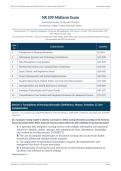
NR 599 Midterm Exam
Nursing Informatics for Advanced Practice
Chamberlain College | Latest 2026/2027 Edition
Total Questions: 75 | Cognitive Distribution: 25% Recall, 50% Application, 25% Analysis | Format: 75% Scenario-Based, 20%
Direct Recall, 5% Case Study
Time Allocation: 90 Minutes | Aligned with 2026-2027 ANA, HIMSS, TIGER, QSEN, ONC, and CMS standards including Promoting
Interoperability and TEFCA frameworks.
Secti
Content Domain Questions
on
1 Foundations of Nursing Informatics Q1-Q10
2 Information Systems and Technology in Healthcare Q11-Q20
3 Data Management and Analytics Q21-Q28
4 Nursing Information and Communication Technology Q29-Q35
5 Legal, Ethical, and Regulatory Issues Q36-Q42
6 Project Management and System Implementation Q43-Q50
7 Quality Improvement, Patient Safety, and Outcomes Measurement Q51-Q58
8 Interoperability and Health Information Exchange Q59-Q66
9 Emerging Technologies and Future Trends Q67-Q72
10 Comprehensive Case Studies and Integrated Scenarios for Advanced Practice Q73-Q75
Section 1: Foundations of Nursing Informatics (Definitions, History, Evolution, & Core
Competencies)
Questions 1-10 | Cognitive focus: ANA/HIMSS definitions, historical milestones, TIGER/QSEN competencies, informatics roles, and APRN
integration.
Q1: A graduate nursing student is asked by a preceptor to define nursing informatics according to the American
Nurses Association (ANA). Which statement most accurately reflects the ANA's definition of nursing informatics?
A. A specialty that integrates nursing science with multiple information and analytical
sciences to identify, define, manage, and communicate data, information, knowledge,
and wisdom in nursing practice. [CORRECT]
B. The use of computer technologies to document nursing care in electronic health
records for billing and reimbursement purposes.
C. The application of information technology to support the administrative and
managerial functions of nurse executives.
D. A subspecialty of nursing focused exclusively on the technical implementation of
hardware and software in clinical settings.
Correct Answer: A
Graduate-Level Advanced Practice Nursing Informatics Page 1
,NR 599: Nursing Informatics for Advanced Practice - Midterm Exam (2026/2027) Chamberlain College
Rationale: The ANA defines nursing informatics as a specialty that integrates nursing science with multiple information and
analytical sciences (computer, information, cognitive sciences) to identify, define, manage, and communicate data,
information, knowledge, and wisdom (DIKW) in nursing practice. Options B, C, and D are overly narrow, focusing on
documentation, administration, or technical implementation alone, and they omit the foundational DIKW framework that
anchors the discipline at the graduate level.
Q2: During a HIMSS webinar, an APRN asks how the HIMSS definition of informatics differs from the ANA
definition. Which response best reflects the HIMSS perspective?
A. HIMSS defines informatics solely as the use of EHRs to capture billing data for
hospital reimbursement.
B. HIMSS emphasizes informatics as an interdisciplinary field that optimizes health
outcomes through information technology, information management, and the
application of informatics principles across the entire health system. [CORRECT]
C. HIMSS limits informatics to nursing-specific applications within acute care hospitals
only.
D. HIMSS defines informatics as the study of computer hardware used exclusively by
clinical laboratory professionals.
Correct Answer: B
Rationale: HIMSS frames informatics as an interdisciplinary, systems-level discipline that leverages information technology
and information management to optimize health outcomes across the continuum of care. Unlike the ANA definition, which
is nursing-specific, the HIMSS perspective is broader and emphasizes cross-disciplinary integration. The distractors represent
common confusions that restrict informatics to billing, nursing-only settings, or hardware management, all of which
contradict the systems-level, interdisciplinary orientation emphasized at the graduate level.
Q3: A nursing informatics professor asks students to identify the most significant milestone in nursing
informatics during the 1960s. Which response is most accurate?
A. The widespread adoption of electronic health records in community hospitals.
B. The establishment of the Healthcare Information and Management Systems Society
(HIMSS).
C. The early use of computers for healthcare data processing, including the first
attempts to automate hospital business and patient care functions. [CORRECT]
D. The implementation of the Health Information Technology for Economic and Clinical
Health (HITECH) Act.
Correct Answer: C
Rationale: During the 1960s, healthcare organizations began experimenting with mainframe computers to automate
hospital business functions and some patient-care tasks, marking the genesis of nursing informatics. HIMSS was founded
later (1961, but its formative informatics role emerged in subsequent decades), HITECH was enacted in 2009, and
widespread EHR adoption did not occur until after the HITECH Act. Selecting option C demonstrates the chronological
understanding of informatics evolution expected at the graduate level.
Q4: An APRN is leading a task force to align nursing staff competencies with a national informatics initiative
launched in the 2000s to prepare nurses for technology-enabled practice. Which initiative is being referenced?
A. The Quality and Safety Education for Nurses (QSEN) initiative.
B. The Technology Informatics Guiding Education Reform (TIGER) initiative.
[CORRECT]
Graduate-Level Advanced Practice Nursing Informatics Page 2
, NR 599: Nursing Informatics for Advanced Practice - Midterm Exam (2026/2027) Chamberlain College
C. The Healthcare Information and Management Systems Society (HIMSS) Analytics
Stage 7 program.
D. The Medicare Access and CHIP Reauthorization Act (MACRA) Quality Payment
Program.
Correct Answer: B
Rationale: The TIGER Initiative, launched in 2004, was specifically created to prepare practicing nurses and nursing students
to use technology and informatics to enhance patient care. QSEN addresses broader quality and safety competencies (with
informatics as one of six), HIMSS Analytics Stage 7 measures EHR adoption maturity, and MACRA is a payment reform
program. The TIGER Initiative remains a cornerstone competency framework tested in graduate nursing informatics
curricula.
Q5: A graduate nursing student is preparing a presentation on the Quality and Safety Education for Nurses
(QSEN) competencies. Which competency is explicitly included as one of the six QSEN competencies and most
directly addresses nursing informatics?
A. Quality Improvement.
B. Evidence-Based Practice.
C. Informatics. [CORRECT]
D. Teamwork and Collaboration.
Correct Answer: C
Rationale: Informatics is one of the six QSEN competencies (alongside Patient-Centered Care, Teamwork and Collaboration,
Evidence-Based Practice, Quality Improvement, and Safety). The QSEN Informatics competency specifically expects nurses to
use information and technology to communicate, manage knowledge, mitigate error, and support decision-making. The
other listed competencies are valid QSEN categories, but only Informatics directly aligns with nursing informatics at the
graduate level.
Q6: A Chief Nursing Officer (CNO) is revising the organization's nursing informatics scope of practice based on the
ANA Scope and Standards of Practice. Which standard most directly addresses the informatics nurse's role in
identifying, collecting, and analyzing data?
A. Standard 1: Assessment. [CORRECT]
B. Standard 2: Diagnosis.
C. Standard 3: Outcomes Identification.
D. Standard 4: Planning.
Correct Answer: A
Rationale: In the ANA Nursing Informatics: Scope and Standards of Practice, Standard 1 (Assessment) directs the informatics
nurse to identify, collect, and analyze data relevant to the practice setting, project, or system. Diagnosis, Outcomes
Identification, and Planning are subsequent standards that build upon the data gathered in Assessment. Misapplying these
standards is a common error and reflects insufficient knowledge of the regulatory framework guiding informatics practice at
the advanced practice level.
Q7: A multi-hospital system is creating a new executive role to provide strategic nursing leadership for all health
information technology initiatives. Which position best fits this description?
A. Chief Information Officer (CIO).
B. Chief Nursing Informatics Officer (CNIO). [CORRECT]
C. Clinical Nurse Analyst.
D. Project Manager.
Graduate-Level Advanced Practice Nursing Informatics Page 3
NR 599 Midterm Exam
Nursing Informatics for Advanced Practice
Chamberlain College | Latest 2026/2027 Edition
Total Questions: 75 | Cognitive Distribution: 25% Recall, 50% Application, 25% Analysis | Format: 75% Scenario-Based, 20%
Direct Recall, 5% Case Study
Time Allocation: 90 Minutes | Aligned with 2026-2027 ANA, HIMSS, TIGER, QSEN, ONC, and CMS standards including Promoting
Interoperability and TEFCA frameworks.
Secti
Content Domain Questions
on
1 Foundations of Nursing Informatics Q1-Q10
2 Information Systems and Technology in Healthcare Q11-Q20
3 Data Management and Analytics Q21-Q28
4 Nursing Information and Communication Technology Q29-Q35
5 Legal, Ethical, and Regulatory Issues Q36-Q42
6 Project Management and System Implementation Q43-Q50
7 Quality Improvement, Patient Safety, and Outcomes Measurement Q51-Q58
8 Interoperability and Health Information Exchange Q59-Q66
9 Emerging Technologies and Future Trends Q67-Q72
10 Comprehensive Case Studies and Integrated Scenarios for Advanced Practice Q73-Q75
Section 1: Foundations of Nursing Informatics (Definitions, History, Evolution, & Core
Competencies)
Questions 1-10 | Cognitive focus: ANA/HIMSS definitions, historical milestones, TIGER/QSEN competencies, informatics roles, and APRN
integration.
Q1: A graduate nursing student is asked by a preceptor to define nursing informatics according to the American
Nurses Association (ANA). Which statement most accurately reflects the ANA's definition of nursing informatics?
A. A specialty that integrates nursing science with multiple information and analytical
sciences to identify, define, manage, and communicate data, information, knowledge,
and wisdom in nursing practice. [CORRECT]
B. The use of computer technologies to document nursing care in electronic health
records for billing and reimbursement purposes.
C. The application of information technology to support the administrative and
managerial functions of nurse executives.
D. A subspecialty of nursing focused exclusively on the technical implementation of
hardware and software in clinical settings.
Correct Answer: A
Graduate-Level Advanced Practice Nursing Informatics Page 1
,NR 599: Nursing Informatics for Advanced Practice - Midterm Exam (2026/2027) Chamberlain College
Rationale: The ANA defines nursing informatics as a specialty that integrates nursing science with multiple information and
analytical sciences (computer, information, cognitive sciences) to identify, define, manage, and communicate data,
information, knowledge, and wisdom (DIKW) in nursing practice. Options B, C, and D are overly narrow, focusing on
documentation, administration, or technical implementation alone, and they omit the foundational DIKW framework that
anchors the discipline at the graduate level.
Q2: During a HIMSS webinar, an APRN asks how the HIMSS definition of informatics differs from the ANA
definition. Which response best reflects the HIMSS perspective?
A. HIMSS defines informatics solely as the use of EHRs to capture billing data for
hospital reimbursement.
B. HIMSS emphasizes informatics as an interdisciplinary field that optimizes health
outcomes through information technology, information management, and the
application of informatics principles across the entire health system. [CORRECT]
C. HIMSS limits informatics to nursing-specific applications within acute care hospitals
only.
D. HIMSS defines informatics as the study of computer hardware used exclusively by
clinical laboratory professionals.
Correct Answer: B
Rationale: HIMSS frames informatics as an interdisciplinary, systems-level discipline that leverages information technology
and information management to optimize health outcomes across the continuum of care. Unlike the ANA definition, which
is nursing-specific, the HIMSS perspective is broader and emphasizes cross-disciplinary integration. The distractors represent
common confusions that restrict informatics to billing, nursing-only settings, or hardware management, all of which
contradict the systems-level, interdisciplinary orientation emphasized at the graduate level.
Q3: A nursing informatics professor asks students to identify the most significant milestone in nursing
informatics during the 1960s. Which response is most accurate?
A. The widespread adoption of electronic health records in community hospitals.
B. The establishment of the Healthcare Information and Management Systems Society
(HIMSS).
C. The early use of computers for healthcare data processing, including the first
attempts to automate hospital business and patient care functions. [CORRECT]
D. The implementation of the Health Information Technology for Economic and Clinical
Health (HITECH) Act.
Correct Answer: C
Rationale: During the 1960s, healthcare organizations began experimenting with mainframe computers to automate
hospital business functions and some patient-care tasks, marking the genesis of nursing informatics. HIMSS was founded
later (1961, but its formative informatics role emerged in subsequent decades), HITECH was enacted in 2009, and
widespread EHR adoption did not occur until after the HITECH Act. Selecting option C demonstrates the chronological
understanding of informatics evolution expected at the graduate level.
Q4: An APRN is leading a task force to align nursing staff competencies with a national informatics initiative
launched in the 2000s to prepare nurses for technology-enabled practice. Which initiative is being referenced?
A. The Quality and Safety Education for Nurses (QSEN) initiative.
B. The Technology Informatics Guiding Education Reform (TIGER) initiative.
[CORRECT]
Graduate-Level Advanced Practice Nursing Informatics Page 2
, NR 599: Nursing Informatics for Advanced Practice - Midterm Exam (2026/2027) Chamberlain College
C. The Healthcare Information and Management Systems Society (HIMSS) Analytics
Stage 7 program.
D. The Medicare Access and CHIP Reauthorization Act (MACRA) Quality Payment
Program.
Correct Answer: B
Rationale: The TIGER Initiative, launched in 2004, was specifically created to prepare practicing nurses and nursing students
to use technology and informatics to enhance patient care. QSEN addresses broader quality and safety competencies (with
informatics as one of six), HIMSS Analytics Stage 7 measures EHR adoption maturity, and MACRA is a payment reform
program. The TIGER Initiative remains a cornerstone competency framework tested in graduate nursing informatics
curricula.
Q5: A graduate nursing student is preparing a presentation on the Quality and Safety Education for Nurses
(QSEN) competencies. Which competency is explicitly included as one of the six QSEN competencies and most
directly addresses nursing informatics?
A. Quality Improvement.
B. Evidence-Based Practice.
C. Informatics. [CORRECT]
D. Teamwork and Collaboration.
Correct Answer: C
Rationale: Informatics is one of the six QSEN competencies (alongside Patient-Centered Care, Teamwork and Collaboration,
Evidence-Based Practice, Quality Improvement, and Safety). The QSEN Informatics competency specifically expects nurses to
use information and technology to communicate, manage knowledge, mitigate error, and support decision-making. The
other listed competencies are valid QSEN categories, but only Informatics directly aligns with nursing informatics at the
graduate level.
Q6: A Chief Nursing Officer (CNO) is revising the organization's nursing informatics scope of practice based on the
ANA Scope and Standards of Practice. Which standard most directly addresses the informatics nurse's role in
identifying, collecting, and analyzing data?
A. Standard 1: Assessment. [CORRECT]
B. Standard 2: Diagnosis.
C. Standard 3: Outcomes Identification.
D. Standard 4: Planning.
Correct Answer: A
Rationale: In the ANA Nursing Informatics: Scope and Standards of Practice, Standard 1 (Assessment) directs the informatics
nurse to identify, collect, and analyze data relevant to the practice setting, project, or system. Diagnosis, Outcomes
Identification, and Planning are subsequent standards that build upon the data gathered in Assessment. Misapplying these
standards is a common error and reflects insufficient knowledge of the regulatory framework guiding informatics practice at
the advanced practice level.
Q7: A multi-hospital system is creating a new executive role to provide strategic nursing leadership for all health
information technology initiatives. Which position best fits this description?
A. Chief Information Officer (CIO).
B. Chief Nursing Informatics Officer (CNIO). [CORRECT]
C. Clinical Nurse Analyst.
D. Project Manager.
Graduate-Level Advanced Practice Nursing Informatics Page 3


