

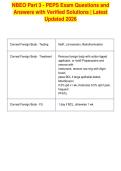
NBEO Part 3 - PEPS Exam Questions and
Answers with Verified Solutions | Latest
Updated 2026
Corneal Foreign Body - Testing NaFl, Lid eversion, Retroillumination
Corneal Foreign Body - Treatment Remove foreign body with cotton-tipped
applicator, or instill Proparacaine and
remove with
instrument, remove rust ring with Alger
brush,
place BCL if large epithelial defect,
Moxifloxacin
0.5% qid x1 wk, Ketorolac 0.5% qid if pain,
frequent
PFATs
Corneal Foreign Body - FU 1 day if BCL, otherwise 1 wk
,Corneal Foreign Body - Education You have a piece of metal in your that we
have
removed. We placed a bandage lens on
your eye
to help your cornea heal, so you need to
return
tomorrow so that we can remove it. We've
given
you an antibiotic to use 4x per day, and we
also
rcmnd using PFATs 6-8x throughout the
next
several days. In the future, it is important
to
remember to wear safety glasses when
working
with metal.
RCE/EBMD - Testing NaFl, Lid eversion
RCE/EBMD - Treatment Propraracaine and debride 1-2mm beyond
lesion,
Place BCL if not a previous CL wearer,
Moxifloxacin
0.5% qid x1 wk, Nacl 5% soln qid x2 wk
then taper
to qhs for 3 months, frequent PFATs
RCE/EBMD - FU 1 day for BCL, Otherwise 3-4 weeks
, RCE/EBMD - Education You have a condition called EBMD, in
which the
top layer of your cornea does not adhere
well to
the bottom layers. Sometimes, this can
lead to the
top layer of the cornea being ripped off,
leaving a
large abrasion. (OR - Because of a past
trauma to
your eye, the top layer of your cornea has
difficulty
staying adhered to the bottom layers). We
removed some of the top layer of your
cornea so
that it can heal properly, and placed a
bandage
lens to speed up the healing process. We
also gave
you an antibiotic to prevent any infection
while this
heals, and a drop that helps to dehydrate
the
cornea. This drop can help to prevent this
from
happening again, but may need to be
continued
for the next few months. If this recurs, you
should
return to our office.
Chemical Burn - Testing Irrigation for 15 mins, lid eversion and
irrigation/swabbing of fornices, Testing PH
with
litmus paper after 5 minutes (normal is
7-7.4), NaFl
Answers with Verified Solutions | Latest
Updated 2026
Corneal Foreign Body - Testing NaFl, Lid eversion, Retroillumination
Corneal Foreign Body - Treatment Remove foreign body with cotton-tipped
applicator, or instill Proparacaine and
remove with
instrument, remove rust ring with Alger
brush,
place BCL if large epithelial defect,
Moxifloxacin
0.5% qid x1 wk, Ketorolac 0.5% qid if pain,
frequent
PFATs
Corneal Foreign Body - FU 1 day if BCL, otherwise 1 wk
,Corneal Foreign Body - Education You have a piece of metal in your that we
have
removed. We placed a bandage lens on
your eye
to help your cornea heal, so you need to
return
tomorrow so that we can remove it. We've
given
you an antibiotic to use 4x per day, and we
also
rcmnd using PFATs 6-8x throughout the
next
several days. In the future, it is important
to
remember to wear safety glasses when
working
with metal.
RCE/EBMD - Testing NaFl, Lid eversion
RCE/EBMD - Treatment Propraracaine and debride 1-2mm beyond
lesion,
Place BCL if not a previous CL wearer,
Moxifloxacin
0.5% qid x1 wk, Nacl 5% soln qid x2 wk
then taper
to qhs for 3 months, frequent PFATs
RCE/EBMD - FU 1 day for BCL, Otherwise 3-4 weeks
, RCE/EBMD - Education You have a condition called EBMD, in
which the
top layer of your cornea does not adhere
well to
the bottom layers. Sometimes, this can
lead to the
top layer of the cornea being ripped off,
leaving a
large abrasion. (OR - Because of a past
trauma to
your eye, the top layer of your cornea has
difficulty
staying adhered to the bottom layers). We
removed some of the top layer of your
cornea so
that it can heal properly, and placed a
bandage
lens to speed up the healing process. We
also gave
you an antibiotic to prevent any infection
while this
heals, and a drop that helps to dehydrate
the
cornea. This drop can help to prevent this
from
happening again, but may need to be
continued
for the next few months. If this recurs, you
should
return to our office.
Chemical Burn - Testing Irrigation for 15 mins, lid eversion and
irrigation/swabbing of fornices, Testing PH
with
litmus paper after 5 minutes (normal is
7-7.4), NaFl


