
NASM CES Textbook Chapter 4 Exam
Questions and Answers with Verified
Solutions | Latest Updated 2026
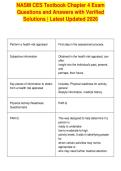
Perform a health risk appraisal First step in the assessment process.
Subjective information Obtained in the health risk appraisal, can
offer
insight into the individual's past, present,
and
perhaps, their future.
Key pieces of information to obtain Includes, Physical readiness for activity,
from a health risk appraisal general
lifestyle information, medical history.
Physical Activity Readiness PAR-Q
Questionnaire
PAR-Q This was designed to help determine if a
person is
ready to undertake
low-to-moderate-to-high
activity levels. It aids in identifying people
for
whom certain activities may not be
appropriate or
who may need further medical attention.
, General lifestyle information This includes occupation, and lifestyle
Occupation questions This includes, extended periods of sitting,
repetitive movements, dress shoes, mental
stress.
Extended periods of sitting (Lower This leads to a person's hips being flexed
body) for
prolonged periods of time. Which leads to
tight hip
flexors that can cause postural imbalances
within
the kinetic chain.
Extended periods of sitting (upper This leads to fatigue in the shoulders and
body) cervical
spine due to the constant weight of gravity.
Which
leads to postural imbalance of rounding of
the
shoulders and a forward head.
Repetitive Movements This can create a pattern overload to
muscles and
joints. Which may lead to tissue trauma
and
eventually kinetic chain dysfunction.
Questions and Answers with Verified
Solutions | Latest Updated 2026
Perform a health risk appraisal First step in the assessment process.
Subjective information Obtained in the health risk appraisal, can
offer
insight into the individual's past, present,
and
perhaps, their future.
Key pieces of information to obtain Includes, Physical readiness for activity,
from a health risk appraisal general
lifestyle information, medical history.
Physical Activity Readiness PAR-Q
Questionnaire
PAR-Q This was designed to help determine if a
person is
ready to undertake
low-to-moderate-to-high
activity levels. It aids in identifying people
for
whom certain activities may not be
appropriate or
who may need further medical attention.
, General lifestyle information This includes occupation, and lifestyle
Occupation questions This includes, extended periods of sitting,
repetitive movements, dress shoes, mental
stress.
Extended periods of sitting (Lower This leads to a person's hips being flexed
body) for
prolonged periods of time. Which leads to
tight hip
flexors that can cause postural imbalances
within
the kinetic chain.
Extended periods of sitting (upper This leads to fatigue in the shoulders and
body) cervical
spine due to the constant weight of gravity.
Which
leads to postural imbalance of rounding of
the
shoulders and a forward head.
Repetitive Movements This can create a pattern overload to
muscles and
joints. Which may lead to tissue trauma
and
eventually kinetic chain dysfunction.


