
NASM CES Textbook Chapter 6 Exam
Questions and Answers with Verified
Solutions | Latest Updated 2026
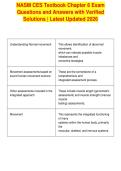
Understanding Normal movement This allows identification of abnormal
movement,
which can indicate possible muscle
imbalances and
corrective strategies.
Movement assessments based on These are the cornerstone of a
sound human movement science comprehensive and
integrated assessment process.
Other assessments included in the These include muscle length (goniometric
integrated approach assessment) and muscle strength (manual
muscle
testing) assessments.
Movement This represents the integrated functioning
of many
systems within the human body, primarily
the
muscular, skeletal, and nervous systems.
, Muscular, Skeletal and Nervous These systems form an interdependent
systems triad that,
when operating correctly, allows for
optimal
structural alignment, neuromuscular
control
(coordination), and movement.
Muscle balance Establishing normal length-tension
relationships,
which ensure proper length and strength of
each
muscle around a joint.
Kinetic Chain "Kinetic" denotes the force transference
from the
nervous system to the muscular and
skeletal
systems as well as from joint to joint, and
"chain"
refers to the interconnected linkage of all
joints in
the body.
Dysfunction This is a result of repetitive stress, impact
trauma,
disease, and sedentary lifestyle.
Questions and Answers with Verified
Solutions | Latest Updated 2026
Understanding Normal movement This allows identification of abnormal
movement,
which can indicate possible muscle
imbalances and
corrective strategies.
Movement assessments based on These are the cornerstone of a
sound human movement science comprehensive and
integrated assessment process.
Other assessments included in the These include muscle length (goniometric
integrated approach assessment) and muscle strength (manual
muscle
testing) assessments.
Movement This represents the integrated functioning
of many
systems within the human body, primarily
the
muscular, skeletal, and nervous systems.
, Muscular, Skeletal and Nervous These systems form an interdependent
systems triad that,
when operating correctly, allows for
optimal
structural alignment, neuromuscular
control
(coordination), and movement.
Muscle balance Establishing normal length-tension
relationships,
which ensure proper length and strength of
each
muscle around a joint.
Kinetic Chain "Kinetic" denotes the force transference
from the
nervous system to the muscular and
skeletal
systems as well as from joint to joint, and
"chain"
refers to the interconnected linkage of all
joints in
the body.
Dysfunction This is a result of repetitive stress, impact
trauma,
disease, and sedentary lifestyle.


