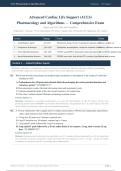
ACLS Pharmacology & Algorithms Exam 50 Questions · 2025 Aligned
Advanced Cardiac Life Support (ACLS)
Pharmacology and Algorithms — Comprehensive Exam
Aligned with 2025 AHA ACLS Guidelines
50 Questions · 4 Sections · 75% Scenario-Based, 25% Direct · Cognitive Mix: 30% Recall, 50% Application, 20% Analysis
Section Range Focus Items
1 — Antiarrhythmic Agents Q1–Q15 Mechanism, dosing, toxicity of amiodarone, lidocaine, adenosine,
15 atropine, etc.
2 — Vasopressors & Inotropes Q16–Q30 Epinephrine, norepinephrine, vasopressin, dopamine, dobutamine,
15 milrinone, infusion m
3 — ACLS Algorithm Integration Q31–Q45 VF/pVT, asystole/PEA, bradycardia, tachycardia algorithms;
15 post-ROSC; pediatric; preg
4 — Special Resuscitation Scenarios Q46–Q50 STEMI, acute stroke, beta-blocker/TCA overdose, hyperkalemia-induced
5 arrest
Section 1 — Antiarrhythmic Agents
Mechanism, indications, contraindications, dosing, and toxicity of amiodarone, lidocaine, adenosine, atropine, procainamide,
sotalol, ibutilide, magnesium, and related agents. Cognitive levels: recall, application, and analysis.
Q1. Which best describes the primary electrophysiologic mechanism of amiodarone in the setting of ventricular
fibrillation (VF)?
A. Predominant class III potassium-channel blockade prolonging the action potential duration and
refractory period **[CORRECT]**
B. Beta-adrenergic receptor blockade decreasing sinus node automaticity only
C. Calcium-channel blockade of the slow inward current in AV nodal tissue
D. Pure class I sodium-channel blockade terminating reentrant circuits
Correct Answer: A
Rationale: Amiodarone is classified predominantly as a class III antiarrhythmic; its anti-VF efficacy derives from
prolonging repolarization (APD/ERP) via potassium-channel blockade, with additional class I, II, and IV effects. The other
choices isolate only one minor action or the wrong dominant mechanism.
Q2. A 54-year-old presents with a regular narrow-complex tachycardia at 180/min and symptomatic hypotension.
After vagal maneuvers fail, which adenosine regimen is correct?
A. 12 mg slow IV push over 2 minutes, repeated once
B. 6 mg IV infusion over 10 minutes, repeated up to 3 times
C. 3 mg rapid IV push, followed by 6 mg if no response
D. 6 mg rapid IV push followed by a 20 mL saline flush; if no response, 12 mg, then a second 12 mg
dose **[CORRECT]**
Correct Answer: D
Rationale: Adenosine must be delivered as a rapid bolus (over 1–2 seconds) followed immediately by a 20 mL saline flush
into a proximal vein because its half-life is under 10 seconds. The correct sequence is 6 mg → 12 mg → 12 mg; slow pushes
or infusions are ineffective and the 3 mg starting dose is subtherapeutic.
Healthcare / Nursing — Advanced Cardiac Life Support Pharmacology Page 1
, ACLS Pharmacology & Algorithms Exam 50 Questions · 2025 Aligned
Q3. During a cardiac arrest with refractory VF after the third shock and the first 1 mg dose of epinephrine, what is
the appropriate amiodarone dose?
A. 75 mg IV push every 5 minutes up to 3 doses
B. 150 mg IV bolus over 10 minutes
C. 300 mg IV bolus, followed by 150 mg if VF/pVT persists after the next shock **[CORRECT]**
D. 450 mg IV infusion over 24 hours
Correct Answer: C
Rationale: For refractory VF/pulseless VT unresponsive to CPR, defibrillation, and vasopressor, the ACLS dose is 300 mg
IV/IO bolus followed by a single 150 mg bolus if arrhythmia persists. The 150 mg over 10 min dose is for stable
wide-complex tachycardia, not arrest.
Q4. A 67-year-old with refractory VF has just received amiodarone 300 mg. Lidocaine is being considered as an
alternative. Which statement best reflects the 2025 ACLS guidance?
A. Lidocaine and amiodarone should be administered together for synergistic effect
B. Lidocaine has been removed from the ACLS algorithm entirely
C. Lidocaine is preferred over amiodarone as the first-line antiarrhythmic in VF/pVT
D. Amiodarone is preferred first-line; lidocaine 1–1.5 mg/kg may be used as an alternative when
amiodarone is unavailable or contraindicated **[CORRECT]**
Correct Answer: D
Rationale: 2025 ACLS continues to recommend amiodarone as the preferred antiarrhythmic for refractory VF/pVT, with
lidocaine as an acceptable alternative. Combined administration increases toxicity (hypotension, seizures) and is not
recommended; lidocaine remains in the algorithm.
Q5. A 78-year-old woman has symptomatic sinus bradycardia at 32/min with hypotension and presyncope after
multiple nebulizer treatments. What is the correct initial atropine dose?
A. 0.5 mg subcutaneously every 10 minutes as needed
B. 2 mg IV bolus one time only
C. 0.5 mg IV push, repeated every 3–5 minutes to a maximum of 3 mg **[CORRECT]**
D. 1 mg IV push, repeated every 5 minutes to a maximum of 5 mg
Correct Answer: C
Rationale: The ACLS bradycardia algorithm specifies atropine 0.5 mg IV push every 3–5 minutes, maximum total 3 mg (at
which point the drug is fully vagolytic). Subcutaneous dosing is too slow; 1 mg increments risk paradoxical bradycardia; a
single 2 mg dose exceeds the recommended incremental dose.
Q6. An ICU nurse is preparing adenosine for an SVT patient with poor proximal IV access. Which action maximizes
the likelihood of terminating the arrhythmia?
A. Use the most proximal IV site available, push adenosine over 1–2 seconds, and immediately follow
with a 20 mL normal saline flush **[CORRECT]**
B. Dilute adenosine in 100 mL of D5W and infuse over 10 minutes
C. Administer adenosine through a central line filtered with a 0.22 micron filter
D. Inject adenosine slowly into a distal hand vein over 30 seconds
Correct Answer: A
Rationale: Because adenosine is metabolized by erythrocyte and endothelial adenosine deaminase with a half-life <10
seconds, it must reach the heart as a compact bolus: proximal IV site, rapid push, and immediate saline flush. Slow infusion
or distal injection allows complete degradation before arrival; filtration is unnecessary.
Healthcare / Nursing — Advanced Cardiac Life Support Pharmacology Page 2
Advanced Cardiac Life Support (ACLS)
Pharmacology and Algorithms — Comprehensive Exam
Aligned with 2025 AHA ACLS Guidelines
50 Questions · 4 Sections · 75% Scenario-Based, 25% Direct · Cognitive Mix: 30% Recall, 50% Application, 20% Analysis
Section Range Focus Items
1 — Antiarrhythmic Agents Q1–Q15 Mechanism, dosing, toxicity of amiodarone, lidocaine, adenosine,
15 atropine, etc.
2 — Vasopressors & Inotropes Q16–Q30 Epinephrine, norepinephrine, vasopressin, dopamine, dobutamine,
15 milrinone, infusion m
3 — ACLS Algorithm Integration Q31–Q45 VF/pVT, asystole/PEA, bradycardia, tachycardia algorithms;
15 post-ROSC; pediatric; preg
4 — Special Resuscitation Scenarios Q46–Q50 STEMI, acute stroke, beta-blocker/TCA overdose, hyperkalemia-induced
5 arrest
Section 1 — Antiarrhythmic Agents
Mechanism, indications, contraindications, dosing, and toxicity of amiodarone, lidocaine, adenosine, atropine, procainamide,
sotalol, ibutilide, magnesium, and related agents. Cognitive levels: recall, application, and analysis.
Q1. Which best describes the primary electrophysiologic mechanism of amiodarone in the setting of ventricular
fibrillation (VF)?
A. Predominant class III potassium-channel blockade prolonging the action potential duration and
refractory period **[CORRECT]**
B. Beta-adrenergic receptor blockade decreasing sinus node automaticity only
C. Calcium-channel blockade of the slow inward current in AV nodal tissue
D. Pure class I sodium-channel blockade terminating reentrant circuits
Correct Answer: A
Rationale: Amiodarone is classified predominantly as a class III antiarrhythmic; its anti-VF efficacy derives from
prolonging repolarization (APD/ERP) via potassium-channel blockade, with additional class I, II, and IV effects. The other
choices isolate only one minor action or the wrong dominant mechanism.
Q2. A 54-year-old presents with a regular narrow-complex tachycardia at 180/min and symptomatic hypotension.
After vagal maneuvers fail, which adenosine regimen is correct?
A. 12 mg slow IV push over 2 minutes, repeated once
B. 6 mg IV infusion over 10 minutes, repeated up to 3 times
C. 3 mg rapid IV push, followed by 6 mg if no response
D. 6 mg rapid IV push followed by a 20 mL saline flush; if no response, 12 mg, then a second 12 mg
dose **[CORRECT]**
Correct Answer: D
Rationale: Adenosine must be delivered as a rapid bolus (over 1–2 seconds) followed immediately by a 20 mL saline flush
into a proximal vein because its half-life is under 10 seconds. The correct sequence is 6 mg → 12 mg → 12 mg; slow pushes
or infusions are ineffective and the 3 mg starting dose is subtherapeutic.
Healthcare / Nursing — Advanced Cardiac Life Support Pharmacology Page 1
, ACLS Pharmacology & Algorithms Exam 50 Questions · 2025 Aligned
Q3. During a cardiac arrest with refractory VF after the third shock and the first 1 mg dose of epinephrine, what is
the appropriate amiodarone dose?
A. 75 mg IV push every 5 minutes up to 3 doses
B. 150 mg IV bolus over 10 minutes
C. 300 mg IV bolus, followed by 150 mg if VF/pVT persists after the next shock **[CORRECT]**
D. 450 mg IV infusion over 24 hours
Correct Answer: C
Rationale: For refractory VF/pulseless VT unresponsive to CPR, defibrillation, and vasopressor, the ACLS dose is 300 mg
IV/IO bolus followed by a single 150 mg bolus if arrhythmia persists. The 150 mg over 10 min dose is for stable
wide-complex tachycardia, not arrest.
Q4. A 67-year-old with refractory VF has just received amiodarone 300 mg. Lidocaine is being considered as an
alternative. Which statement best reflects the 2025 ACLS guidance?
A. Lidocaine and amiodarone should be administered together for synergistic effect
B. Lidocaine has been removed from the ACLS algorithm entirely
C. Lidocaine is preferred over amiodarone as the first-line antiarrhythmic in VF/pVT
D. Amiodarone is preferred first-line; lidocaine 1–1.5 mg/kg may be used as an alternative when
amiodarone is unavailable or contraindicated **[CORRECT]**
Correct Answer: D
Rationale: 2025 ACLS continues to recommend amiodarone as the preferred antiarrhythmic for refractory VF/pVT, with
lidocaine as an acceptable alternative. Combined administration increases toxicity (hypotension, seizures) and is not
recommended; lidocaine remains in the algorithm.
Q5. A 78-year-old woman has symptomatic sinus bradycardia at 32/min with hypotension and presyncope after
multiple nebulizer treatments. What is the correct initial atropine dose?
A. 0.5 mg subcutaneously every 10 minutes as needed
B. 2 mg IV bolus one time only
C. 0.5 mg IV push, repeated every 3–5 minutes to a maximum of 3 mg **[CORRECT]**
D. 1 mg IV push, repeated every 5 minutes to a maximum of 5 mg
Correct Answer: C
Rationale: The ACLS bradycardia algorithm specifies atropine 0.5 mg IV push every 3–5 minutes, maximum total 3 mg (at
which point the drug is fully vagolytic). Subcutaneous dosing is too slow; 1 mg increments risk paradoxical bradycardia; a
single 2 mg dose exceeds the recommended incremental dose.
Q6. An ICU nurse is preparing adenosine for an SVT patient with poor proximal IV access. Which action maximizes
the likelihood of terminating the arrhythmia?
A. Use the most proximal IV site available, push adenosine over 1–2 seconds, and immediately follow
with a 20 mL normal saline flush **[CORRECT]**
B. Dilute adenosine in 100 mL of D5W and infuse over 10 minutes
C. Administer adenosine through a central line filtered with a 0.22 micron filter
D. Inject adenosine slowly into a distal hand vein over 30 seconds
Correct Answer: A
Rationale: Because adenosine is metabolized by erythrocyte and endothelial adenosine deaminase with a half-life <10
seconds, it must reach the heart as a compact bolus: proximal IV site, rapid push, and immediate saline flush. Slow infusion
or distal injection allows complete degradation before arrival; filtration is unnecessary.
Healthcare / Nursing — Advanced Cardiac Life Support Pharmacology Page 2