
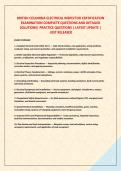
BRITISH COLUMBIA ELECTRICAL INSPECTOR CERTIFICATION
EXAMINATION COMPLETE QUESTIONS AND DETAILED
SOLUTIONS| PRACTICE QUESTIONS | LATEST UPDATE |
JUST RELEASED
EXAM COVERAGE:
1. Canadian Electrical Code (CEC), Part I — Code interpretation, rule application, wiring methods,
conductor sizing, overcurrent protection, and equipment installation requirements.
2. British Columbia Electrical Safety Regulation — Provincial legislation, enforcement requirements,
permits, certifications, and regulatory responsibilities.
3. Electrical Inspection Procedures — Inspection planning, documentation, defect identification,
correction notices, and approval processes.
4. Electrical Theory Fundamentals — Voltage, current, resistance, power, AC/DC principles, three-
phase systems, and electrical calculations.
5. Grounding and Bonding — Grounding electrode systems, bonding conductors, fault current paths,
and shock protection.
6. Electrical Equipment and Installations — Service equipment, switchgear, transformers, motors,
generators, distribution equipment, and special occupancies.
7. Occupational Safety Requirements — Arc flash awareness, lockout/tagout, PPE, energized work
limitations, and hazard assessment.
8. Special Electrical Installations — Hazardous locations, healthcare facilities, pools, marinas,
renewable energy systems, EV charging equipment, and emergency power.
9. Inspector Ethics and Professional Responsibilities — Code consistency, impartial inspections,
technical communication, documentation, and conflict resolution.
10. Plan Review and Code Interpretation — Blueprint review, load calculations, service sizing,
occupancy requirements, and application of code exceptions.
1
,SECTION 1: CANADIAN ELECTRICAL CODE (CEC), PART I (Questions 1-50)
Q1. What is the primary objective of the Canadian Electrical Code, Part I?
A) To promote energy efficiency
B) To establish safety standards for installation and maintenance of electrical
equipment
C) To regulate manufacturing of electrical products
D) To standardize utility distribution
Answer: B — The CEC is a safety standard focused on reducing fire and shock
hazards.
Q2. The Canadian Electrical Code, Part I is published by which organization?
A) NFPA
B) Standards Council of Canada
C) CSA Group
D) Electrical Safety Authority
Answer: C — CSA Group publishes the CEC as CSA C22.1.
Q3. In British Columbia, which edition of the CE Code is currently adopted under
the Electrical Safety Regulation?
A) 2021 CE Code
B) 2024 CE Code
C) 2018 CE Code
D) 2015 CE Code
Answer: B — The BC regulation adopts the 2024 CE Code.
Q4. The CE Code defines a "qualified person" as someone who:
A) Holds a journeyman certificate
B) Has knowledge and skills related to construction/operation of electrical
equipment and has received safety training
C) Is a licensed professional engineer
D) Is a registered electrical inspector
Answer: B — Qualification is based on knowledge, skill, and safety training.
2
,Q5. What is the minimum copper conductor size for a 100-ampere service in a
single-family dwelling?
A) 6 AWG
B) 4 AWG
C) 2 AWG
D) 1 AWG
Answer: C — 2 AWG copper is the standard minimum for 100A.
Q6. The maximum overcurrent device rating for a 14 AWG copper conductor in a
general branch circuit is:
A) 10 A
B) 15 A
C) 20 A
D) 25 A
Answer: B — 14 AWG is limited to 15A protection.
Q7. When more than three current-carrying conductors are installed in a raceway,
the ampacity correction factor for 4–6 conductors is:
A) 100%
B) 90%
C) 80%
D) 70%
Answer: C — 80% applies for 4-6 conductors.
Q8. A branch circuit supplying a continuous load must have conductor ampacity
of at least:
A) 100% of the load
B) 125% of the continuous load plus 100% of non-continuous load
C) 150% of the continuous load
D) 80% of the load
Answer: B — Continuous loads require a 125% sizing factor.
3
, Q9. The minimum clearance for overhead service conductors over a residential
driveway is:
A) 3.5 m
B) 4.0 m
C) 5.0 m
D) 6.0 m
Answer: B — 4.0 metres is the required clearance over driveways.
Q10. In a dwelling unit, the minimum number of small-appliance branch circuits
required for the kitchen is:
A) One
B) Two
C) Three
D) Four
Answer: B — Two 20A circuits are required for kitchen counter receptacles.
Q11. Which wiring method is permitted for direct burial in the ground?
A) NMD90
B) NMWU
C) T90
D) TW
Answer: B — NMWU (Non-Metallic Wet Underground) is rated for direct burial.
Q12. The maximum distance from a swimming pool to a receptacle that must be
GFCI protected is:
A) 1.0 m
B) 2.0 m
C) 3.0 m
D) 5.0 m
Answer: C — Receptacles within 3.0 m of the pool require GFCI.
Q13. A "multi-wire branch circuit" is defined as:
A) Two or more ungrounded conductors sharing a common neutral
4
EXAMINATION COMPLETE QUESTIONS AND DETAILED
SOLUTIONS| PRACTICE QUESTIONS | LATEST UPDATE |
JUST RELEASED
EXAM COVERAGE:
1. Canadian Electrical Code (CEC), Part I — Code interpretation, rule application, wiring methods,
conductor sizing, overcurrent protection, and equipment installation requirements.
2. British Columbia Electrical Safety Regulation — Provincial legislation, enforcement requirements,
permits, certifications, and regulatory responsibilities.
3. Electrical Inspection Procedures — Inspection planning, documentation, defect identification,
correction notices, and approval processes.
4. Electrical Theory Fundamentals — Voltage, current, resistance, power, AC/DC principles, three-
phase systems, and electrical calculations.
5. Grounding and Bonding — Grounding electrode systems, bonding conductors, fault current paths,
and shock protection.
6. Electrical Equipment and Installations — Service equipment, switchgear, transformers, motors,
generators, distribution equipment, and special occupancies.
7. Occupational Safety Requirements — Arc flash awareness, lockout/tagout, PPE, energized work
limitations, and hazard assessment.
8. Special Electrical Installations — Hazardous locations, healthcare facilities, pools, marinas,
renewable energy systems, EV charging equipment, and emergency power.
9. Inspector Ethics and Professional Responsibilities — Code consistency, impartial inspections,
technical communication, documentation, and conflict resolution.
10. Plan Review and Code Interpretation — Blueprint review, load calculations, service sizing,
occupancy requirements, and application of code exceptions.
1
,SECTION 1: CANADIAN ELECTRICAL CODE (CEC), PART I (Questions 1-50)
Q1. What is the primary objective of the Canadian Electrical Code, Part I?
A) To promote energy efficiency
B) To establish safety standards for installation and maintenance of electrical
equipment
C) To regulate manufacturing of electrical products
D) To standardize utility distribution
Answer: B — The CEC is a safety standard focused on reducing fire and shock
hazards.
Q2. The Canadian Electrical Code, Part I is published by which organization?
A) NFPA
B) Standards Council of Canada
C) CSA Group
D) Electrical Safety Authority
Answer: C — CSA Group publishes the CEC as CSA C22.1.
Q3. In British Columbia, which edition of the CE Code is currently adopted under
the Electrical Safety Regulation?
A) 2021 CE Code
B) 2024 CE Code
C) 2018 CE Code
D) 2015 CE Code
Answer: B — The BC regulation adopts the 2024 CE Code.
Q4. The CE Code defines a "qualified person" as someone who:
A) Holds a journeyman certificate
B) Has knowledge and skills related to construction/operation of electrical
equipment and has received safety training
C) Is a licensed professional engineer
D) Is a registered electrical inspector
Answer: B — Qualification is based on knowledge, skill, and safety training.
2
,Q5. What is the minimum copper conductor size for a 100-ampere service in a
single-family dwelling?
A) 6 AWG
B) 4 AWG
C) 2 AWG
D) 1 AWG
Answer: C — 2 AWG copper is the standard minimum for 100A.
Q6. The maximum overcurrent device rating for a 14 AWG copper conductor in a
general branch circuit is:
A) 10 A
B) 15 A
C) 20 A
D) 25 A
Answer: B — 14 AWG is limited to 15A protection.
Q7. When more than three current-carrying conductors are installed in a raceway,
the ampacity correction factor for 4–6 conductors is:
A) 100%
B) 90%
C) 80%
D) 70%
Answer: C — 80% applies for 4-6 conductors.
Q8. A branch circuit supplying a continuous load must have conductor ampacity
of at least:
A) 100% of the load
B) 125% of the continuous load plus 100% of non-continuous load
C) 150% of the continuous load
D) 80% of the load
Answer: B — Continuous loads require a 125% sizing factor.
3
, Q9. The minimum clearance for overhead service conductors over a residential
driveway is:
A) 3.5 m
B) 4.0 m
C) 5.0 m
D) 6.0 m
Answer: B — 4.0 metres is the required clearance over driveways.
Q10. In a dwelling unit, the minimum number of small-appliance branch circuits
required for the kitchen is:
A) One
B) Two
C) Three
D) Four
Answer: B — Two 20A circuits are required for kitchen counter receptacles.
Q11. Which wiring method is permitted for direct burial in the ground?
A) NMD90
B) NMWU
C) T90
D) TW
Answer: B — NMWU (Non-Metallic Wet Underground) is rated for direct burial.
Q12. The maximum distance from a swimming pool to a receptacle that must be
GFCI protected is:
A) 1.0 m
B) 2.0 m
C) 3.0 m
D) 5.0 m
Answer: C — Receptacles within 3.0 m of the pool require GFCI.
Q13. A "multi-wire branch circuit" is defined as:
A) Two or more ungrounded conductors sharing a common neutral
4


