

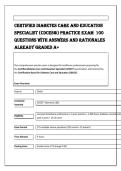
Certified diabetes Care and eduCation
speCialist (CdCes®) praCtiCe exam 100
Questions with answers and rationales
alreadY Graded a+
This comprehensive practice exam is designed for healthcare professionals preparing for
the Certified Diabetes Care and Education Specialist (CDCES®) examination, administered by
the Certification Board for Diabetes Care and Education (CBDCE) .
Exam Overview
Feature Detail
Credential
CDCES® (formerly CDE)
Awarded
Licensed healthcare professional + 2 years practice + 1,000 hours diabetes care/educatio
Eligibility
past 5 years + 15 CE hours
Exam Format 175 multiple-choice questions (150 scored + 25 pretest)
Time Allowed 4 hours
Passing Score Scaled score of 70 (range 0-99)
,Feature Detail
Cost $350
Renewal Every 5 years
Test
PSI Test Centers or Live Remote Proctoring
Administrator
Exam Content Outline (Effective July 1, 2024)
Domain Scored Questions
Assessment 37
Care/Education Interventions 105
Standards and Practices 8
SECTION 1: ASSESSMENT (Questions 1-37)
Question 1
A patient with type 2 diabetes presents with a fasting blood glucose of 180 mg/dL. Which of the
following is the most appropriate next step in the assessment process?
A. Initiate insulin therapy immediately
B. Assess the patient's current medication regimen, dietary patterns, and physical activity
C. Refer the patient to an endocrinologist
D. Repeat the fasting blood glucose test in one week
Answer: B
,Rationale: The assessment process for diabetes care requires evaluation of the patient's current
treatment regimen, lifestyle factors, and barriers to glycemic control. A comprehensive
assessment guides individualized intervention planning.
Question 2
Which of the following is the most reliable indicator of long-term glycemic control?
A. Fasting blood glucose
B. Postprandial blood glucose
C. Hemoglobin A1C
D. Random blood glucose
Answer: C
Rationale: Hemoglobin A1C reflects average blood glucose levels over the preceding 2-3 months
and is the gold standard for assessing long-term glycemic control.
Question 3
A patient reports frequent hypoglycemic episodes. Which of the following should the diabetes
care and education specialist assess first?
A. The patient's insulin injection technique
B. The patient's carbohydrate intake and timing of meals
C. The patient's medication regimen and timing
D. All of the above
Answer: D
Rationale: Hypoglycemia assessment requires evaluation of medication timing and dosing,
carbohydrate intake, physical activity, and insulin injection technique.
Question 4
The diabetes care and education specialist is assessing a patient with newly diagnosed type 2
diabetes. Which of the following is a key component of the initial assessment?
A. Assessment of cardiovascular risk factors
B. Assessment of the patient's readiness to learn
C. Assessment of psychosocial factors affecting diabetes management
D. All of the above
, Answer: D
Rationale: Initial assessment for diabetes includes evaluation of cardiovascular risk factors,
readiness to learn, psychosocial factors, and diabetes-related complications.
Question 5
A patient with type 1 diabetes reports that their blood glucose levels are consistently elevated
in the morning. Which of the following should the specialist assess to differentiate between the
Somogyi effect and dawn phenomenon?
A. The patient's bedtime snack
B. The patient's insulin pump settings
C. The patient's blood glucose levels between 2:00 AM and 4:00 AM
D. The patient's exercise routine
Answer: C
Rationale: The Somogyi effect is rebound hyperglycemia following nocturnal hypoglycemia.
Checking blood glucose levels between 2:00 AM and 4:00 AM helps differentiate between the
two conditions.
Question 6
When assessing a patient with diabetic neuropathy, which of the following is the most
appropriate screening tool?
A. Monofilament testing
B. Ankle-brachial index
C. Fundoscopic examination
D. Urinary albumin-to-creatinine ratio
Answer: A
Rationale: Monofilament testing assesses loss of protective sensation, which is a key indicator
of diabetic neuropathy.
Question 7
Which laboratory test is used to screen for diabetic kidney disease?
speCialist (CdCes®) praCtiCe exam 100
Questions with answers and rationales
alreadY Graded a+
This comprehensive practice exam is designed for healthcare professionals preparing for
the Certified Diabetes Care and Education Specialist (CDCES®) examination, administered by
the Certification Board for Diabetes Care and Education (CBDCE) .
Exam Overview
Feature Detail
Credential
CDCES® (formerly CDE)
Awarded
Licensed healthcare professional + 2 years practice + 1,000 hours diabetes care/educatio
Eligibility
past 5 years + 15 CE hours
Exam Format 175 multiple-choice questions (150 scored + 25 pretest)
Time Allowed 4 hours
Passing Score Scaled score of 70 (range 0-99)
,Feature Detail
Cost $350
Renewal Every 5 years
Test
PSI Test Centers or Live Remote Proctoring
Administrator
Exam Content Outline (Effective July 1, 2024)
Domain Scored Questions
Assessment 37
Care/Education Interventions 105
Standards and Practices 8
SECTION 1: ASSESSMENT (Questions 1-37)
Question 1
A patient with type 2 diabetes presents with a fasting blood glucose of 180 mg/dL. Which of the
following is the most appropriate next step in the assessment process?
A. Initiate insulin therapy immediately
B. Assess the patient's current medication regimen, dietary patterns, and physical activity
C. Refer the patient to an endocrinologist
D. Repeat the fasting blood glucose test in one week
Answer: B
,Rationale: The assessment process for diabetes care requires evaluation of the patient's current
treatment regimen, lifestyle factors, and barriers to glycemic control. A comprehensive
assessment guides individualized intervention planning.
Question 2
Which of the following is the most reliable indicator of long-term glycemic control?
A. Fasting blood glucose
B. Postprandial blood glucose
C. Hemoglobin A1C
D. Random blood glucose
Answer: C
Rationale: Hemoglobin A1C reflects average blood glucose levels over the preceding 2-3 months
and is the gold standard for assessing long-term glycemic control.
Question 3
A patient reports frequent hypoglycemic episodes. Which of the following should the diabetes
care and education specialist assess first?
A. The patient's insulin injection technique
B. The patient's carbohydrate intake and timing of meals
C. The patient's medication regimen and timing
D. All of the above
Answer: D
Rationale: Hypoglycemia assessment requires evaluation of medication timing and dosing,
carbohydrate intake, physical activity, and insulin injection technique.
Question 4
The diabetes care and education specialist is assessing a patient with newly diagnosed type 2
diabetes. Which of the following is a key component of the initial assessment?
A. Assessment of cardiovascular risk factors
B. Assessment of the patient's readiness to learn
C. Assessment of psychosocial factors affecting diabetes management
D. All of the above
, Answer: D
Rationale: Initial assessment for diabetes includes evaluation of cardiovascular risk factors,
readiness to learn, psychosocial factors, and diabetes-related complications.
Question 5
A patient with type 1 diabetes reports that their blood glucose levels are consistently elevated
in the morning. Which of the following should the specialist assess to differentiate between the
Somogyi effect and dawn phenomenon?
A. The patient's bedtime snack
B. The patient's insulin pump settings
C. The patient's blood glucose levels between 2:00 AM and 4:00 AM
D. The patient's exercise routine
Answer: C
Rationale: The Somogyi effect is rebound hyperglycemia following nocturnal hypoglycemia.
Checking blood glucose levels between 2:00 AM and 4:00 AM helps differentiate between the
two conditions.
Question 6
When assessing a patient with diabetic neuropathy, which of the following is the most
appropriate screening tool?
A. Monofilament testing
B. Ankle-brachial index
C. Fundoscopic examination
D. Urinary albumin-to-creatinine ratio
Answer: A
Rationale: Monofilament testing assesses loss of protective sensation, which is a key indicator
of diabetic neuropathy.
Question 7
Which laboratory test is used to screen for diabetic kidney disease?


