
classmerit.com — The Marketplace to Buy and Sell Study Materials
CRITICAL
CRITICAL CARE
CARE NURSING
NURSING DIAGNOSIS AND
AND MANAGEMENT
DIAGNOSISDiagnosis
MANAGEMENT 10TH
10TH EDITION
EDITION
Critical Care
TEST PAPER
Nursing:
CORRECT ANSWERS
and
TEST BANK EXAMPREP ACTUAL SOLVEDPREMIUM GUIDE
QUESTIONS CORRECT
Management (10thANSWERS Edition)
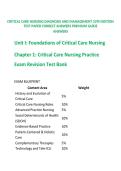
Unit I: Foundations of Critical Care Nursing
Chapter 1: Critical Care Nursing Practice
Exam Revision Test Bank
EXAM BLUEPRINT
Content Area Weight
History and Evolution of
5%
Critical Care
Critical Care Nursing Roles 10%
Advanced Practice Nursing 5%
Social Determinants of Health
10%
(SDOH)
Evidence-Based Practice 10%
Patient-Centered & Holistic
10%
Care
Complementary Therapies 5%
Technology and Tele-ICU 10%
Downloaded by: Want to earn $1,500
Distribution of this document is illegal extra per year?
, classmerit.com — The Marketplace to Buy and Sell Study Materials
Interprofessional
10%
Collaboration
Rapid Response Teams 10%
Quality & Safety 10%
Healthy Work Environment 5%
Type: MCQ
Bloom’s Level: Recall
Learning Objective: Define the historical development of critical
care nursing.
Chapter Reference: Critical Care Nursing Practice — History of
Critical Care
Difficulty: Easy
Question: Which development most directly supported the
emergence of modern critical care units?
A. Routine outpatient monitoring of stable patients
B. Concentration of invasive monitoring and life-support
technologies in one setting
C. Elimination of interdisciplinary care
D. Exclusive use of paper charting
Correct Answer: B
Downloaded by: Want to earn $1,500
Distribution of this document is illegal extra per year?
, classmerit.com — The Marketplace to Buy and Sell Study Materials
Rationale: Critical care evolved as hospitals concentrated highly
unstable patients, invasive monitoring, and advanced life-
support therapies in specialized units with trained staff.
Distractor Analysis:
A is incorrect because critical care is not outpatient-based.
C is incorrect because interdisciplinary collaboration is central
to critical care.
D is incorrect because documentation method does not define
the specialty.
Clinical Significance: Understanding the origin of critical care
explains why monitoring intensity, staffing expertise, and rapid
intervention are core ICU priorities.
Type: MCQ
Bloom’s Level: Comprehension
Learning Objective: Distinguish contemporary critical care from
earlier models of care.
Chapter Reference: Contemporary Critical Care
Difficulty: Moderate
Question: Which statement best reflects contemporary critical
care practice?
Downloaded by: Want to earn $1,500
Distribution of this document is illegal extra per year?
, classmerit.com — The Marketplace to Buy and Sell Study Materials
A. Care is delivered primarily by a single discipline with minimal
consultation.
B. Critical care focuses only on technology and hemodynamic
numbers.
C. Care integrates advanced monitoring, evidence-based
practice, and family-centered collaboration.
D. Critical care is limited to patients receiving mechanical
ventilation.
Correct Answer: C
Rationale: Modern critical care emphasizes technology plus
evidence-based, patient-centered, and collaborative care that
includes families when appropriate.
Distractor Analysis:
A is incorrect because interprofessional teamwork is essential.
B is incorrect because care includes holistic, psychosocial, and
ethical dimensions.
D is incorrect because many ICU patients do not require
ventilation.
Clinical Significance: Contemporary ICU nursing requires
balancing physiologic stabilization with communication,
coordination, and family engagement.
Type: SATA
Downloaded by: Want to earn $1,500
Distribution of this document is illegal extra per year?
CRITICAL
CRITICAL CARE
CARE NURSING
NURSING DIAGNOSIS AND
AND MANAGEMENT
DIAGNOSISDiagnosis
MANAGEMENT 10TH
10TH EDITION
EDITION
Critical Care
TEST PAPER
Nursing:
CORRECT ANSWERS
and
TEST BANK EXAMPREP ACTUAL SOLVEDPREMIUM GUIDE
QUESTIONS CORRECT
Management (10thANSWERS Edition)
Unit I: Foundations of Critical Care Nursing
Chapter 1: Critical Care Nursing Practice
Exam Revision Test Bank
EXAM BLUEPRINT
Content Area Weight
History and Evolution of
5%
Critical Care
Critical Care Nursing Roles 10%
Advanced Practice Nursing 5%
Social Determinants of Health
10%
(SDOH)
Evidence-Based Practice 10%
Patient-Centered & Holistic
10%
Care
Complementary Therapies 5%
Technology and Tele-ICU 10%
Downloaded by: Want to earn $1,500
Distribution of this document is illegal extra per year?
, classmerit.com — The Marketplace to Buy and Sell Study Materials
Interprofessional
10%
Collaboration
Rapid Response Teams 10%
Quality & Safety 10%
Healthy Work Environment 5%
Type: MCQ
Bloom’s Level: Recall
Learning Objective: Define the historical development of critical
care nursing.
Chapter Reference: Critical Care Nursing Practice — History of
Critical Care
Difficulty: Easy
Question: Which development most directly supported the
emergence of modern critical care units?
A. Routine outpatient monitoring of stable patients
B. Concentration of invasive monitoring and life-support
technologies in one setting
C. Elimination of interdisciplinary care
D. Exclusive use of paper charting
Correct Answer: B
Downloaded by: Want to earn $1,500
Distribution of this document is illegal extra per year?
, classmerit.com — The Marketplace to Buy and Sell Study Materials
Rationale: Critical care evolved as hospitals concentrated highly
unstable patients, invasive monitoring, and advanced life-
support therapies in specialized units with trained staff.
Distractor Analysis:
A is incorrect because critical care is not outpatient-based.
C is incorrect because interdisciplinary collaboration is central
to critical care.
D is incorrect because documentation method does not define
the specialty.
Clinical Significance: Understanding the origin of critical care
explains why monitoring intensity, staffing expertise, and rapid
intervention are core ICU priorities.
Type: MCQ
Bloom’s Level: Comprehension
Learning Objective: Distinguish contemporary critical care from
earlier models of care.
Chapter Reference: Contemporary Critical Care
Difficulty: Moderate
Question: Which statement best reflects contemporary critical
care practice?
Downloaded by: Want to earn $1,500
Distribution of this document is illegal extra per year?
, classmerit.com — The Marketplace to Buy and Sell Study Materials
A. Care is delivered primarily by a single discipline with minimal
consultation.
B. Critical care focuses only on technology and hemodynamic
numbers.
C. Care integrates advanced monitoring, evidence-based
practice, and family-centered collaboration.
D. Critical care is limited to patients receiving mechanical
ventilation.
Correct Answer: C
Rationale: Modern critical care emphasizes technology plus
evidence-based, patient-centered, and collaborative care that
includes families when appropriate.
Distractor Analysis:
A is incorrect because interprofessional teamwork is essential.
B is incorrect because care includes holistic, psychosocial, and
ethical dimensions.
D is incorrect because many ICU patients do not require
ventilation.
Clinical Significance: Contemporary ICU nursing requires
balancing physiologic stabilization with communication,
coordination, and family engagement.
Type: SATA
Downloaded by: Want to earn $1,500
Distribution of this document is illegal extra per year?


