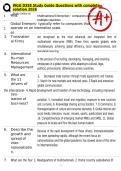
WGU D358 Study Guide Questions with complete
solution 2026
Study online at
1 MNE Multinational Enterprises - companies opperating in
. multiple countries
Global Enterpris- typically refer to companies that
2 operate on an internation scale.
. es
3. Transnation are recognized as the most advanced and integrated form of
al Firms multinational enter-prise (MNE). These firms operate globally while
simultaneously achieving global eflciency, local responsiveness, and
worldwide learning.
4. International
Hu-man is the process of recruiting, developing, managing, and retaining
Resources employees in a global context, while adapting to cultural, legal,
Management political, and economic ditterences across countries.
5. What are 1. Decreased trade barriers through trade agreements and treaties.
the 11 2. Search for new markets and reduced costs. 3 Rapid and extensive
drivers of global communication.
the international- 4. Rapid development and transfer of new technology, including improved
trans-
ization of portation. 5. Increadsed travel and migration, exposure to new countries
busi-ness? and cul-tures. 6. Knowledge sharing across borders. 7. E-Commerce. 8.
Homogenization of culture and consumer demands. 9. Global Internet and
social media, television, music, moveis, sports, publications and news.
10. Competitiveness of emerging market MNEs and SMEs, 11. Global
pressure to locate and hire the best human talent.
6. Describe the Because of the rapid development of these drivers, internationalization
growth and
has been spreading rapidly, although the recent focus on
spread of
nationalization and the global pandemic has slowed some of this drive
inter-
to internationalize.
nationalizatio
n.
7. What are the four 1. Headquarters of multinationals. 2. Home country subsidiaries of
, foreign-owned
different settings firms. 3. domestic firms (e.g. immigrant employees) 4. Government agencies
of and non-governmental organizations. Setting Scope HR
international FocusDomestic One country National workforce, domestic HR
resource man- lawsInternational Exports only Occasional global
agement? assignmentsMultinational (MNE) Multiple countries Local adaptation,
regional
, WGU D358 Study Guide
HR practicesGlobal/Transnational Fully integrated worldwide
Global strategy with local flexibility
8 What are the both terms refer to the ever-increasing interaction,
. similarities connectedness, and integra-
tween
be- tion of individuals,
12. What does companies, countries and cultures.
a HR professional working in
globaliza-tion the
vs. interna- headquarters of a multinational
tionalization? organization do?
9. Who tracks
the world's
Transna-tional
Corpora-tions
(TNCs)?
10. What does a
HR
professional
working in a
do-mestic
firm do?
11. What does a
HR
profession-al
working in
a home
coun-try
subsidiaries
of foreign-
owned firms
do?
, HR professional working at the headquarters (HQ) of a multinational
organization (MNO) plays a strategic and global coordination role.
Their work influences HR operations across all international
subsidiaries and regions. These HR profession-als are based at the
The United Nations Conference global HQ (often in the MNO's home country) and oversee or support
on Trade and Development
HR functions company-wide, including subsidiaries in multiple countries.
An HR professional in a
domestic firm manages the
human resource functions
within a single country,
operating under one
national legal system, one
culture, and usually one
language.
These HR professionals
work for a subsidiary
located in their own
country, but the
headquarters (HQ) is based
abroad. They must balance
local compliance and
culture with the
expectations of the foreign
parent company.
solution 2026
Study online at
1 MNE Multinational Enterprises - companies opperating in
. multiple countries
Global Enterpris- typically refer to companies that
2 operate on an internation scale.
. es
3. Transnation are recognized as the most advanced and integrated form of
al Firms multinational enter-prise (MNE). These firms operate globally while
simultaneously achieving global eflciency, local responsiveness, and
worldwide learning.
4. International
Hu-man is the process of recruiting, developing, managing, and retaining
Resources employees in a global context, while adapting to cultural, legal,
Management political, and economic ditterences across countries.
5. What are 1. Decreased trade barriers through trade agreements and treaties.
the 11 2. Search for new markets and reduced costs. 3 Rapid and extensive
drivers of global communication.
the international- 4. Rapid development and transfer of new technology, including improved
trans-
ization of portation. 5. Increadsed travel and migration, exposure to new countries
busi-ness? and cul-tures. 6. Knowledge sharing across borders. 7. E-Commerce. 8.
Homogenization of culture and consumer demands. 9. Global Internet and
social media, television, music, moveis, sports, publications and news.
10. Competitiveness of emerging market MNEs and SMEs, 11. Global
pressure to locate and hire the best human talent.
6. Describe the Because of the rapid development of these drivers, internationalization
growth and
has been spreading rapidly, although the recent focus on
spread of
nationalization and the global pandemic has slowed some of this drive
inter-
to internationalize.
nationalizatio
n.
7. What are the four 1. Headquarters of multinationals. 2. Home country subsidiaries of
, foreign-owned
different settings firms. 3. domestic firms (e.g. immigrant employees) 4. Government agencies
of and non-governmental organizations. Setting Scope HR
international FocusDomestic One country National workforce, domestic HR
resource man- lawsInternational Exports only Occasional global
agement? assignmentsMultinational (MNE) Multiple countries Local adaptation,
regional
, WGU D358 Study Guide
HR practicesGlobal/Transnational Fully integrated worldwide
Global strategy with local flexibility
8 What are the both terms refer to the ever-increasing interaction,
. similarities connectedness, and integra-
tween
be- tion of individuals,
12. What does companies, countries and cultures.
a HR professional working in
globaliza-tion the
vs. interna- headquarters of a multinational
tionalization? organization do?
9. Who tracks
the world's
Transna-tional
Corpora-tions
(TNCs)?
10. What does a
HR
professional
working in a
do-mestic
firm do?
11. What does a
HR
profession-al
working in
a home
coun-try
subsidiaries
of foreign-
owned firms
do?
, HR professional working at the headquarters (HQ) of a multinational
organization (MNO) plays a strategic and global coordination role.
Their work influences HR operations across all international
subsidiaries and regions. These HR profession-als are based at the
The United Nations Conference global HQ (often in the MNO's home country) and oversee or support
on Trade and Development
HR functions company-wide, including subsidiaries in multiple countries.
An HR professional in a
domestic firm manages the
human resource functions
within a single country,
operating under one
national legal system, one
culture, and usually one
language.
These HR professionals
work for a subsidiary
located in their own
country, but the
headquarters (HQ) is based
abroad. They must balance
local compliance and
culture with the
expectations of the foreign
parent company.