

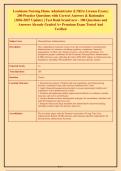
Louisiana Nursing Home Administrator (LNHA) License Exam |
200 Practice Questions with Correct Answers & Rationales
(2026-2027 Update) | Test Bank brand new - 180 Questions and
Answers Already Graded A+ Premium Exam Tested And
Verified
Subject Area Nursing Home Administration
Description This comprehensive practice exam covers the core domains of nursing home
administration in Louisiana, including regulatory compliance, financial
management, resident care, human resources, and facility operations. It is
designed to prepare candidates for the Louisiana Nursing Home Administrator
(LNHA) license exam, reflecting the latest 2026-2027 updates to federal and state
regulations, including CMS guidelines and Louisiana-specific statutes.
Expected Grade A+
Total Questions 180
Duration 3 hours
Learning Outcomes 1. Demonstrate mastery of federal and state regulations governing nursing
facilities, including F-tags and Louisiana Administrative Code.
2. Apply financial management principles to ensure operational viability and
compliance with reimbursement systems.
3. Evaluate and implement quality improvement initiatives to enhance resident
outcomes and survey performance.
4. Analyze human resource management strategies for recruitment, retention, and
staff development in long-term care.
5. Integrate ethical and legal standards into administrative decision-making,
including resident rights and advance directives.
Accreditation This test bank aligns with the National Association of Long Term Care
Administrator Boards (NAB) domains and Louisiana-specific requirements for
nursing home administrator licensure.
Page 1
,1. A nursing home administrator is reviewing the facility's compliance with the
Centers for Medicare & Medicaid Services (CMS) requirements for the Minimum
Data Set (MDS) 3.0. Which of the following actions would most likely result in a
deficiency citation for failure to comply with MDS requirements?
Answer: Failing to electronically submit the MDS assessment within 7 days after
completion.
CMS requires MDS assessments to be submitted electronically within 7 days of
completion. Failure to meet this deadline can result in a deficiency citation. Options A,
B, and D are all compliant practices: MDS must be completed within 14 days of
admission, an RN must coordinate the process, and the assessment must be signed and
certified by the RN coordinator.
2. A nursing home is considering implementing a new staffing model to improve
resident outcomes. Based on the latest research on nurse staffing in nursing homes,
which of the following strategies is most strongly associated with reducing hospital
readmissions?
Answer: Ensuring that at least 50% of direct care hours are provided by registered
nurses (RNs).
Research indicates that higher RN staffing levels are associated with lower hospital
readmission rates in nursing homes. A minimum of 0.75 RN hours per resident day is
often cited, but having RNs provide a substantial proportion of direct care (e.g., 50% of
total nursing hours) is linked to better outcomes. Increasing LPN ratios (A) does not
have the same evidence base. Mandatory overtime (C) can lead to burnout and errors.
Financial incentives for satisfaction (D) may not directly impact readmissions.
3. A facility's quality assurance and performance improvement (QAPI) committee is
evaluating a recent increase in urinary tract infections (UTIs) among residents.
Which of the following actions should the committee prioritize?
Answer: Reviewing the facility's antibiotic stewardship program and ensuring it
aligns with the latest CDC Core Elements.
The QAPI process should focus on systemic improvement. Reviewing the antibiotic
stewardship program is a high-priority action because inappropriate antibiotic use is a
major driver of UTIs and antibiotic resistance. The CDC Core Elements provide a
framework for optimizing antibiotic use. Option A is a clinical decision that should be
based on guidelines, not a QAPI priority. Option C is not evidence-based and may
cause skin irritation. Option D could be part of the analysis but is less impactful than
addressing the underlying stewardship program.
Page 2
,4. A nursing home administrator is preparing for a survey by the Louisiana
Department of Health. Which of the following is the most important action to ensure
compliance with the Emergency Preparedness Requirements for nursing homes
participating in Medicare and Medicaid?
Answer: Ensuring that the emergency plan includes provisions for the care of
residents with dementia during a disaster.
CMS emergency preparedness requirements mandate that facilities must address the
needs of all residents, including those with special needs such as dementia. While
annual exercises (A) and staff training (B) are required, they are not the most critical
element for compliance. Monthly testing of emergency power (D) is a requirement, but
the question asks for the 'most important action' to ensure compliance, and addressing
the needs of vulnerable populations is a key focus of surveyors.
5. A resident in a nursing home has a diagnosis of Alzheimer's disease and exhibits
aggressive behavior. The interdisciplinary team is considering the use of
antipsychotic medications. According to the latest CMS guidelines, which of the
following must be documented in the medical record before initiating an
antipsychotic?
Answer: A diagnosis of a specific psychotic disorder, such as schizophrenia or
bipolar disorder.
CMS regulations require that antipsychotic medications be used only for residents with
a specific diagnosed condition (e.g., schizophrenia, Tourette's syndrome, Huntington's
disease) or for short-term use for documented medical reasons. Off-label use for
behavioral symptoms of dementia is subject to strict scrutiny. Option B is not a CMS
requirement, though non-pharmacological approaches are encouraged. Option C is
generally required for any medication but not specifically for antipsychotics. Option D
may be a facility policy but is not a federal requirement.
Page 3
, 6. A nursing home administrator is analyzing the facility's financial statements and
notes that the current ratio has declined from 2.0 to 1.2 over the past year. Which of
the following is the most likely interpretation of this change?
Answer: The facility may have difficulty paying its short-term debts as they come
due.
The current ratio (current assets / current liabilities) measures liquidity. A ratio below
1.5 is often considered a warning sign, and a decline from 2.0 to 1.2 suggests worsening
liquidity, meaning the facility may struggle to meet short-term obligations. Option A is
the opposite. Option C is not directly indicated by the current ratio, as long-term debt is
not part of the calculation. Option D could affect retained earnings but does not directly
explain the current ratio change.
7. A nursing home administrator is reviewing the facility's compliance with the
Health Insurance Portability and Accountability Act (HIPAA). Which of the
following scenarios would constitute a breach of protected health information (PHI)
requiring notification to affected individuals?
Answer: A nurse accidentally leaves a resident's paper chart in the break room,
where it is found by another staff member who returns it immediately.
Under HIPAA, a breach is an impermissible use or disclosure of PHI that compromises
its security or privacy. In option A, the chart was left unattended and accessed by an
unauthorized person (even if returned), so it is a breach requiring notification unless a
risk assessment demonstrates low probability of compromise. Option B is permissible
because the durable power of attorney allows disclosure. Option C is with
authorization. Option D is incidental and not considered a breach if the nurse took
reasonable precautions.
8. A nursing home is developing a policy for the use of physical restraints. Which of
the following statements best reflects the current regulatory standards for physical
restraint use in nursing homes?
Answer: Physical restraints may be used as a last resort for residents who pose a
danger to themselves or others.
CMS regulations state that physical restraints should be used only when necessary to
treat a resident's medical symptoms and as a last resort after non-pharmacological
interventions have failed. Option B is explicitly prohibited. Option C is incorrect; there
is no 24-hour discontinuation rule; restraints must be reviewed and renewed according
to facility policy and state law. Option D is partially correct but not the best answer;
restraints must be ordered by a physician, but renewal periods are typically more
frequent than 30 days (e.g., every 24 hours or as per facility policy).
Page 4
200 Practice Questions with Correct Answers & Rationales
(2026-2027 Update) | Test Bank brand new - 180 Questions and
Answers Already Graded A+ Premium Exam Tested And
Verified
Subject Area Nursing Home Administration
Description This comprehensive practice exam covers the core domains of nursing home
administration in Louisiana, including regulatory compliance, financial
management, resident care, human resources, and facility operations. It is
designed to prepare candidates for the Louisiana Nursing Home Administrator
(LNHA) license exam, reflecting the latest 2026-2027 updates to federal and state
regulations, including CMS guidelines and Louisiana-specific statutes.
Expected Grade A+
Total Questions 180
Duration 3 hours
Learning Outcomes 1. Demonstrate mastery of federal and state regulations governing nursing
facilities, including F-tags and Louisiana Administrative Code.
2. Apply financial management principles to ensure operational viability and
compliance with reimbursement systems.
3. Evaluate and implement quality improvement initiatives to enhance resident
outcomes and survey performance.
4. Analyze human resource management strategies for recruitment, retention, and
staff development in long-term care.
5. Integrate ethical and legal standards into administrative decision-making,
including resident rights and advance directives.
Accreditation This test bank aligns with the National Association of Long Term Care
Administrator Boards (NAB) domains and Louisiana-specific requirements for
nursing home administrator licensure.
Page 1
,1. A nursing home administrator is reviewing the facility's compliance with the
Centers for Medicare & Medicaid Services (CMS) requirements for the Minimum
Data Set (MDS) 3.0. Which of the following actions would most likely result in a
deficiency citation for failure to comply with MDS requirements?
Answer: Failing to electronically submit the MDS assessment within 7 days after
completion.
CMS requires MDS assessments to be submitted electronically within 7 days of
completion. Failure to meet this deadline can result in a deficiency citation. Options A,
B, and D are all compliant practices: MDS must be completed within 14 days of
admission, an RN must coordinate the process, and the assessment must be signed and
certified by the RN coordinator.
2. A nursing home is considering implementing a new staffing model to improve
resident outcomes. Based on the latest research on nurse staffing in nursing homes,
which of the following strategies is most strongly associated with reducing hospital
readmissions?
Answer: Ensuring that at least 50% of direct care hours are provided by registered
nurses (RNs).
Research indicates that higher RN staffing levels are associated with lower hospital
readmission rates in nursing homes. A minimum of 0.75 RN hours per resident day is
often cited, but having RNs provide a substantial proportion of direct care (e.g., 50% of
total nursing hours) is linked to better outcomes. Increasing LPN ratios (A) does not
have the same evidence base. Mandatory overtime (C) can lead to burnout and errors.
Financial incentives for satisfaction (D) may not directly impact readmissions.
3. A facility's quality assurance and performance improvement (QAPI) committee is
evaluating a recent increase in urinary tract infections (UTIs) among residents.
Which of the following actions should the committee prioritize?
Answer: Reviewing the facility's antibiotic stewardship program and ensuring it
aligns with the latest CDC Core Elements.
The QAPI process should focus on systemic improvement. Reviewing the antibiotic
stewardship program is a high-priority action because inappropriate antibiotic use is a
major driver of UTIs and antibiotic resistance. The CDC Core Elements provide a
framework for optimizing antibiotic use. Option A is a clinical decision that should be
based on guidelines, not a QAPI priority. Option C is not evidence-based and may
cause skin irritation. Option D could be part of the analysis but is less impactful than
addressing the underlying stewardship program.
Page 2
,4. A nursing home administrator is preparing for a survey by the Louisiana
Department of Health. Which of the following is the most important action to ensure
compliance with the Emergency Preparedness Requirements for nursing homes
participating in Medicare and Medicaid?
Answer: Ensuring that the emergency plan includes provisions for the care of
residents with dementia during a disaster.
CMS emergency preparedness requirements mandate that facilities must address the
needs of all residents, including those with special needs such as dementia. While
annual exercises (A) and staff training (B) are required, they are not the most critical
element for compliance. Monthly testing of emergency power (D) is a requirement, but
the question asks for the 'most important action' to ensure compliance, and addressing
the needs of vulnerable populations is a key focus of surveyors.
5. A resident in a nursing home has a diagnosis of Alzheimer's disease and exhibits
aggressive behavior. The interdisciplinary team is considering the use of
antipsychotic medications. According to the latest CMS guidelines, which of the
following must be documented in the medical record before initiating an
antipsychotic?
Answer: A diagnosis of a specific psychotic disorder, such as schizophrenia or
bipolar disorder.
CMS regulations require that antipsychotic medications be used only for residents with
a specific diagnosed condition (e.g., schizophrenia, Tourette's syndrome, Huntington's
disease) or for short-term use for documented medical reasons. Off-label use for
behavioral symptoms of dementia is subject to strict scrutiny. Option B is not a CMS
requirement, though non-pharmacological approaches are encouraged. Option C is
generally required for any medication but not specifically for antipsychotics. Option D
may be a facility policy but is not a federal requirement.
Page 3
, 6. A nursing home administrator is analyzing the facility's financial statements and
notes that the current ratio has declined from 2.0 to 1.2 over the past year. Which of
the following is the most likely interpretation of this change?
Answer: The facility may have difficulty paying its short-term debts as they come
due.
The current ratio (current assets / current liabilities) measures liquidity. A ratio below
1.5 is often considered a warning sign, and a decline from 2.0 to 1.2 suggests worsening
liquidity, meaning the facility may struggle to meet short-term obligations. Option A is
the opposite. Option C is not directly indicated by the current ratio, as long-term debt is
not part of the calculation. Option D could affect retained earnings but does not directly
explain the current ratio change.
7. A nursing home administrator is reviewing the facility's compliance with the
Health Insurance Portability and Accountability Act (HIPAA). Which of the
following scenarios would constitute a breach of protected health information (PHI)
requiring notification to affected individuals?
Answer: A nurse accidentally leaves a resident's paper chart in the break room,
where it is found by another staff member who returns it immediately.
Under HIPAA, a breach is an impermissible use or disclosure of PHI that compromises
its security or privacy. In option A, the chart was left unattended and accessed by an
unauthorized person (even if returned), so it is a breach requiring notification unless a
risk assessment demonstrates low probability of compromise. Option B is permissible
because the durable power of attorney allows disclosure. Option C is with
authorization. Option D is incidental and not considered a breach if the nurse took
reasonable precautions.
8. A nursing home is developing a policy for the use of physical restraints. Which of
the following statements best reflects the current regulatory standards for physical
restraint use in nursing homes?
Answer: Physical restraints may be used as a last resort for residents who pose a
danger to themselves or others.
CMS regulations state that physical restraints should be used only when necessary to
treat a resident's medical symptoms and as a last resort after non-pharmacological
interventions have failed. Option B is explicitly prohibited. Option C is incorrect; there
is no 24-hour discontinuation rule; restraints must be reviewed and renewed according
to facility policy and state law. Option D is partially correct but not the best answer;
restraints must be ordered by a physician, but renewal periods are typically more
frequent than 30 days (e.g., every 24 hours or as per facility policy).
Page 4


