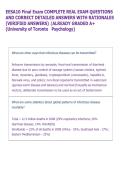
EESA10 Final Exam COMPLETE REAL EXAM QUESTIONS
AND CORRECT DETAILED ANSWERS WITH RATIONALES
(VERIFIED ANSWERS) |ALREADY GRADED A+
(University of Toronto Psychology)
What are other ways that infectious diseases can be transmitted?
Airborne transmission by aerosols; fecal-oral transmission of diarrheal
disease due to poor control of sewage system (causes cholera, typhoid
fever, dysentery, giardiasis, cryptosporidium (zoonosesto), hepatitis A,
Norwalk virus, and polio); non-fecal organisms transmitted in water/soil
(guinea worm disease and tetanus) and via food (housefly as mechanical
vector); deliberate transmission to be used as an act of bioterrorism
What are some statistics about global patterns of infectious disease
mortality?
Total ~ 12.3 million deaths in 2008 (29% respiratory infections; 20%
diarrheal disease; 14% HIV/AIDS)
Worldwide ~ 22% of all deaths in 2008 (Africa - 53%; Southeast Asia - 27%;
Eastern Mediterranean - 25%)
,What is the connection between infectious disease and cancer?
Chronic irritation leads to cell proliferation; infectious disease is known to
account for ~ 18% of cancers worldwide (liver - Hep. B and C viruses, liver
fluke; cervix - human papilloma virus; stomach - helicobactor pylori
bacterium); higher percentage in lower income countries
Bacterial Diseases - Tuberculosis (TB)
One of the world's deadliest diseases with 1/3 of the world's population
infected; in 2011, ~ 9 million people became sick with TB worldwide and
there were ~ 1.4 million TB related deaths worldwide; leading killer of
those with HIV; commonly attacks the lungs; symptoms include chest pain,
coughing up blood, a productive prolonged cough for more than 3 weeks,
fever, chills, night sweats, appetite loss, weight loss, paleness, and a
tendency to fatigue very easily; transmitted orally through cough, sneeze,
speak, kiss or spit of ill person
,Bacterial Diseases - Anthrax (Bacillus Anthracis)
Large spore forming bacteria that produces toxins and may lead to
septicemia and death; no smell or taste and too small to be seen by the
naked eye; cannot be transmitted from person to person; three major
clinical forms - cutaneous (on skin), inhalation, and gastrointestinal; is
bioterrorism related
Cutaneous anthrax
Most common (>95%); after skin contact with contaminated meat, wool or
leather from infected animals, the incubation period begins and lasts 1-12
days; begins as a small bump but progresses into a vesicle and then a
painless ulcer; fever, headache, and lymph glands swell; 20% of cases
result in death
, Inhalation anthrax
Most lethal form; inhalation of spores; incubation period is 1-60 days;
starts as viral respiratory illness (sore throat, mild fever, and muscle aches)
and progresses to respiratory failure and shock with developing
meningitis; 75% of cases result in death even with all possible supportive
care
Gastrointestinal antrax
Consumption of raw/undercooked contaminated meat; incubation period
is 1-7 days; symptoms are nausea, loss of appetite, vomiting, fever,
abdominal pain, vomiting blood, and bloody diarrhea; 25-60% of cases
result in death; effect of early treatment is not defined
Bioterrorism related anthrax
Mixed with powder to transport the bacteria; suspicious letters/parcels;
when someone receives a suspicious letter/parcel, they should have it
tested and if they are impacted, they should get diagnosed and cured
(antibiotics and vaccine)
AND CORRECT DETAILED ANSWERS WITH RATIONALES
(VERIFIED ANSWERS) |ALREADY GRADED A+
(University of Toronto Psychology)
What are other ways that infectious diseases can be transmitted?
Airborne transmission by aerosols; fecal-oral transmission of diarrheal
disease due to poor control of sewage system (causes cholera, typhoid
fever, dysentery, giardiasis, cryptosporidium (zoonosesto), hepatitis A,
Norwalk virus, and polio); non-fecal organisms transmitted in water/soil
(guinea worm disease and tetanus) and via food (housefly as mechanical
vector); deliberate transmission to be used as an act of bioterrorism
What are some statistics about global patterns of infectious disease
mortality?
Total ~ 12.3 million deaths in 2008 (29% respiratory infections; 20%
diarrheal disease; 14% HIV/AIDS)
Worldwide ~ 22% of all deaths in 2008 (Africa - 53%; Southeast Asia - 27%;
Eastern Mediterranean - 25%)
,What is the connection between infectious disease and cancer?
Chronic irritation leads to cell proliferation; infectious disease is known to
account for ~ 18% of cancers worldwide (liver - Hep. B and C viruses, liver
fluke; cervix - human papilloma virus; stomach - helicobactor pylori
bacterium); higher percentage in lower income countries
Bacterial Diseases - Tuberculosis (TB)
One of the world's deadliest diseases with 1/3 of the world's population
infected; in 2011, ~ 9 million people became sick with TB worldwide and
there were ~ 1.4 million TB related deaths worldwide; leading killer of
those with HIV; commonly attacks the lungs; symptoms include chest pain,
coughing up blood, a productive prolonged cough for more than 3 weeks,
fever, chills, night sweats, appetite loss, weight loss, paleness, and a
tendency to fatigue very easily; transmitted orally through cough, sneeze,
speak, kiss or spit of ill person
,Bacterial Diseases - Anthrax (Bacillus Anthracis)
Large spore forming bacteria that produces toxins and may lead to
septicemia and death; no smell or taste and too small to be seen by the
naked eye; cannot be transmitted from person to person; three major
clinical forms - cutaneous (on skin), inhalation, and gastrointestinal; is
bioterrorism related
Cutaneous anthrax
Most common (>95%); after skin contact with contaminated meat, wool or
leather from infected animals, the incubation period begins and lasts 1-12
days; begins as a small bump but progresses into a vesicle and then a
painless ulcer; fever, headache, and lymph glands swell; 20% of cases
result in death
, Inhalation anthrax
Most lethal form; inhalation of spores; incubation period is 1-60 days;
starts as viral respiratory illness (sore throat, mild fever, and muscle aches)
and progresses to respiratory failure and shock with developing
meningitis; 75% of cases result in death even with all possible supportive
care
Gastrointestinal antrax
Consumption of raw/undercooked contaminated meat; incubation period
is 1-7 days; symptoms are nausea, loss of appetite, vomiting, fever,
abdominal pain, vomiting blood, and bloody diarrhea; 25-60% of cases
result in death; effect of early treatment is not defined
Bioterrorism related anthrax
Mixed with powder to transport the bacteria; suspicious letters/parcels;
when someone receives a suspicious letter/parcel, they should have it
tested and if they are impacted, they should get diagnosed and cured
(antibiotics and vaccine)