
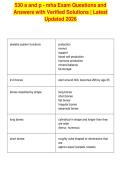
530 a and p - mha Exam Questions and
Answers with Verified Solutions | Latest
Updated 2026
skeletal system functions protection
mvmnt
support
blood cell production
hormone production
mineral balance
fat storage
# of bones start around 300, becomes 206 by age 25
bones classified by shape long bones
short bones
flat bones
irregular bones
sesamoid bones
long bones cylindrical in shape and longer than they
are wide
(femur, humerus)
short bones roughly cube shaped w/ dimensions that
are
approx equal (carpals, tarsals)
,flat bones thin, flattened, usually curved (skull bones,
ribs)
irregular bones do not fit into other categories d/t complex
shapes
(vertebrae)
sesamoid bones small round bones that are embedded w/in
tendons (patella)
periosteum outer covering of bone, a layer of dense
connective tissue. it is anchored to the
bone by
collagen fibers called perforating fibers
2 distinct layers of periosteum outer fibrous layer, inner osteogenic
cellular layer
medullary cavity lined w/ similar layer of connective tissue
called
endosteum
endosteum contains osteoclasts, osteoblasts, and
osteoprogenitor cells
bone marrow found w/in bones either in medullary cavity
or w/in
spaces of spongy bone. contains a mix of
hematopoietic stem cells, adipose tissue,
and
stromal cells
, 2 types of bone marrow hematopoietic (red) and adipose (yellow)
hematopoietic marrow (red) produces all types of blood cells
adipose marrow (yellow) stores fat
in childhood... red marrow present thruout spongy bone
in the
skeleton
in adolescence... most red marrow is converted to yellow
marrow
in adults... red marrow is found only in the skull,
vertebrae,
thoracic cage, pelvis, and the proximal
epiphyses
of femur and humerus
4 major types of bone cells osteoprogenitor (osteogenic cells)
osteoblasts
osteocytes
osteoclasts
bone cells arise from one of these mesenchymal progenitor cells
2 hematopoietic progenitor cells
progenitors
mesenchymal progenitor cells osteogenic cells, osteoblasts, and
osteocytes
Answers with Verified Solutions | Latest
Updated 2026
skeletal system functions protection
mvmnt
support
blood cell production
hormone production
mineral balance
fat storage
# of bones start around 300, becomes 206 by age 25
bones classified by shape long bones
short bones
flat bones
irregular bones
sesamoid bones
long bones cylindrical in shape and longer than they
are wide
(femur, humerus)
short bones roughly cube shaped w/ dimensions that
are
approx equal (carpals, tarsals)
,flat bones thin, flattened, usually curved (skull bones,
ribs)
irregular bones do not fit into other categories d/t complex
shapes
(vertebrae)
sesamoid bones small round bones that are embedded w/in
tendons (patella)
periosteum outer covering of bone, a layer of dense
connective tissue. it is anchored to the
bone by
collagen fibers called perforating fibers
2 distinct layers of periosteum outer fibrous layer, inner osteogenic
cellular layer
medullary cavity lined w/ similar layer of connective tissue
called
endosteum
endosteum contains osteoclasts, osteoblasts, and
osteoprogenitor cells
bone marrow found w/in bones either in medullary cavity
or w/in
spaces of spongy bone. contains a mix of
hematopoietic stem cells, adipose tissue,
and
stromal cells
, 2 types of bone marrow hematopoietic (red) and adipose (yellow)
hematopoietic marrow (red) produces all types of blood cells
adipose marrow (yellow) stores fat
in childhood... red marrow present thruout spongy bone
in the
skeleton
in adolescence... most red marrow is converted to yellow
marrow
in adults... red marrow is found only in the skull,
vertebrae,
thoracic cage, pelvis, and the proximal
epiphyses
of femur and humerus
4 major types of bone cells osteoprogenitor (osteogenic cells)
osteoblasts
osteocytes
osteoclasts
bone cells arise from one of these mesenchymal progenitor cells
2 hematopoietic progenitor cells
progenitors
mesenchymal progenitor cells osteogenic cells, osteoblasts, and
osteocytes


