

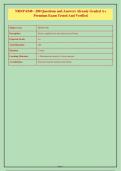
NRNP 6540 - 200 Questions and Answers Already Graded A+
Premium Exam Tested And Verified
Subject Area NRNP 6540
Description Exam compiled from the shared exam library.
Expected Grade A+
Total Questions 200
Duration 3 hours
Learning Outcomes 1. Demonstrate mastery of core concepts
Accreditation Sourced from the shared exam library.
Page 1
,1. A woman who is Rh-negative is pregnant with her first child, and her
husband is Rh-positive. During her 12-week prenatal visit, she tells the nurse
that she has been informed that this situation is dangerous. What should the
nurse tell her?
Answer: Administration of Rh immunoglobulin is indicated at 26 to 28 weeks
of gestation.
The goal is to prevent isoimmunization. If themother has not been previously
exposed to theRh- negative antigen, Rh immunoglobulin (RhIg) is administered
at 26 to 28 weeks of gestation and again within 72 hours of birth.
theintramuscular administration of RhIg has virtually eliminated hemolytic
disease of theinfant secondary to theRh factor. Unless other problems coexist,
thenewborn will not require transfusions at birth.
2. What is the clinical interpretation of a serum TSH level above the normal
reference range?
Answer: The thyroid is underactive, indicating hypothyroidism.
Elevated TSH indicates the pituitary is signaling the thyroid to produce more
hormone due to low thyroid hormone levels, which is consistent with primary
hypothyroidism. Options B and C would typically show low TSH, and D would
show normal TSH.
3. The nurse is teaching the parents of a child with recurrent headaches about
modifying behavior patterns that increase the risk of headaches. Which
statement by the parents indicates an understanding of the teaching?
Answer: We will respond matter-of-factly to requests for special attention.
Responding matter-of-factly to requests for special attention avoids reinforcing
headache-related behaviors, which can reduce the frequency of headaches. The
other options inadvertently reward or accommodate headache behavior,
potentially increasing headache risk.
Page 2
,4. A nurse is caring for a client receiving parenteral nutrition. Which of the
following findings indicates that the therapy is effective?
Answer: Client reports ability to complete ADLs.
Parenteral nutrition is effective when it improves nutritional status, indicated by
stable weight and improved lab values like albumin. Option A is subjective and
not a direct measure of nutritional effectiveness. Options C and D suggest
complications or lack of improvement.
5. A nurse is assessing a client with symptoms suggestive of type 2 diabetes.
When reviewing the client's past medical history, which previous diagnosis
should the nurse identify as a potential risk factor?
Answer: Gestational diabetes 7 years ago
Gestational diabetes is a well-established risk factor for developing type 2
diabetes later in life. The other options are also risk factors, but the question asks
for a past diagnosis that the nurse should recognize, and gestational diabetes is
the most directly linked.
6. What is the intended therapeutic action of inhaled corticosteroids in patients
with chronic respiratory conditions?
Answer: Reduction of airway inflammation
Inhaled corticosteroids primarily reduce airway inflammation by suppressing
inflammatory cell activity and cytokine production. They do not directly cause
bronchodilation, inhibit leukotrienes, or stabilize mast cells as primary
mechanisms.
7. A nurse is caring for a client undergoing chemotherapy for cancer. Which
intervention should the nurse recommend to help manage treatment-related
taste alterations?
Answer: Use plastic utensils.
Using plastic utensils can help reduce metallic taste often associated with
chemotherapy. Other interventions like rinsing with saline, avoiding strong
smells, and eating cold foods also help manage taste changes, but using plastic
utensils is a specific and effective strategy.
Page 3
, 8. A 72-year-old man presents to the clinic with a three-week history of
dyspnea, wheezing, chills, and night sweats. He has hypertension but has not
taken his antihypertensive medication for several months. He is homeless, lives
in shelters or outdoors, and has an income of approximately $300 per month
from an unknown donor. He has no family or social support, has an
eighth-grade education, and is functionally illiterate. He denies illicit drug use
and uses public transportation. Which of the following social determinants of
health is most likely contributing to his current presentation?
Answer: Lack of income and poverty level
The patient's lack of income and poverty level is the most critical social
determinant affecting his health, as it limits access to medications, stable housing,
and healthcare. While other factors like homelessness and low literacy are
present, poverty is the root cause that exacerbates all other issues.
9. What is the most common cause of hypothyroidism that presents with
thyroid peroxidase (TPO) antibodies?
Answer: Hashimoto thyroiditis
Hashimoto thyroiditis is the most common cause of hypothyroidism and is
characterized by the presence of thyroid peroxidase (TPO) antibodies. The other
options are associated with hyperthyroidism or transient thyroiditis, not chronic
hypothyroidism with TPO antibodies.
10. A nurse is caring for a client with acute inflammatory bowel disease. Which
of the following nutritional supplements should the nurse anticipate providing
to this client?
Answer: Hydrolyzed formula
In acute inflammatory bowel disease, the bowel needs rest and reduced
stimulation. Elemental formulas are easily absorbed and leave minimal residue,
reducing bowel irritation. Hydrolyzed formulas are also used but are less
complete; elemental formulas are preferred for acute exacerbations.
Page 4
Premium Exam Tested And Verified
Subject Area NRNP 6540
Description Exam compiled from the shared exam library.
Expected Grade A+
Total Questions 200
Duration 3 hours
Learning Outcomes 1. Demonstrate mastery of core concepts
Accreditation Sourced from the shared exam library.
Page 1
,1. A woman who is Rh-negative is pregnant with her first child, and her
husband is Rh-positive. During her 12-week prenatal visit, she tells the nurse
that she has been informed that this situation is dangerous. What should the
nurse tell her?
Answer: Administration of Rh immunoglobulin is indicated at 26 to 28 weeks
of gestation.
The goal is to prevent isoimmunization. If themother has not been previously
exposed to theRh- negative antigen, Rh immunoglobulin (RhIg) is administered
at 26 to 28 weeks of gestation and again within 72 hours of birth.
theintramuscular administration of RhIg has virtually eliminated hemolytic
disease of theinfant secondary to theRh factor. Unless other problems coexist,
thenewborn will not require transfusions at birth.
2. What is the clinical interpretation of a serum TSH level above the normal
reference range?
Answer: The thyroid is underactive, indicating hypothyroidism.
Elevated TSH indicates the pituitary is signaling the thyroid to produce more
hormone due to low thyroid hormone levels, which is consistent with primary
hypothyroidism. Options B and C would typically show low TSH, and D would
show normal TSH.
3. The nurse is teaching the parents of a child with recurrent headaches about
modifying behavior patterns that increase the risk of headaches. Which
statement by the parents indicates an understanding of the teaching?
Answer: We will respond matter-of-factly to requests for special attention.
Responding matter-of-factly to requests for special attention avoids reinforcing
headache-related behaviors, which can reduce the frequency of headaches. The
other options inadvertently reward or accommodate headache behavior,
potentially increasing headache risk.
Page 2
,4. A nurse is caring for a client receiving parenteral nutrition. Which of the
following findings indicates that the therapy is effective?
Answer: Client reports ability to complete ADLs.
Parenteral nutrition is effective when it improves nutritional status, indicated by
stable weight and improved lab values like albumin. Option A is subjective and
not a direct measure of nutritional effectiveness. Options C and D suggest
complications or lack of improvement.
5. A nurse is assessing a client with symptoms suggestive of type 2 diabetes.
When reviewing the client's past medical history, which previous diagnosis
should the nurse identify as a potential risk factor?
Answer: Gestational diabetes 7 years ago
Gestational diabetes is a well-established risk factor for developing type 2
diabetes later in life. The other options are also risk factors, but the question asks
for a past diagnosis that the nurse should recognize, and gestational diabetes is
the most directly linked.
6. What is the intended therapeutic action of inhaled corticosteroids in patients
with chronic respiratory conditions?
Answer: Reduction of airway inflammation
Inhaled corticosteroids primarily reduce airway inflammation by suppressing
inflammatory cell activity and cytokine production. They do not directly cause
bronchodilation, inhibit leukotrienes, or stabilize mast cells as primary
mechanisms.
7. A nurse is caring for a client undergoing chemotherapy for cancer. Which
intervention should the nurse recommend to help manage treatment-related
taste alterations?
Answer: Use plastic utensils.
Using plastic utensils can help reduce metallic taste often associated with
chemotherapy. Other interventions like rinsing with saline, avoiding strong
smells, and eating cold foods also help manage taste changes, but using plastic
utensils is a specific and effective strategy.
Page 3
, 8. A 72-year-old man presents to the clinic with a three-week history of
dyspnea, wheezing, chills, and night sweats. He has hypertension but has not
taken his antihypertensive medication for several months. He is homeless, lives
in shelters or outdoors, and has an income of approximately $300 per month
from an unknown donor. He has no family or social support, has an
eighth-grade education, and is functionally illiterate. He denies illicit drug use
and uses public transportation. Which of the following social determinants of
health is most likely contributing to his current presentation?
Answer: Lack of income and poverty level
The patient's lack of income and poverty level is the most critical social
determinant affecting his health, as it limits access to medications, stable housing,
and healthcare. While other factors like homelessness and low literacy are
present, poverty is the root cause that exacerbates all other issues.
9. What is the most common cause of hypothyroidism that presents with
thyroid peroxidase (TPO) antibodies?
Answer: Hashimoto thyroiditis
Hashimoto thyroiditis is the most common cause of hypothyroidism and is
characterized by the presence of thyroid peroxidase (TPO) antibodies. The other
options are associated with hyperthyroidism or transient thyroiditis, not chronic
hypothyroidism with TPO antibodies.
10. A nurse is caring for a client with acute inflammatory bowel disease. Which
of the following nutritional supplements should the nurse anticipate providing
to this client?
Answer: Hydrolyzed formula
In acute inflammatory bowel disease, the bowel needs rest and reduced
stimulation. Elemental formulas are easily absorbed and leave minimal residue,
reducing bowel irritation. Hydrolyzed formulas are also used but are less
complete; elemental formulas are preferred for acute exacerbations.
Page 4


