
y = ax² + bx + c
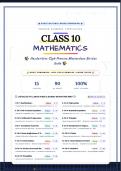
🎓 N C E R T N AT I O N A L B O A R D C O M PA N I O N 🎓
PREMIUM ACADEMIC COMPILATION
∫ ✨ Handwritten-Style Premium Masterclass Revision
Guide ✨
🚀 N C E R T C O M PA N I O N • H I G H -Y I E L D F O R M U L A S • B O A R D T R I C K S 🚀
∑
15 90 100%
CHAPTERS A4 SHEETS NCERT SYLLABUS
DETAILED SYLLABUS INDEX & BOARD WEIGHTAGE MAP 📑 🔥 CBSE 2026 Target Blueprint
√
1. Ch 1: Real Numbers 6 Marks P. 2 2. Ch 2: Polynomials 4 Marks P. 8
• Fundamental Thm of Arithmetic • Irrationality Proof of √2, √3 • Geometrical zeroes meaning • Quadratic zeroes & coefficients
3. Ch 3: Pair of Linear Equations … 6 Marks P. 14 4. Ch 4: Quadratic Equations 9 Marks P. 20
• Graphical compatibility tests • Substitution & Elimination • Standard form ax² + bx + c = 0 • Quadratic Formula & Factoring
π
5. Ch 5: Arithmetic Progressions 6 Marks P. 26 6. Ch 6: Triangles 10 Marks P. 32
• Derivation of n-th term (a_n) • Sum of first n terms (S_n) • Basic Proportionality (BPT) • Similarity Criteria (AAA, SSS)
7. Ch 7: Coordinate Geometry 6 Marks P. 38 8. Ch 8: Introduction to Trigono… 8 Marks P. 44
• Distance Formula derivation • Section Formula (Internal) • Trigonometric ratios • Standard Angles (0° - 90°)
9. Ch 9: Some Applications of Tr… 4 Marks P. 50 10. Ch 10: Circles 6 Marks P. 56
• Angles of Elevation & Depression • Heights and distances • Tangent perpendicularity • Equal external tangents proof
11. Ch 11: Constructions 4 Marks P. 62 12. Ch 12: Areas Related to Circles 4 Marks P. 68
• Line segment division • External tangents drawing • Sectors of a circle area • Segment area calculation
13. Ch 13: Surface Areas and Vol… 6 Marks P. 74 14. Ch 14: Statistics 7 Marks P. 80
• Combined solid surface areas • Combination solid volumes • Grouped Mean (Assumed method) • Grouped Median & Mode
15. Ch 15: Probability 4 Marks P. 86
• Classical event definitions • Complementary probability
NCERT National Revision Companion • CBSE Board 2026
,HIGH-RESOLUTION PDF COMPILER • DESIGNED FOR CRACKING 100/100 💯
,🔢 NCERT BOARD REVISION COMPANION Ch 1 REAL NUMBERS
1.1 Euclid's Division Lemma 🔢
FOUNDATIONS OF NUMBER THEORY
📐 BOARD GRAPHICAL REPRESENTATION 📉 CH 1 GEOMETRY REF
√2 ≈ 1.414...
π ≈ 3.1415...
-2 -1 0 1 2 3 4 5
Real Number Line: Visualising Rational & Irrational Positions
Real numbers form the foundation of algebra and arithmetic. In this chapter, we explore divisibility properties of
positive integers, starting with Euclid's Division Lemma.
📖 EUCLID'S DIVISION LEMMA STATEMENT CORE CONCEPT
⚡ For any two positive integers a and b, there exist unique integers q (quotient) and r (remainder)
satisfying:
⚡ a = bq + r, where 0 ≤ r < b
⚡ Here, a is the dividend, b is the divisor, q is the quotient, and r is the remainder.
This lemma is the mathematical basis of Euclid's Division Algorithm, which is an iterative procedure used to find
the Highest Common Factor (HCF) of any two positive integers.
✍️ NCERT SOLVED EXEMPLAR & BOARD Q ID: ch1-ex1
❓ THE QUESTION
Find the HCF of 135 and 225 using Euclid's Division Algorithm.
🧠 STEP-BY-STEP SOLVED DERIVATION
① Step 1: Since 225 > 135, we apply Euclid's Division Lemma to a = 225 and b = 135:
② 225 = 135 × 1 + 90 (remainder r = 90 ≠ 0)
③ Step 2: Since the remainder is non-zero, we apply the lemma again with divisor 135 and remainder
90:
© NCERT Revision Companion • Board Prep Syllabus Sheet 1 of 6 ISO 216 (A4 Portrait)
, 🔢 NCERT BOARD REVISION COMPANION Ch 1 REAL NUMBERS
1.2 The Fundamental Theorem of Arithmetic 🔢
PRIME FACTORISATION AND ITS APPLICATIONS
Every integer greater than 1 can either be classified as a prime number or can be constructed as a product of
prime factors. The Fundamental Theorem of Arithmetic states that this prime factorization is entirely unique.
📌 THE FUNDAMENTAL THEOREM OF ARITHMETIC KEY FORMULA & RELATIONS
⚡ Every composite number can be expressed (factorised) as a product of primes, and this factorisation
is unique, apart from the order in which the prime factors occur.
⚡ General Form: x = (p₁)^a₁ × (p₂)^a₂ × ... × (p_n)^a_n where p_i are distinct prime numbers and a_i are
positive integers.
✍️ NCERT SOLVED EXEMPLAR & BOARD Q ID: ch1-ex2
❓ THE QUESTION
Express 140 as a product of its prime factors.
🧠 STEP-BY-STEP SOLVED DERIVATION
① To find the prime factors of 140, we divide it by successive prime numbers:
② 1. 140 is even, divide by 2: 140 = 2 × 70
③ 2. 70 is even, divide by 2: 70 = 2 × 35
④ 3. 35 ends in 5, divide by 5: 35 = 5 × 7
⑤ 4. 7 is a prime number.
⑥ Putting it all together:
⑦ 140 = 2 × 2 × 5 × 7
⑧ ∴ 140 = 2² × 5 × 7
© NCERT Revision Companion • Board Prep Syllabus Sheet 2 of 6 ISO 216 (A4 Portrait)
🎓 N C E R T N AT I O N A L B O A R D C O M PA N I O N 🎓
PREMIUM ACADEMIC COMPILATION
∫ ✨ Handwritten-Style Premium Masterclass Revision
Guide ✨
🚀 N C E R T C O M PA N I O N • H I G H -Y I E L D F O R M U L A S • B O A R D T R I C K S 🚀
∑
15 90 100%
CHAPTERS A4 SHEETS NCERT SYLLABUS
DETAILED SYLLABUS INDEX & BOARD WEIGHTAGE MAP 📑 🔥 CBSE 2026 Target Blueprint
√
1. Ch 1: Real Numbers 6 Marks P. 2 2. Ch 2: Polynomials 4 Marks P. 8
• Fundamental Thm of Arithmetic • Irrationality Proof of √2, √3 • Geometrical zeroes meaning • Quadratic zeroes & coefficients
3. Ch 3: Pair of Linear Equations … 6 Marks P. 14 4. Ch 4: Quadratic Equations 9 Marks P. 20
• Graphical compatibility tests • Substitution & Elimination • Standard form ax² + bx + c = 0 • Quadratic Formula & Factoring
π
5. Ch 5: Arithmetic Progressions 6 Marks P. 26 6. Ch 6: Triangles 10 Marks P. 32
• Derivation of n-th term (a_n) • Sum of first n terms (S_n) • Basic Proportionality (BPT) • Similarity Criteria (AAA, SSS)
7. Ch 7: Coordinate Geometry 6 Marks P. 38 8. Ch 8: Introduction to Trigono… 8 Marks P. 44
• Distance Formula derivation • Section Formula (Internal) • Trigonometric ratios • Standard Angles (0° - 90°)
9. Ch 9: Some Applications of Tr… 4 Marks P. 50 10. Ch 10: Circles 6 Marks P. 56
• Angles of Elevation & Depression • Heights and distances • Tangent perpendicularity • Equal external tangents proof
11. Ch 11: Constructions 4 Marks P. 62 12. Ch 12: Areas Related to Circles 4 Marks P. 68
• Line segment division • External tangents drawing • Sectors of a circle area • Segment area calculation
13. Ch 13: Surface Areas and Vol… 6 Marks P. 74 14. Ch 14: Statistics 7 Marks P. 80
• Combined solid surface areas • Combination solid volumes • Grouped Mean (Assumed method) • Grouped Median & Mode
15. Ch 15: Probability 4 Marks P. 86
• Classical event definitions • Complementary probability
NCERT National Revision Companion • CBSE Board 2026
,HIGH-RESOLUTION PDF COMPILER • DESIGNED FOR CRACKING 100/100 💯
,🔢 NCERT BOARD REVISION COMPANION Ch 1 REAL NUMBERS
1.1 Euclid's Division Lemma 🔢
FOUNDATIONS OF NUMBER THEORY
📐 BOARD GRAPHICAL REPRESENTATION 📉 CH 1 GEOMETRY REF
√2 ≈ 1.414...
π ≈ 3.1415...
-2 -1 0 1 2 3 4 5
Real Number Line: Visualising Rational & Irrational Positions
Real numbers form the foundation of algebra and arithmetic. In this chapter, we explore divisibility properties of
positive integers, starting with Euclid's Division Lemma.
📖 EUCLID'S DIVISION LEMMA STATEMENT CORE CONCEPT
⚡ For any two positive integers a and b, there exist unique integers q (quotient) and r (remainder)
satisfying:
⚡ a = bq + r, where 0 ≤ r < b
⚡ Here, a is the dividend, b is the divisor, q is the quotient, and r is the remainder.
This lemma is the mathematical basis of Euclid's Division Algorithm, which is an iterative procedure used to find
the Highest Common Factor (HCF) of any two positive integers.
✍️ NCERT SOLVED EXEMPLAR & BOARD Q ID: ch1-ex1
❓ THE QUESTION
Find the HCF of 135 and 225 using Euclid's Division Algorithm.
🧠 STEP-BY-STEP SOLVED DERIVATION
① Step 1: Since 225 > 135, we apply Euclid's Division Lemma to a = 225 and b = 135:
② 225 = 135 × 1 + 90 (remainder r = 90 ≠ 0)
③ Step 2: Since the remainder is non-zero, we apply the lemma again with divisor 135 and remainder
90:
© NCERT Revision Companion • Board Prep Syllabus Sheet 1 of 6 ISO 216 (A4 Portrait)
, 🔢 NCERT BOARD REVISION COMPANION Ch 1 REAL NUMBERS
1.2 The Fundamental Theorem of Arithmetic 🔢
PRIME FACTORISATION AND ITS APPLICATIONS
Every integer greater than 1 can either be classified as a prime number or can be constructed as a product of
prime factors. The Fundamental Theorem of Arithmetic states that this prime factorization is entirely unique.
📌 THE FUNDAMENTAL THEOREM OF ARITHMETIC KEY FORMULA & RELATIONS
⚡ Every composite number can be expressed (factorised) as a product of primes, and this factorisation
is unique, apart from the order in which the prime factors occur.
⚡ General Form: x = (p₁)^a₁ × (p₂)^a₂ × ... × (p_n)^a_n where p_i are distinct prime numbers and a_i are
positive integers.
✍️ NCERT SOLVED EXEMPLAR & BOARD Q ID: ch1-ex2
❓ THE QUESTION
Express 140 as a product of its prime factors.
🧠 STEP-BY-STEP SOLVED DERIVATION
① To find the prime factors of 140, we divide it by successive prime numbers:
② 1. 140 is even, divide by 2: 140 = 2 × 70
③ 2. 70 is even, divide by 2: 70 = 2 × 35
④ 3. 35 ends in 5, divide by 5: 35 = 5 × 7
⑤ 4. 7 is a prime number.
⑥ Putting it all together:
⑦ 140 = 2 × 2 × 5 × 7
⑧ ∴ 140 = 2² × 5 × 7
© NCERT Revision Companion • Board Prep Syllabus Sheet 2 of 6 ISO 216 (A4 Portrait)


