

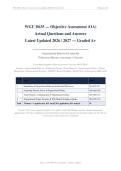
WGU D635 | Objective Assessment | Actual Q&A | 2026/2027 (Graded A+) 70-Question OA
WGU D635 — Objective Assessment (OA)
Actual Questions and Answers
Latest Updated — Graded A+
Organizational Behavior & Leadership
70-Question Objective Assessment • 4 Sections
Curriculum Alignment: Western Governors University (WGU) D635
Domains: Organizational Behavior • Leadership Theories • Team Dynamics • Organizational Culture • Change
Management • Organizational Structure • 2026/2027 Modern Workplace (Hybrid Work, AI Integration, DEIB, Agile)
Sectio
Focus Items
n
1 Foundations of Organizational Behavior & Individual Differences Q1–Q18 (18)
2 Leadership Theories, Power, & Organizational Politics Q19–Q36 (18)
3 Team Dynamics, Communication, & Organizational Culture Q37–Q53 (17)
4 Organizational Change, Structure, & 2026 Modern Workplace Updates Q54–Q70 (17)
Total 70 Items — Cognitive mix: 30% recall, 50% application, 20% analysis 70
Format: 75% scenario-based (workplace case studies, leadership dilemma vignettes, change-management
applications); 25% direct (definitions, theoretical frameworks). Each question presents four options (A–D) with one
correct answer and a mastery-level rationale.
Page 1 | D635 Objective Assessment | Graded A+ Edition
,WGU D635 | Objective Assessment | Actual Q&A | 2026/2027 (Graded A+) 70-Question OA
Section 1: Foundations of Organizational Behavior & Individual Differences
(Q1–Q18)
1. Maria, a senior financial analyst, consistently volunteers for high-visibility projects, tolerates stressful
deadlines without complaint, and remains calm when clients escalate issues. In terms of the Big Five personality
traits, Maria most likely scores high on which dimension?
A. Agreeableness, because she cooperates with clients under pressure.
B. Neuroticism, because she remains emotionally reactive to deadlines.
C. Emotional stability (low neuroticism), because she remains calm, resilient, and steady under stress.
D. Openness to experience, because she volunteers for new projects.
Correct Answer: C
Correct Answer: C
Rationale: Emotional stability (the low pole of neuroticism) describes resilience, calmness, and stress tolerance.
Agreeableness concerns cooperation/interpersonal trust, not stress response; high (not low) neuroticism would mean
emotional reactivity; openness reflects curiosity and creativity, not stress tolerance. Therefore C is correct.
2. Which of the following correctly pairs a Big Five trait with its defining behavioral indicator?
A. Conscientiousness → sociability and talkativeness in groups.
B. Extraversion → imagination and preference for novelty.
C. Agreeableness → trust, compliance, and tender-mindedness toward others.
D. Openness to experience → disorganization and carelessness.
Correct Answer: C
Correct Answer: C
Rationale: Agreeableness is defined by trust, compliance, modesty, and tender-mindedness. Sociability/talkativeness
is extraversion (A wrong); imagination/novelty is openness (B wrong); disorganization/carelessness is the low pole
of conscientiousness (D wrong). Thus C is the correct pairing.
3. A hiring manager rejects a candidate after one interview, reasoning, "She didn't smile much, so she probably
lacks interpersonal skills." The manager has known the candidate for only 45 minutes. This judgment is best
explained by which perceptual bias?
A. The halo effect, because one global impression colors all inferences.
B. Self-serving bias, because the manager protects her own self-esteem.
C. Fundamental attribution error, because the manager overattributes behavior to disposition with limited
situational data.
D. Contrast effect, because the manager compares the candidate to prior applicants.
Correct Answer: C
Correct Answer: C
Rationale: Inferring a stable dispositional trait ("lacks interpersonal skills") from a brief, situationally constrained
behavior (a 45-minute interview) is the fundamental attribution error — overestimating internal causes and
underestimating situational constraints. Halo involves one positive trait coloring overall judgment; self-serving
concerns credit/blame for oneself; contrast requires comparison to others. C is correct.
Page 2 | D635 Objective Assessment | Graded A+ Edition
, WGU D635 | Objective Assessment | Actual Q&A | 2026/2027 (Graded A+) 70-Question OA
4. After a successful product launch, a team leader tells the press, "Our team's exceptional collaboration made
this possible." After a failed launch two quarters later, the same leader says, "Market conditions were
unfavorable." This pattern illustrates:
A. The halo effect, because success colors later judgments.
B. Self-serving bias, because the leader attributes success internally and failure externally.
C. Stereotyping, because the leader generalizes about market conditions.
D. Selective perception, because the leader only notices confirming data.
Correct Answer: B
Correct Answer: B
Rationale: Self-serving bias is the tendency to credit internal/dispositional factors for success and
external/situational factors for failure. Halo, stereotyping, and selective perception describe different distortions. The
internal-then-external attribution pattern uniquely identifies B as correct.
5. In the workplace, an attitude is best defined as:
A. A learned predisposition to respond consistently favorably or unfavorably to an object, person, or event.
B. An innate personality trait that determines emotional reactivity.
C. A short-term emotional state triggered by a specific stimulus.
D. A behavior pattern reinforced through operant conditioning.
Correct Answer: A
Correct Answer: A
Rationale: An attitude is a relatively enduring learned predisposition to respond favorably or unfavorably (the
cognitive, affective, behavioral components). It is not innate (B), not a fleeting emotion (C — that is an affective
state/mood), and not a behavior itself (D). A is the standard OB definition.
6. A call-center employee reports high job satisfaction but has been absent 18 days this quarter and routinely
leaves customer tickets unresolved. This inconsistency most directly challenges which assumption?
A. That job satisfaction always predicts organizational citizenship behavior.
B. That attitudes and behaviors are always perfectly correlated.
C. That job satisfaction is a sufficient predictor of job performance and withdrawal behaviors.
D. That job involvement causes job satisfaction.
Correct Answer: C
Correct Answer: C
Rationale: The scenario illustrates that stated satisfaction does not reliably predict performance or withdrawal
(absenteeism). The correct lesson is that satisfaction is an imperfect, insufficient predictor of those outcomes. The
other options are either trivially true restatements or unrelated constructs. C best captures the specific challenge
posed by the data.
7. According to Maslow's hierarchy, an employee who recently lost their home in a natural disaster is most
likely to be motivated first and foremost by which need?
A. Esteem needs, because they seek recognition after a loss.
B. Self-actualization needs, because they want to rebuild their potential.
C. Physiological and safety needs, because basic shelter and security take precedence.
D. Belongingness needs, because they require social support.
Correct Answer: C
Correct Answer: C
Page 3 | D635 Objective Assessment | Graded A+ Edition
WGU D635 — Objective Assessment (OA)
Actual Questions and Answers
Latest Updated — Graded A+
Organizational Behavior & Leadership
70-Question Objective Assessment • 4 Sections
Curriculum Alignment: Western Governors University (WGU) D635
Domains: Organizational Behavior • Leadership Theories • Team Dynamics • Organizational Culture • Change
Management • Organizational Structure • 2026/2027 Modern Workplace (Hybrid Work, AI Integration, DEIB, Agile)
Sectio
Focus Items
n
1 Foundations of Organizational Behavior & Individual Differences Q1–Q18 (18)
2 Leadership Theories, Power, & Organizational Politics Q19–Q36 (18)
3 Team Dynamics, Communication, & Organizational Culture Q37–Q53 (17)
4 Organizational Change, Structure, & 2026 Modern Workplace Updates Q54–Q70 (17)
Total 70 Items — Cognitive mix: 30% recall, 50% application, 20% analysis 70
Format: 75% scenario-based (workplace case studies, leadership dilemma vignettes, change-management
applications); 25% direct (definitions, theoretical frameworks). Each question presents four options (A–D) with one
correct answer and a mastery-level rationale.
Page 1 | D635 Objective Assessment | Graded A+ Edition
,WGU D635 | Objective Assessment | Actual Q&A | 2026/2027 (Graded A+) 70-Question OA
Section 1: Foundations of Organizational Behavior & Individual Differences
(Q1–Q18)
1. Maria, a senior financial analyst, consistently volunteers for high-visibility projects, tolerates stressful
deadlines without complaint, and remains calm when clients escalate issues. In terms of the Big Five personality
traits, Maria most likely scores high on which dimension?
A. Agreeableness, because she cooperates with clients under pressure.
B. Neuroticism, because she remains emotionally reactive to deadlines.
C. Emotional stability (low neuroticism), because she remains calm, resilient, and steady under stress.
D. Openness to experience, because she volunteers for new projects.
Correct Answer: C
Correct Answer: C
Rationale: Emotional stability (the low pole of neuroticism) describes resilience, calmness, and stress tolerance.
Agreeableness concerns cooperation/interpersonal trust, not stress response; high (not low) neuroticism would mean
emotional reactivity; openness reflects curiosity and creativity, not stress tolerance. Therefore C is correct.
2. Which of the following correctly pairs a Big Five trait with its defining behavioral indicator?
A. Conscientiousness → sociability and talkativeness in groups.
B. Extraversion → imagination and preference for novelty.
C. Agreeableness → trust, compliance, and tender-mindedness toward others.
D. Openness to experience → disorganization and carelessness.
Correct Answer: C
Correct Answer: C
Rationale: Agreeableness is defined by trust, compliance, modesty, and tender-mindedness. Sociability/talkativeness
is extraversion (A wrong); imagination/novelty is openness (B wrong); disorganization/carelessness is the low pole
of conscientiousness (D wrong). Thus C is the correct pairing.
3. A hiring manager rejects a candidate after one interview, reasoning, "She didn't smile much, so she probably
lacks interpersonal skills." The manager has known the candidate for only 45 minutes. This judgment is best
explained by which perceptual bias?
A. The halo effect, because one global impression colors all inferences.
B. Self-serving bias, because the manager protects her own self-esteem.
C. Fundamental attribution error, because the manager overattributes behavior to disposition with limited
situational data.
D. Contrast effect, because the manager compares the candidate to prior applicants.
Correct Answer: C
Correct Answer: C
Rationale: Inferring a stable dispositional trait ("lacks interpersonal skills") from a brief, situationally constrained
behavior (a 45-minute interview) is the fundamental attribution error — overestimating internal causes and
underestimating situational constraints. Halo involves one positive trait coloring overall judgment; self-serving
concerns credit/blame for oneself; contrast requires comparison to others. C is correct.
Page 2 | D635 Objective Assessment | Graded A+ Edition
, WGU D635 | Objective Assessment | Actual Q&A | 2026/2027 (Graded A+) 70-Question OA
4. After a successful product launch, a team leader tells the press, "Our team's exceptional collaboration made
this possible." After a failed launch two quarters later, the same leader says, "Market conditions were
unfavorable." This pattern illustrates:
A. The halo effect, because success colors later judgments.
B. Self-serving bias, because the leader attributes success internally and failure externally.
C. Stereotyping, because the leader generalizes about market conditions.
D. Selective perception, because the leader only notices confirming data.
Correct Answer: B
Correct Answer: B
Rationale: Self-serving bias is the tendency to credit internal/dispositional factors for success and
external/situational factors for failure. Halo, stereotyping, and selective perception describe different distortions. The
internal-then-external attribution pattern uniquely identifies B as correct.
5. In the workplace, an attitude is best defined as:
A. A learned predisposition to respond consistently favorably or unfavorably to an object, person, or event.
B. An innate personality trait that determines emotional reactivity.
C. A short-term emotional state triggered by a specific stimulus.
D. A behavior pattern reinforced through operant conditioning.
Correct Answer: A
Correct Answer: A
Rationale: An attitude is a relatively enduring learned predisposition to respond favorably or unfavorably (the
cognitive, affective, behavioral components). It is not innate (B), not a fleeting emotion (C — that is an affective
state/mood), and not a behavior itself (D). A is the standard OB definition.
6. A call-center employee reports high job satisfaction but has been absent 18 days this quarter and routinely
leaves customer tickets unresolved. This inconsistency most directly challenges which assumption?
A. That job satisfaction always predicts organizational citizenship behavior.
B. That attitudes and behaviors are always perfectly correlated.
C. That job satisfaction is a sufficient predictor of job performance and withdrawal behaviors.
D. That job involvement causes job satisfaction.
Correct Answer: C
Correct Answer: C
Rationale: The scenario illustrates that stated satisfaction does not reliably predict performance or withdrawal
(absenteeism). The correct lesson is that satisfaction is an imperfect, insufficient predictor of those outcomes. The
other options are either trivially true restatements or unrelated constructs. C best captures the specific challenge
posed by the data.
7. According to Maslow's hierarchy, an employee who recently lost their home in a natural disaster is most
likely to be motivated first and foremost by which need?
A. Esteem needs, because they seek recognition after a loss.
B. Self-actualization needs, because they want to rebuild their potential.
C. Physiological and safety needs, because basic shelter and security take precedence.
D. Belongingness needs, because they require social support.
Correct Answer: C
Correct Answer: C
Page 3 | D635 Objective Assessment | Graded A+ Edition


