

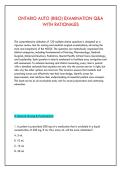
ONTARIO AUTO (RIBO) EXAMINATION Q&A
WITH RATIONALES
This comprehensive collection of 120 multiple-choice questions is designed as a
rigorous review tool for nursing and medical-surgical examinations, mirroring the
style and complexity of the NCLEX. The questions are meticulously organized into
distinct categories, including Fundamentals of Nursing, Pharmacology, Medical-
Surgical, Maternal-Newborn, Pediatrics, Mental Health, Critical Care, Gerontology,
and Leadership. Each question is clearly numbered to facilitate easy navigation and
self-assessment. To enhance learning and clinical reasoning, every item is paired
with a detailed rationale that explains not only why the correct answer is right, but
also why the other options are incorrect. This structure ensures that students and
practicing nurses can effectively test their knowledge, identify areas for
improvement, and reinforce their understanding of essential patient care concepts.
This bank serves as an invaluable study aid for exam preparation and continuing
education.
# General Nursing & Fundamentals
1. A patient is prescribed 500 mg of a medication that is available in a liquid
concentration of 250 mg/5 mL. How many mL will the nurse administer?
A. 5 mL
B. 10 mL
C. 15 mL
D. 20 mL
,Correct Answer: B
Rationale: Set up a proportion: 250 mg / 5 mL = 500 mg / X mL. Cross-multiply:
250X = 2500. Solve for X: X = 10 mL.
2. A nurse is preparing to insert a nasogastric (NG) tube. In which position should
the patient be placed to facilitate tube insertion?
A. Supine with the head flat
B. Left lateral recumbent
C. High Fowler's with the head tilted forward
D. Prone
Correct Answer: C
Rationale: High Fowler's position (sitting upright) with the head tilted forward uses
gravity to help pass the tube and closes the trachea, reducing the risk of accidental
tracheal insertion.
3. Which of the following is the most appropriate nursing intervention for a patient
with a stage 2 pressure injury?
A. Massage the area to promote circulation
B. Apply a transparent film dressing to prevent infection
C. Use a foam dressing to absorb drainage and protect the wound
D. Apply a dry, sterile gauze dressing and change it every 8 hours
Correct Answer: C
Rationale: Stage 2 pressure injuries are partial-thickness wounds. Foam dressings
are ideal because they are absorbent and provide a moist wound environment that
promotes healing while protecting the wound from further damage. Massaging can
cause further tissue damage.
4. A patient is on fall precautions. Which of the following interventions is most
effective in preventing falls?
,A. Keeping the bed in the highest position for easy patient access
B. Placing all personal items out of reach to encourage the patient to call for help
C. Encouraging the patient to wear non-skid footwear when ambulating
D. Applying wrist restraints to prevent the patient from getting up unsupervised
Correct Answer: C
Rationale: Non-skid footwear provides traction and is a key safety measure. The
bed should be in the lowest position, personal items should be within reach, and
restraints should be a last resort and not used for convenience.
5. A nurse is teaching a patient about a low-sodium diet. Which food choice
indicates the patient understands the teaching?
A. A dill pickle
B. A slice of processed cheese
C. Fresh broccoli
D. A can of tomato soup
Correct Answer: C
Rationale: Fresh fruits and vegetables are naturally low in sodium. Processed foods,
canned goods, and pickled items are typically high in sodium.
6. What is the priority nursing action when a patient reports chest pain?
A. Administer a PRN antacid
B. Call the physician
C. Assess the patient's pain using a pain scale and vital signs
D. Reassure the patient that it is likely indigestion
Correct Answer: C
Rationale: Assessment is always the first step. The nurse must gather data about the
pain (quality, location, severity) and check vital signs to determine the stability of
the patient and guide further intervention.
, 7. A patient has an order for contact precautions. Which of the following is
necessary for all staff and visitors?
A. N95 respirator mask
B. Surgical mask and eye shield
C. Gown and gloves
D. Placing the patient in a negative-pressure room
Correct Answer: C
Rationale: Contact precautions require the use of a gown and gloves for all
interactions with the patient or the patient's environment. This is to prevent the
transmission of organisms like MRSA or VRE.
8. When administering a subcutaneous injection of heparin, which action is most
appropriate?
A. Aspirate before injecting to ensure you are not in a blood vessel
B. Rub the site vigorously after the injection to promote absorption
C. Administer the injection in the abdomen, at least 2 inches away from the umbilicus
D. Use a 22-gauge, 1.5-inch needle
Correct Answer: C
Rationale: The abdomen is the preferred site for subcutaneous heparin. It should be
given in the fatty tissue, at least 2 inches from the umbilicus. Do not aspirate or rub
the site, as this can cause bleeding. A small-gauge, short needle is used.
9. What is the most accurate method for measuring a patient's core body
temperature?
A. Oral
B. Axillary
C. Rectal
D. Tympanic
WITH RATIONALES
This comprehensive collection of 120 multiple-choice questions is designed as a
rigorous review tool for nursing and medical-surgical examinations, mirroring the
style and complexity of the NCLEX. The questions are meticulously organized into
distinct categories, including Fundamentals of Nursing, Pharmacology, Medical-
Surgical, Maternal-Newborn, Pediatrics, Mental Health, Critical Care, Gerontology,
and Leadership. Each question is clearly numbered to facilitate easy navigation and
self-assessment. To enhance learning and clinical reasoning, every item is paired
with a detailed rationale that explains not only why the correct answer is right, but
also why the other options are incorrect. This structure ensures that students and
practicing nurses can effectively test their knowledge, identify areas for
improvement, and reinforce their understanding of essential patient care concepts.
This bank serves as an invaluable study aid for exam preparation and continuing
education.
# General Nursing & Fundamentals
1. A patient is prescribed 500 mg of a medication that is available in a liquid
concentration of 250 mg/5 mL. How many mL will the nurse administer?
A. 5 mL
B. 10 mL
C. 15 mL
D. 20 mL
,Correct Answer: B
Rationale: Set up a proportion: 250 mg / 5 mL = 500 mg / X mL. Cross-multiply:
250X = 2500. Solve for X: X = 10 mL.
2. A nurse is preparing to insert a nasogastric (NG) tube. In which position should
the patient be placed to facilitate tube insertion?
A. Supine with the head flat
B. Left lateral recumbent
C. High Fowler's with the head tilted forward
D. Prone
Correct Answer: C
Rationale: High Fowler's position (sitting upright) with the head tilted forward uses
gravity to help pass the tube and closes the trachea, reducing the risk of accidental
tracheal insertion.
3. Which of the following is the most appropriate nursing intervention for a patient
with a stage 2 pressure injury?
A. Massage the area to promote circulation
B. Apply a transparent film dressing to prevent infection
C. Use a foam dressing to absorb drainage and protect the wound
D. Apply a dry, sterile gauze dressing and change it every 8 hours
Correct Answer: C
Rationale: Stage 2 pressure injuries are partial-thickness wounds. Foam dressings
are ideal because they are absorbent and provide a moist wound environment that
promotes healing while protecting the wound from further damage. Massaging can
cause further tissue damage.
4. A patient is on fall precautions. Which of the following interventions is most
effective in preventing falls?
,A. Keeping the bed in the highest position for easy patient access
B. Placing all personal items out of reach to encourage the patient to call for help
C. Encouraging the patient to wear non-skid footwear when ambulating
D. Applying wrist restraints to prevent the patient from getting up unsupervised
Correct Answer: C
Rationale: Non-skid footwear provides traction and is a key safety measure. The
bed should be in the lowest position, personal items should be within reach, and
restraints should be a last resort and not used for convenience.
5. A nurse is teaching a patient about a low-sodium diet. Which food choice
indicates the patient understands the teaching?
A. A dill pickle
B. A slice of processed cheese
C. Fresh broccoli
D. A can of tomato soup
Correct Answer: C
Rationale: Fresh fruits and vegetables are naturally low in sodium. Processed foods,
canned goods, and pickled items are typically high in sodium.
6. What is the priority nursing action when a patient reports chest pain?
A. Administer a PRN antacid
B. Call the physician
C. Assess the patient's pain using a pain scale and vital signs
D. Reassure the patient that it is likely indigestion
Correct Answer: C
Rationale: Assessment is always the first step. The nurse must gather data about the
pain (quality, location, severity) and check vital signs to determine the stability of
the patient and guide further intervention.
, 7. A patient has an order for contact precautions. Which of the following is
necessary for all staff and visitors?
A. N95 respirator mask
B. Surgical mask and eye shield
C. Gown and gloves
D. Placing the patient in a negative-pressure room
Correct Answer: C
Rationale: Contact precautions require the use of a gown and gloves for all
interactions with the patient or the patient's environment. This is to prevent the
transmission of organisms like MRSA or VRE.
8. When administering a subcutaneous injection of heparin, which action is most
appropriate?
A. Aspirate before injecting to ensure you are not in a blood vessel
B. Rub the site vigorously after the injection to promote absorption
C. Administer the injection in the abdomen, at least 2 inches away from the umbilicus
D. Use a 22-gauge, 1.5-inch needle
Correct Answer: C
Rationale: The abdomen is the preferred site for subcutaneous heparin. It should be
given in the fatty tissue, at least 2 inches from the umbilicus. Do not aspirate or rub
the site, as this can cause bleeding. A small-gauge, short needle is used.
9. What is the most accurate method for measuring a patient's core body
temperature?
A. Oral
B. Axillary
C. Rectal
D. Tympanic


