

Med Surg II - Neuro Assessment/Diagnostics
(U4) Exam Questions and Answers with
Verified Solutions | Latest Updated 2026
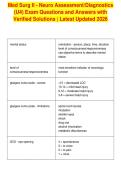
mental status orientation - person, place, time, situation
level of consciousness/responsiveness
use objective terms to describe mental
status
level of most sensitive indicator of neurologic
consciousness/responsiveness function
glasgow coma scale - scores <15 = decreased LOC
13-14 = mild head injury
9-12 = moderate head injury
3-8 = severe head injury
glasgow coma scale - limitations spinal cord injuries
intubation
swollen eyes
shock
drug use
alcohol intoxication
metabolic disturbances
GCS - eye opening 4 = spontaneous
3 = to voice
2 = to pain
1 = none
, GCS - verbal response 5 = normal conversation
4 = disoriented conversation
3 = words, but not coherent
2 = no words, only sounds
1 = none
GCS - motor response 6 = normal
5 = localizes to pain
4 = withdraws to pain
3 = decorticate posturing
2 = decerebate posturing
1 = none
stimuli begin with saying name, then shout name,
then
shake
last: painful stimuli
- trapezius squeeze (best)
- supraorbital pressure
- sternal rube
- nailbed pressure
GCS - considerations doesn't evaluate brain stem functions
change of more than 2 should be reported
<8 = intubate
richmond agitation sedation scale used with sedation, analgesia, and
(RASS) neuromuscular
blockage to assess mental status
RASS goal 0 to -1
(U4) Exam Questions and Answers with
Verified Solutions | Latest Updated 2026
mental status orientation - person, place, time, situation
level of consciousness/responsiveness
use objective terms to describe mental
status
level of most sensitive indicator of neurologic
consciousness/responsiveness function
glasgow coma scale - scores <15 = decreased LOC
13-14 = mild head injury
9-12 = moderate head injury
3-8 = severe head injury
glasgow coma scale - limitations spinal cord injuries
intubation
swollen eyes
shock
drug use
alcohol intoxication
metabolic disturbances
GCS - eye opening 4 = spontaneous
3 = to voice
2 = to pain
1 = none
, GCS - verbal response 5 = normal conversation
4 = disoriented conversation
3 = words, but not coherent
2 = no words, only sounds
1 = none
GCS - motor response 6 = normal
5 = localizes to pain
4 = withdraws to pain
3 = decorticate posturing
2 = decerebate posturing
1 = none
stimuli begin with saying name, then shout name,
then
shake
last: painful stimuli
- trapezius squeeze (best)
- supraorbital pressure
- sternal rube
- nailbed pressure
GCS - considerations doesn't evaluate brain stem functions
change of more than 2 should be reported
<8 = intubate
richmond agitation sedation scale used with sedation, analgesia, and
(RASS) neuromuscular
blockage to assess mental status
RASS goal 0 to -1


