
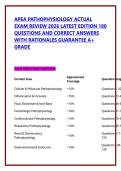
APEA PATHOPHYSIOLOGY ACTUAL
EXAM REVIEW 2026 LATEST EDITION 180
QUESTIONS AND CORRECT ANSWERS
WITH RATIONALES GUARANTEE A+
GRADE
EXAM STRUCTURE OVERVIEW
Approximate
Content Area Question Rang
Coverage
Cellular & Molecular Pathophysiology ~15% Questions 1-22
Inflammation & Immunity ~15% Questions 23-4
Fluid, Electrolyte & Acid-Base ~10% Questions 46-6
Hematologic Pathophysiology ~10% Questions 61-7
Cardiovascular Pathophysiology ~15% Questions 76-9
Respiratory Pathophysiology ~10% Questions 96-1
Renal & Genitourinary Questions 111-
~10%
Pathophysiology 125
Questions 126-
Gastrointestinal & Endocrine ~10%
140
, Approximate
Content Area Question Rang
Coverage
Questions 141-
Neurological & Musculoskeletal ~5%
150
Exam Details:
• Format: Multiple Choice
• Focus: Etiology, pathogenesis, clinical manifestations, disease
mechanisms
• Target: Nurse Practitioners, Advanced Practice Providers
SECTION 1: CELLULAR & MOLECULAR PATHOPHYSIOLOGY
Questions 1-22
Question 1
A patient with chronic hepatitis C develops liver cirrhosis. Which cellular
adaptation best describes the changes in the liver tissue?
A. Hyperplasia
B. Hypertrophy
C. Metaplasia
D. Dysplasia
Correct ,,,,answer,,: C
Rationale: Metaplasia is the reversible replacement of one differentiated
cell type with another. In chronic liver disease, hepatocytes may undergo
,metaplastic changes. Cirrhosis itself involves fibrosis and regeneration,
but the cellular adaptation in response to chronic injury is metaplasia.
Question 2
A 65-year-old patient with a history of smoking presents with a lung
mass. Biopsy reveals cells that are abnormal in size, shape, and
organization. This finding is most consistent with:
A. Hyperplasia
B. Metaplasia
C. Dysplasia
D. Anaplasia
Correct ,,,,answer,,: C
Rationale: Dysplasia is characterized by abnormal changes in cell size,
shape, and organization. It is often a precancerous condition. Anaplasia
refers to undifferentiated cells seen in malignant tumors.
Question 3
Which of the following best describes the mechanism of cellular injury in
ischemia?
A. Direct damage to cell membranes by free radicals
B. Lack of oxygen leading to ATP depletion and failure of sodium-
potassium pumps
C. Activation of the complement system
D. Accumulation of misfolded proteins in the endoplasmic reticulum
, Correct ,,,,answer,,: B
Rationale: Ischemia causes cellular injury through oxygen deprivation,
leading to decreased ATP production. Without ATP, the sodium-
potassium pump fails, causing cellular swelling and eventual cell death.
Question 4
A patient with a genetic mutation in the BRCA1 gene is at increased risk
for which type of cancer?
A. Lung cancer
B. Colon cancer
C. Breast and ovarian cancer
D. Prostate cancer
Correct ,,,,answer,,: C
Rationale: BRCA1 and BRCA2 are tumor suppressor genes. Mutations in
these genes significantly increase the risk of breast and ovarian cancer.
Question 5
Which of the following cellular changes is reversible?
A. Coagulative necrosis
B. Apoptosis
C. Hydropic swelling
D. Liquefactive necrosis
Correct ,,,,answer,,: C
Rationale: Hydropic swelling (cellular swelling) is a reversible change
that occurs with cellular injury. If the cause is removed, the cell can
EXAM REVIEW 2026 LATEST EDITION 180
QUESTIONS AND CORRECT ANSWERS
WITH RATIONALES GUARANTEE A+
GRADE
EXAM STRUCTURE OVERVIEW
Approximate
Content Area Question Rang
Coverage
Cellular & Molecular Pathophysiology ~15% Questions 1-22
Inflammation & Immunity ~15% Questions 23-4
Fluid, Electrolyte & Acid-Base ~10% Questions 46-6
Hematologic Pathophysiology ~10% Questions 61-7
Cardiovascular Pathophysiology ~15% Questions 76-9
Respiratory Pathophysiology ~10% Questions 96-1
Renal & Genitourinary Questions 111-
~10%
Pathophysiology 125
Questions 126-
Gastrointestinal & Endocrine ~10%
140
, Approximate
Content Area Question Rang
Coverage
Questions 141-
Neurological & Musculoskeletal ~5%
150
Exam Details:
• Format: Multiple Choice
• Focus: Etiology, pathogenesis, clinical manifestations, disease
mechanisms
• Target: Nurse Practitioners, Advanced Practice Providers
SECTION 1: CELLULAR & MOLECULAR PATHOPHYSIOLOGY
Questions 1-22
Question 1
A patient with chronic hepatitis C develops liver cirrhosis. Which cellular
adaptation best describes the changes in the liver tissue?
A. Hyperplasia
B. Hypertrophy
C. Metaplasia
D. Dysplasia
Correct ,,,,answer,,: C
Rationale: Metaplasia is the reversible replacement of one differentiated
cell type with another. In chronic liver disease, hepatocytes may undergo
,metaplastic changes. Cirrhosis itself involves fibrosis and regeneration,
but the cellular adaptation in response to chronic injury is metaplasia.
Question 2
A 65-year-old patient with a history of smoking presents with a lung
mass. Biopsy reveals cells that are abnormal in size, shape, and
organization. This finding is most consistent with:
A. Hyperplasia
B. Metaplasia
C. Dysplasia
D. Anaplasia
Correct ,,,,answer,,: C
Rationale: Dysplasia is characterized by abnormal changes in cell size,
shape, and organization. It is often a precancerous condition. Anaplasia
refers to undifferentiated cells seen in malignant tumors.
Question 3
Which of the following best describes the mechanism of cellular injury in
ischemia?
A. Direct damage to cell membranes by free radicals
B. Lack of oxygen leading to ATP depletion and failure of sodium-
potassium pumps
C. Activation of the complement system
D. Accumulation of misfolded proteins in the endoplasmic reticulum
, Correct ,,,,answer,,: B
Rationale: Ischemia causes cellular injury through oxygen deprivation,
leading to decreased ATP production. Without ATP, the sodium-
potassium pump fails, causing cellular swelling and eventual cell death.
Question 4
A patient with a genetic mutation in the BRCA1 gene is at increased risk
for which type of cancer?
A. Lung cancer
B. Colon cancer
C. Breast and ovarian cancer
D. Prostate cancer
Correct ,,,,answer,,: C
Rationale: BRCA1 and BRCA2 are tumor suppressor genes. Mutations in
these genes significantly increase the risk of breast and ovarian cancer.
Question 5
Which of the following cellular changes is reversible?
A. Coagulative necrosis
B. Apoptosis
C. Hydropic swelling
D. Liquefactive necrosis
Correct ,,,,answer,,: C
Rationale: Hydropic swelling (cellular swelling) is a reversible change
that occurs with cellular injury. If the cause is removed, the cell can


