lOMoAR cPSD| 67691079
PROBLEM SET 2
Question 1 (100 points)
You are a student from an immunology lab. You perform three independent experiments using
different mouse strains and you want to explain your results with what you have learned from
MIMG 185.
a) In the first set of experiments, you infect two strains of mice with extracellular bacteria. You
test their serum cytokine levels and get the following results: +++ (strong response), ++ or +
(lower response), +/- (partial response), - (no response).
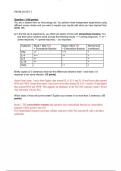
Cytokines Strain 1 Mice Th2 Strain 2 Mice Th1 Normal level
+ Extracellular Bacteria + Extracellular Bacteria (uninfected)
IFNJ -/+ +++ +
IL-4 +++ -/+ +
IL-5 ++ - +
IL-10 ++ - +
TNFE - ++ +
Briefly explain (2-3 sentences) what are the differences between strain 1 and strain 2 in
response to the same infection. (15 points)
Serum from strain 1 mice show higher than normal IL-4, IL-5 and IL-10 and lower than normal
IFNJ and TNFE. Serum from strain 2 mice have lower than normal IL-4, IL-5 and IL-10 and higher
than normal IFNJ and TNFE. This suggests an imbalance in the Th1/Th2 response; strain 1 favors
Th2 and strain 2 favors Th1.
Which strain of mice will survive better? Explain your answer in no more than 3 sentences. (15
points)
Strain 1, Th2 extracellular response (the question says extracellular bacteria so extracellular
response will be good to survive)
Th1 (intracellular response) activates cellular responses while Th2 activates B cells to produce
antibodies.
, lOMoAR cPSD| 67691079
PROBLEM SET 2
b) In the second set of experiments, you test the function of lymphocytes from two additional
mouse strains (A and B). You isolate T cells and NK cells, and test their response to cytokine
stimulation. In strain A, T cells and NK cells respond normally to IL-7 and IL-21, however,
their proliferative response to IL-2 and IL-15 is diminished. T cells and NK cells from strain B
respond normally to all cytokines. ++ (strong proliferative response), - (no proliferative
response).
Cell type Cytokine Strain A Strain B Normal mice
T cell IL-2 - ++ ++
IL-7 ++ ++ ++
IL-15 - ++ ++
IL-21 ++ ++ ++
NK cells IL-7 ++ ++ ++
IL-15 - ++ ++
IL-21 ++ ++ ++
Briefly explain (2-3 sentences) what is the defect in strain A and why do cells from this mouse
behave this way. (20 points)
IL-2RE deficiency that is seen in both IL-2 and IL-15
PROBLEM SET 2
Question 1 (100 points)
You are a student from an immunology lab. You perform three independent experiments using
different mouse strains and you want to explain your results with what you have learned from
MIMG 185.
a) In the first set of experiments, you infect two strains of mice with extracellular bacteria. You
test their serum cytokine levels and get the following results: +++ (strong response), ++ or +
(lower response), +/- (partial response), - (no response).
Cytokines Strain 1 Mice Th2 Strain 2 Mice Th1 Normal level
+ Extracellular Bacteria + Extracellular Bacteria (uninfected)
IFNJ -/+ +++ +
IL-4 +++ -/+ +
IL-5 ++ - +
IL-10 ++ - +
TNFE - ++ +
Briefly explain (2-3 sentences) what are the differences between strain 1 and strain 2 in
response to the same infection. (15 points)
Serum from strain 1 mice show higher than normal IL-4, IL-5 and IL-10 and lower than normal
IFNJ and TNFE. Serum from strain 2 mice have lower than normal IL-4, IL-5 and IL-10 and higher
than normal IFNJ and TNFE. This suggests an imbalance in the Th1/Th2 response; strain 1 favors
Th2 and strain 2 favors Th1.
Which strain of mice will survive better? Explain your answer in no more than 3 sentences. (15
points)
Strain 1, Th2 extracellular response (the question says extracellular bacteria so extracellular
response will be good to survive)
Th1 (intracellular response) activates cellular responses while Th2 activates B cells to produce
antibodies.
, lOMoAR cPSD| 67691079
PROBLEM SET 2
b) In the second set of experiments, you test the function of lymphocytes from two additional
mouse strains (A and B). You isolate T cells and NK cells, and test their response to cytokine
stimulation. In strain A, T cells and NK cells respond normally to IL-7 and IL-21, however,
their proliferative response to IL-2 and IL-15 is diminished. T cells and NK cells from strain B
respond normally to all cytokines. ++ (strong proliferative response), - (no proliferative
response).
Cell type Cytokine Strain A Strain B Normal mice
T cell IL-2 - ++ ++
IL-7 ++ ++ ++
IL-15 - ++ ++
IL-21 ++ ++ ++
NK cells IL-7 ++ ++ ++
IL-15 - ++ ++
IL-21 ++ ++ ++
Briefly explain (2-3 sentences) what is the defect in strain A and why do cells from this mouse
behave this way. (20 points)
IL-2RE deficiency that is seen in both IL-2 and IL-15