
BOTAONE T2
Botany Lecture AY 22-23
How plants
TRANS: TOPIC
grow
————————Outline———————— monocot
I. Dicot
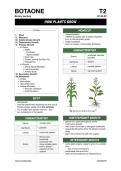
- monocotyledon
II. Monocot
- marked by seeds with a single cotyledon
III. Indeterminate Growth
- form a monophyletic group
IV. Determinate Growth
- single cotyledon
V. Primary Growth
- have no means of secondary thickeing
• In Roots
> Stelle characteristics
• Prosteles
• Siphonosteles - scattered vascular
> Root Cap Stems
bundles
> Growth behind the Root Tip
> Endodermis Cambium - absent
• In Shoots
> Shoot Apical Meristem Leaves - parallel pattern
> Leaf Premordia
> Axillary Buds Roots - tap root system
VI. Secondary Growth
VII. Meristems
• Initials
• Derivatives
• Apical Meristem
• Lateral Meristem
> Vascular Cambium
> Cork Cambium
Dicot
- dicotyledon
- vascular plants that reproduce by the use of
owers whose seeds have two embryos
- no. of xylem and phloem are two - four
- two cotyledons in the seeds
characteristics indetermidate growth
- growth of a plant throughout its life
Stems - usually solid - continuous growth
- present - main stem continues to elongate inde nitely
Cambium - sequential owering from the lateral or basal
- branched pattern buds
Leaves
- plant will continue to add new organs
- brous and
branched
- branched into determinate growth
Roots many smaller parts - some plant organs cease to grow to a certain
- form a dense size
network of root - size of fruit and owers
system - predictable size and form
- shoot is terminated by an in orescence
Joshua Mercado 12230278
fifl fl fl fl fi
, BOTAONE T2
Botany Lecture AY 22-23
How plants grow
- nite growth - solenostele
- dictyostele
- eustele (dicot stem)
primary growth - atactostele (monocot stem)
- elongates parts of the root and shoot
systems
- upward and downward growth
- present in all plants
- arises from cells produced by apical
meristems
- occur simultaneously with secondary growth
- in most eudicots
- xylem is starlike in appearance w/ phloem root cap
between the “arms”
- in many monocots
- covers the root tip
- core of parenchyma is surrounded by - protects the apical meristem as the root
rings of xylem then phloem pushes through the soil
primary growth of roots growth behid the root tip
- produces epidermis, ground tissue, and zone of
vascular tissue zone of cell zone of
di erentiation
division elongation
/mutation
stele
- central core of the stem and root of vascular
plant
- consists of the vascular tissues and
associated supporting tissue
protosteles
- xylem is in the centre of the stem and
surrounded by a narrow band of phloem
- Types:
- haplosteles
- actinostele
- plectostele
siphonosteles
- consists of a core of pith surrounded by endodermis
concentric layers of xylem and phloem - innermost layer of the cortex
- Types: - regulates passage of substances from the
soil into the vascular cylinder
Joshua Mercado 12230278
fi ff
Botany Lecture AY 22-23
How plants
TRANS: TOPIC
grow
————————Outline———————— monocot
I. Dicot
- monocotyledon
II. Monocot
- marked by seeds with a single cotyledon
III. Indeterminate Growth
- form a monophyletic group
IV. Determinate Growth
- single cotyledon
V. Primary Growth
- have no means of secondary thickeing
• In Roots
> Stelle characteristics
• Prosteles
• Siphonosteles - scattered vascular
> Root Cap Stems
bundles
> Growth behind the Root Tip
> Endodermis Cambium - absent
• In Shoots
> Shoot Apical Meristem Leaves - parallel pattern
> Leaf Premordia
> Axillary Buds Roots - tap root system
VI. Secondary Growth
VII. Meristems
• Initials
• Derivatives
• Apical Meristem
• Lateral Meristem
> Vascular Cambium
> Cork Cambium
Dicot
- dicotyledon
- vascular plants that reproduce by the use of
owers whose seeds have two embryos
- no. of xylem and phloem are two - four
- two cotyledons in the seeds
characteristics indetermidate growth
- growth of a plant throughout its life
Stems - usually solid - continuous growth
- present - main stem continues to elongate inde nitely
Cambium - sequential owering from the lateral or basal
- branched pattern buds
Leaves
- plant will continue to add new organs
- brous and
branched
- branched into determinate growth
Roots many smaller parts - some plant organs cease to grow to a certain
- form a dense size
network of root - size of fruit and owers
system - predictable size and form
- shoot is terminated by an in orescence
Joshua Mercado 12230278
fifl fl fl fl fi
, BOTAONE T2
Botany Lecture AY 22-23
How plants grow
- nite growth - solenostele
- dictyostele
- eustele (dicot stem)
primary growth - atactostele (monocot stem)
- elongates parts of the root and shoot
systems
- upward and downward growth
- present in all plants
- arises from cells produced by apical
meristems
- occur simultaneously with secondary growth
- in most eudicots
- xylem is starlike in appearance w/ phloem root cap
between the “arms”
- in many monocots
- covers the root tip
- core of parenchyma is surrounded by - protects the apical meristem as the root
rings of xylem then phloem pushes through the soil
primary growth of roots growth behid the root tip
- produces epidermis, ground tissue, and zone of
vascular tissue zone of cell zone of
di erentiation
division elongation
/mutation
stele
- central core of the stem and root of vascular
plant
- consists of the vascular tissues and
associated supporting tissue
protosteles
- xylem is in the centre of the stem and
surrounded by a narrow band of phloem
- Types:
- haplosteles
- actinostele
- plectostele
siphonosteles
- consists of a core of pith surrounded by endodermis
concentric layers of xylem and phloem - innermost layer of the cortex
- Types: - regulates passage of substances from the
soil into the vascular cylinder
Joshua Mercado 12230278
fi ff


