

Chapter 34 Mod 4 MDC Exam Questions and
Answers with Verified Solutions | Latest
Updated 2026
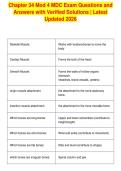
Skeletal Muscle: Works with tendons/bones to move the
body
Cardiac Muscle: Forms the bulk of the heart
Smooth Muscle: Forms the walls of hollow organs
(stomach,
intestines, blood vessels, ureters)
origin muscle attachment the attachment to the more stationary
bone,
insertion muscle attachment the attachment to the more movable bone
Which bones are long bones: Upper and lower extremities (contribute to
height/length)
Which bones are short bones: Wrist and ankle (contribute to movement)
Which bones are flat bones: Ribs and skull (contribute to shape)
which bones are irregular bones: Spinal column and jaw
, Abduction: Lateral movement away from the midline
of the
body
Adduction: Movement toward the midline
Circumduction: Turning the distal part of a limb to trace a
circle
while the proximal end remains fixed
Flexion: The state of being bent
Dorsiflexion: Backward bending of the hand or foot
Plantar flexion: Bending the foot downward
Afferent neurons convey information from the periphery to
the CNS;
the CNS processes it.
Efferent neurons convey the response back to skeletal
muscles via
the somatic nervous system
pyramidal pathway controls voluntary movements,
extrapyramidal pathway controls involuntary movements
Answers with Verified Solutions | Latest
Updated 2026
Skeletal Muscle: Works with tendons/bones to move the
body
Cardiac Muscle: Forms the bulk of the heart
Smooth Muscle: Forms the walls of hollow organs
(stomach,
intestines, blood vessels, ureters)
origin muscle attachment the attachment to the more stationary
bone,
insertion muscle attachment the attachment to the more movable bone
Which bones are long bones: Upper and lower extremities (contribute to
height/length)
Which bones are short bones: Wrist and ankle (contribute to movement)
Which bones are flat bones: Ribs and skull (contribute to shape)
which bones are irregular bones: Spinal column and jaw
, Abduction: Lateral movement away from the midline
of the
body
Adduction: Movement toward the midline
Circumduction: Turning the distal part of a limb to trace a
circle
while the proximal end remains fixed
Flexion: The state of being bent
Dorsiflexion: Backward bending of the hand or foot
Plantar flexion: Bending the foot downward
Afferent neurons convey information from the periphery to
the CNS;
the CNS processes it.
Efferent neurons convey the response back to skeletal
muscles via
the somatic nervous system
pyramidal pathway controls voluntary movements,
extrapyramidal pathway controls involuntary movements


