

Rédigé par des étudiants ayant réussi Disponible immédiatement après paiement Lire en ligne ou en PDF Mauvais document ? Échangez-le gratuitement 4,6 TrustPilot
logo-home
Document preview thumbnail
Aperçu 1 sur 2 pages
Dissertation

Humans have an innate knowledge of God – Discuss. 40 marks

Document preview thumbnail
Aperçu 1 sur 2 pages

This is an OCR A Level Religious Studies Developments in Christian Thought essay on the question “Humans have an innate knowledge of God – Discuss”, written by myself after achieving an A grade in OCR A Level Religious Studies (2021). It explores the idea of natural knowledge of God, focusing on John Calvin’s concept of sensus divinitatis and the belief that humans have an inbuilt awareness of the divine. The essay evaluates arguments for and against innate knowledge of God, considering ideas such as the Universal Consent argument, the role of conscience, imago Dei, and the distinction between natural and revealed knowledge. It also compares the views of key thinkers including Karl Barth and Richard Dawkins, weighing up whether God can be known through reason alone or only through revelation. This resource is ideal for revision, essay planning, and exam preparation, providing a clear model answer with balanced evaluation for OCR A Level Religious Studies Developments in Christian Thought 40-mark questions on the knowledge of God

Aperçu du contenu

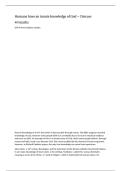
Humans have an innate knowledge of God – Discuss
40 marks
OCR A-level religious studies


Natural knowledge of God is that which is discoverable through reason. The Bible supports revealed
knowledge of God, however many people think it is unreliable due to its lack of empirical evidence
and focus on faith. An example of this is an innate sense of God, which some people believe, through
reason and faith, leads us to discover God. This can be justified by the Universal Consent argument,
however, as Richard Dawkins argues, the only true knowledge can come from experience.

John Calvin, a 16th century theologian, and the Catechism of the Roman Catholic Church both believe
in an innate knowledge of God. Calvin, in his writings ‘Institutes’, called this ‘sensus divinitatis’,
meaning a sense of the divine, or ‘seed of religion’, which is imprinted into human nature. He


Infos sur le Document

Niveau d'études
Sujet
Publié le
5 juillet 2026
Nombre de pages
2
Écrit en
2020/2021
Type
Dissertation
Professeur(s)
Inconnu
Grade
A
$4.87

Mauvais document ? Échangez-le gratuitement Dans les 14 jours suivant votre achat et avant le téléchargement, vous pouvez choisir un autre document. Vous pouvez simplement dépenser le montant à nouveau.
Rédigé par des étudiants ayant réussi
Disponible immédiatement après paiement
Lire en ligne ou en PDF

Vendu
0
Abonnés
0
Éléments
20
Dernière vente
-


Pourquoi les étudiants choisissent Stuvia

Créé par d'autres étudiants, vérifié par les avis

Une qualité sur laquelle compter : rédigé par des étudiants qui ont réussi et évalué par d'autres qui ont utilisé ce document.

Le document ne convient pas ? Choisis un autre document

Aucun souci ! Tu peux sélectionner directement un autre document qui correspond mieux à ce que tu cherches.

Paye comme tu veux, apprends aussitôt

Aucun abonnement, aucun engagement. Paye selon tes habitudes par carte de crédit et télécharge ton document PDF instantanément.

Student with book image

“Acheté, téléchargé et réussi. C'est aussi simple que ça.”

Alisha Student

Vous travaillez sur vos références ?

Créez des citations précises en APA, MLA et Harvard avec notre générateur de sources gratuit.

Vous travaillez sur vos références ?

Foire aux questions
