

KINE 405 - Exercise Management Lab
Midterm Exam Questions and Answers with
Verified Solutions | Latest Updated 2026
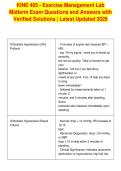
Orthostatic Hypotension (OH) - 5 minutes of supine rest measure BP +
Protocol HR).
- say "At my signal, I want you to stand up
smoothly
but not too quickly. Take a moment to get
your
balance. Tell me if you feel dizzy,
lightheaded, or
unwell at any point. If so, I'll help you back
to lying
down immediately."
- followed by measurements taken at 1
minute, 2
minutes, and 3 minutes after standing.
Some
protocols also measure immediately upon
standing.
Orthostatic Hypotension Result - Normal: drop < 10 mmHg; HR increase of
Criteria 10-15
bpm.
- Abnormal (Diagnostic): drop ≥ 20 mmHg
or DBP
drop ≥ 10 mmHg within 3 minutes of
standing.
- Clinical Significance: Indicates autonomic
dysfunction or hypovolemia; high fall risk.
, A client's blood pressure changes This is a positive ("abnormal") result for
from 130/84 mmHg while supine to Orthostatic
108/80 mmHg after 2 minutes of Hypotension. The SBP dropped by 22
standing during the OH test. How mmHg (130 -
would you classify this response 108), which exceeds the diagnostic
and threshold of ≥
why? 20 mmHg.
What is the formula for calculating Rate-Pressure Product = Heart Rate (bpm)
RPP? ×
Systolic Blood Pressure (mmHg)
What is the primary safety action The examiner must stand near the client
an during the
examiner must take during the transition to standing to be able to catch
"immediate standing" phase of the them in
OH test? case of syncope (fainting). This is a critical
spotting
technique.
What is the normal RPP range for A normal resting RPP is 7,000-9,000
a mmHg·bpm.
healthy resting adult, and what A value >10,000 mmHg·bpm at rest
value suggests
suggests an elevated elevated cardiovascular risk.
cardiovascular
risk?
Midterm Exam Questions and Answers with
Verified Solutions | Latest Updated 2026
Orthostatic Hypotension (OH) - 5 minutes of supine rest measure BP +
Protocol HR).
- say "At my signal, I want you to stand up
smoothly
but not too quickly. Take a moment to get
your
balance. Tell me if you feel dizzy,
lightheaded, or
unwell at any point. If so, I'll help you back
to lying
down immediately."
- followed by measurements taken at 1
minute, 2
minutes, and 3 minutes after standing.
Some
protocols also measure immediately upon
standing.
Orthostatic Hypotension Result - Normal: drop < 10 mmHg; HR increase of
Criteria 10-15
bpm.
- Abnormal (Diagnostic): drop ≥ 20 mmHg
or DBP
drop ≥ 10 mmHg within 3 minutes of
standing.
- Clinical Significance: Indicates autonomic
dysfunction or hypovolemia; high fall risk.
, A client's blood pressure changes This is a positive ("abnormal") result for
from 130/84 mmHg while supine to Orthostatic
108/80 mmHg after 2 minutes of Hypotension. The SBP dropped by 22
standing during the OH test. How mmHg (130 -
would you classify this response 108), which exceeds the diagnostic
and threshold of ≥
why? 20 mmHg.
What is the formula for calculating Rate-Pressure Product = Heart Rate (bpm)
RPP? ×
Systolic Blood Pressure (mmHg)
What is the primary safety action The examiner must stand near the client
an during the
examiner must take during the transition to standing to be able to catch
"immediate standing" phase of the them in
OH test? case of syncope (fainting). This is a critical
spotting
technique.
What is the normal RPP range for A normal resting RPP is 7,000-9,000
a mmHg·bpm.
healthy resting adult, and what A value >10,000 mmHg·bpm at rest
value suggests
suggests an elevated elevated cardiovascular risk.
cardiovascular
risk?


