
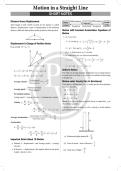
Motion in a Straight Line
SHORT NOTES
Distance Versus Displacement Differentiation Differentiation
Displa- Accele-
Velocity
Total length of path (ACB) covered by the particle is called cement ration
Integration Integration
distance. Displacement vector or displacement is the minimum
distance (AB) and directed from initial position to final position. Motion with Constant Acceleration: Equations of
C Motion
In vector form:
A B
u+v 1 2 1 2
v= u + at and ∆ r = r2 − r1 , s = t = ut + at = vt − at
Displacement is Change of Position Vector 2 2 2
From DOAB ∆ r = rB − rA a
v2 = u2 + 2a.s and sn th =u + (2n − 1)
2
A
(Snth → displacement in nth second)
Dr
In scalar form (for one dimensional motion):
rA B u+v 1 2 1 2
v = u + at s= t =+ut at =−vt at
2 2 2
rB
a
O v2 = u2 + 2as sn = u + (2n – 1)
2
rB = x 2 ˆi + y 2 ˆj + z 2 kˆ and rA = x1ˆi + y1ˆj + z1kˆ Uniform Motion
If an object is moving along the straight line covers equal distance
∆ r= (x 2 − x1 )iˆ + (y 2 − y1 )ˆj + (z 2 − z1 )kˆ in equal interval of time, it is said to be in uniform motion along
a straight line.
Displacement ∆r
Average velocity = ⇒ v av = Motion under Gravity (No Air Resistance)
Time interval ∆t
If an object is falling freely (u = 0) under gravity, then equations
Distance travelled of motion becomes
Average speed = (i) v = u + gt
Time interval
1
For uniform motion (ii) h = ut + gt2
2
Average speed = | average velocity | = | instantaneous velocity | (iii) v2 = u2 + 2gh
Notes: If an object is thrown upward then g is replaced by –g in
Velocity v = dr = d (xiˆ + yjˆ + zk)
ˆ
dt dt above three equations.
If a body is thrown vertically up with a velocity u in the uniform
dx ˆ dy ˆ dz ˆ
= i+ j + k = v x ˆi + v y ˆj + v z kˆ gravitational field then
dt dt dt
Total change in velocity ∆v
Average Acceleration = = a= av
Total time taken ∆t
H
Acceleration
dv d
a= = (v x ˆi + v y ˆj + v z k)
ˆ u
dt dt
dv dv y ˆ dv z ˆ
= x ˆi + j+ k = a x ˆi + a y ˆj + a z kˆ
dt dt dt u2
(i) Maximum height attained H =
2g
Important Points About 1D Motion
u
Distance ≥ | displacement | and Average speed ≥ | average (ii) Time of ascent = time of descent =
g
velocity |
If distance > | displacement | this implies atleast at one point 2u
(iii) Total time of flight =
in path, velocity is zero. g
1
SHORT NOTES
Distance Versus Displacement Differentiation Differentiation
Displa- Accele-
Velocity
Total length of path (ACB) covered by the particle is called cement ration
Integration Integration
distance. Displacement vector or displacement is the minimum
distance (AB) and directed from initial position to final position. Motion with Constant Acceleration: Equations of
C Motion
In vector form:
A B
u+v 1 2 1 2
v= u + at and ∆ r = r2 − r1 , s = t = ut + at = vt − at
Displacement is Change of Position Vector 2 2 2
From DOAB ∆ r = rB − rA a
v2 = u2 + 2a.s and sn th =u + (2n − 1)
2
A
(Snth → displacement in nth second)
Dr
In scalar form (for one dimensional motion):
rA B u+v 1 2 1 2
v = u + at s= t =+ut at =−vt at
2 2 2
rB
a
O v2 = u2 + 2as sn = u + (2n – 1)
2
rB = x 2 ˆi + y 2 ˆj + z 2 kˆ and rA = x1ˆi + y1ˆj + z1kˆ Uniform Motion
If an object is moving along the straight line covers equal distance
∆ r= (x 2 − x1 )iˆ + (y 2 − y1 )ˆj + (z 2 − z1 )kˆ in equal interval of time, it is said to be in uniform motion along
a straight line.
Displacement ∆r
Average velocity = ⇒ v av = Motion under Gravity (No Air Resistance)
Time interval ∆t
If an object is falling freely (u = 0) under gravity, then equations
Distance travelled of motion becomes
Average speed = (i) v = u + gt
Time interval
1
For uniform motion (ii) h = ut + gt2
2
Average speed = | average velocity | = | instantaneous velocity | (iii) v2 = u2 + 2gh
Notes: If an object is thrown upward then g is replaced by –g in
Velocity v = dr = d (xiˆ + yjˆ + zk)
ˆ
dt dt above three equations.
If a body is thrown vertically up with a velocity u in the uniform
dx ˆ dy ˆ dz ˆ
= i+ j + k = v x ˆi + v y ˆj + v z kˆ gravitational field then
dt dt dt
Total change in velocity ∆v
Average Acceleration = = a= av
Total time taken ∆t
H
Acceleration
dv d
a= = (v x ˆi + v y ˆj + v z k)
ˆ u
dt dt
dv dv y ˆ dv z ˆ
= x ˆi + j+ k = a x ˆi + a y ˆj + a z kˆ
dt dt dt u2
(i) Maximum height attained H =
2g
Important Points About 1D Motion
u
Distance ≥ | displacement | and Average speed ≥ | average (ii) Time of ascent = time of descent =
g
velocity |
If distance > | displacement | this implies atleast at one point 2u
(iii) Total time of flight =
in path, velocity is zero. g
1


