

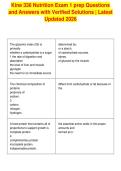
Kine 336 Nutrition Exam 1 prep Questions
and Answers with Verified Solutions | Latest
Updated 2026
The glycemic index (GI) is determined by:
primarily or a starch.
whether a carbohydrate is a sugar of carbohydrate sources.
1 the rate of digestion and stores.
absorption of glucose by the muscle.
the level of liver and muscle
glycogen
the need for an immediate source
The chemical composition of differs from carbohydrate or fat because of
proteins the
presence of:
sodium.
3
carbon.
nitrogen.
hydrogen.
A food protein that contains all of the essential amino acids in the proper
proportions to support growth is amounts and
complete protein. termed a(n):
4
complementary protein.
incomplete protein.
indispensable protein.
, The glycemic index (GI) is the rate of digestion and absorption of
primarily carbohydrate sources.
determined by:
whether a carbohydrate is a sugar
or
a starch.
the rate of digestion and
absorption
of carbohydrate sources.
the level of liver and muscle
glycogen stores.
the need for an immediate source
of
glucose by the muscle.
What are the consequences of All of the above
reduced carbohydrate intake for
athletes?
Glycogen depletion
Acute fatigue
Chronic fatigue
All of the above
None of the above
According to Acceptable 338-488 g/d
Macronutrient Distribution Ranges
(AMDR), how many grams of
carbohydrate should be consumed
daily for an athlete consuming a
3,000 calorie diet?
130-200 g/d
225-325 g/d
338-488 g/d
500-650 g/d
and Answers with Verified Solutions | Latest
Updated 2026
The glycemic index (GI) is determined by:
primarily or a starch.
whether a carbohydrate is a sugar of carbohydrate sources.
1 the rate of digestion and stores.
absorption of glucose by the muscle.
the level of liver and muscle
glycogen
the need for an immediate source
The chemical composition of differs from carbohydrate or fat because of
proteins the
presence of:
sodium.
3
carbon.
nitrogen.
hydrogen.
A food protein that contains all of the essential amino acids in the proper
proportions to support growth is amounts and
complete protein. termed a(n):
4
complementary protein.
incomplete protein.
indispensable protein.
, The glycemic index (GI) is the rate of digestion and absorption of
primarily carbohydrate sources.
determined by:
whether a carbohydrate is a sugar
or
a starch.
the rate of digestion and
absorption
of carbohydrate sources.
the level of liver and muscle
glycogen stores.
the need for an immediate source
of
glucose by the muscle.
What are the consequences of All of the above
reduced carbohydrate intake for
athletes?
Glycogen depletion
Acute fatigue
Chronic fatigue
All of the above
None of the above
According to Acceptable 338-488 g/d
Macronutrient Distribution Ranges
(AMDR), how many grams of
carbohydrate should be consumed
daily for an athlete consuming a
3,000 calorie diet?
130-200 g/d
225-325 g/d
338-488 g/d
500-650 g/d


