

Test Bank For
Environment The Science Behind the Stories, Canadian Edition, 3rd edition Jay H Withgott
Matthew Laposata Barbara Murck
Chapters 1-22
Chapter 1 An Introduction to Environmental Science
1.1 Graph and Figure Interpretation Questions
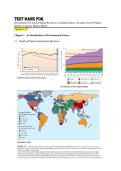
, Figure 1.1
Use Figure 1.1 to answer the following questions.
1) The component of the ecological footprint that in all years accounts for the greatest amount is
________.
A) built-up land
B) fishing grounds
C) carbon
D) cropland
E) grazing land
Answer: C
Diff: 3 Type: MC
Bloom's Taxonomy: 3 - Applying
Objective: 1.4 Diagnose and illustrate some of the pressures on the global environment
2) Canada currently has a biocapacity credit of approximately ________.
A) 0-50%
B) 50-100%
C) 100-150%
D) 150%
E) 200%
Answer: C
Diff: 1 Type: MC
Bloom's Taxonomy: 3 - Applying
Objective: 1.4 Diagnose and illustrate some of the pressures on the global environment
3) The United States and China are the two largest economies in the world and account for what
percentage of biocapacity debt each respectively?
A) 50-100% and 100-150%
B) 150% each
C) 50-100% and 150%
D) 50-100% each
Answer: A
Diff: 1 Type: MC
Bloom's Taxonomy: 2 - Understanding
Objective: 1.4 Diagnose and illustrate some of the pressures on the global environment
,1.2 Matching Questions
Match the following.
A) traditional
B) environmentalism
C) goods
D) nonrenewable resources
E) natural resources
F) ecology
G) experimental data
H) natural sciences.
I) sustainable development
J) science
K) environmental studies.
L) ecological sustainability
M) renewable resources
N) interdisciplinary
1) a scientific field of study
Diff: 1 Type: MA
Bloom's Taxonomy: 2 - Understanding
Objective: 1.2 Characterize the interdisciplinary nature of environmental science
2) Environmental science is a(n) ________ field.
Diff: 1 Type: MA
Bloom's Taxonomy: 1 - Remembering
Objective: 1.2 Characterize the interdisciplinary nature of environmental science
3) Tangible material things that can be extracted from the environment are ________.
Diff: 2 Type: MA
Bloom's Taxonomy: 2 - Understanding
Objective: 1.3 Describe several types of natural resources and explain their importance to
human life
4) "Meets the needs of the present without sacrificing the ability of future generations to meet
their needs" is the definition of ________.
Diff: 2 Type: MA
Bloom's Taxonomy: 1 - Remembering
Objective: 1.5 Articulate the concepts of sustainability and sustainable development
5) Social studies dealing with the environment are part of
Diff: 2 Type: MA
Bloom's Taxonomy: 3 - Applying
Objective: 1.2 Characterize the interdisciplinary nature of environmental science
, 6) a social movement
Diff: 1 Type: MA
Bloom's Taxonomy: 1 - Remembering
Objective: 1.2 Characterize the interdisciplinary nature of environmental science
7) resources that replenish over short periods of time
Diff: 1 Type: MA
Bloom's Taxonomy: 1 - Remembering
Objective: 1.3 Describe several types of natural resources and explain their importance to
human life
Answers: 1) F 2) N 3) C 4) I 5) K 6) B 7) M
1.3 Short Answer Questions
1) Differentiate between renewable and nonrenewable natural resources. Give examples of each.
Answer: Renewable resources are virtually unlimited (e.g., sunlight) or are replenished over
short periods of time (e.g., plants). Nonrenewable natural resources are limited in supply and are
not replenished or are formed much more slowly than we use them. These would include oil and
minerals such as gold, copper, and aluminium. Renewable resources may become nonrenewable
if the rate of use outstrips the rate of renewal (e.g., overfishing).
Diff: 1 Type: ES
Bloom's Taxonomy: 4 - Analyzing
Objective: 1.3 Describe several types of natural resources and explain their importance to
human life
2) How does the lesson of Rapa Nui apply to the modern world?
Answer: On Rapa Nui, research has provided data supporting the hypothesis that overuse of
natural resources led to the collapse of the civilization. Even the cultural move from hunting and
gathering to agriculture did not prevent the collapse; it only delayed it. The modern world is
much like Easter Island with larger resource pools, and the message remains the same.
Civilizations can crumble when population pressure overwhelms resource availability, although
for the modern world, this collapse will be a long time in arriving because of advances in such
fields as technology, engineering, agriculture, and medicine. This will postpone, but not prevent,
eventual societal collapse if the way that resources are used is not changed to be more
sustainable.
Diff: 2 Type: ES
Bloom's Taxonomy: 5 - Evaluating
Objective: 1.2 Characterize the interdisciplinary nature of environmental science
Environment The Science Behind the Stories, Canadian Edition, 3rd edition Jay H Withgott
Matthew Laposata Barbara Murck
Chapters 1-22
Chapter 1 An Introduction to Environmental Science
1.1 Graph and Figure Interpretation Questions
, Figure 1.1
Use Figure 1.1 to answer the following questions.
1) The component of the ecological footprint that in all years accounts for the greatest amount is
________.
A) built-up land
B) fishing grounds
C) carbon
D) cropland
E) grazing land
Answer: C
Diff: 3 Type: MC
Bloom's Taxonomy: 3 - Applying
Objective: 1.4 Diagnose and illustrate some of the pressures on the global environment
2) Canada currently has a biocapacity credit of approximately ________.
A) 0-50%
B) 50-100%
C) 100-150%
D) 150%
E) 200%
Answer: C
Diff: 1 Type: MC
Bloom's Taxonomy: 3 - Applying
Objective: 1.4 Diagnose and illustrate some of the pressures on the global environment
3) The United States and China are the two largest economies in the world and account for what
percentage of biocapacity debt each respectively?
A) 50-100% and 100-150%
B) 150% each
C) 50-100% and 150%
D) 50-100% each
Answer: A
Diff: 1 Type: MC
Bloom's Taxonomy: 2 - Understanding
Objective: 1.4 Diagnose and illustrate some of the pressures on the global environment
,1.2 Matching Questions
Match the following.
A) traditional
B) environmentalism
C) goods
D) nonrenewable resources
E) natural resources
F) ecology
G) experimental data
H) natural sciences.
I) sustainable development
J) science
K) environmental studies.
L) ecological sustainability
M) renewable resources
N) interdisciplinary
1) a scientific field of study
Diff: 1 Type: MA
Bloom's Taxonomy: 2 - Understanding
Objective: 1.2 Characterize the interdisciplinary nature of environmental science
2) Environmental science is a(n) ________ field.
Diff: 1 Type: MA
Bloom's Taxonomy: 1 - Remembering
Objective: 1.2 Characterize the interdisciplinary nature of environmental science
3) Tangible material things that can be extracted from the environment are ________.
Diff: 2 Type: MA
Bloom's Taxonomy: 2 - Understanding
Objective: 1.3 Describe several types of natural resources and explain their importance to
human life
4) "Meets the needs of the present without sacrificing the ability of future generations to meet
their needs" is the definition of ________.
Diff: 2 Type: MA
Bloom's Taxonomy: 1 - Remembering
Objective: 1.5 Articulate the concepts of sustainability and sustainable development
5) Social studies dealing with the environment are part of
Diff: 2 Type: MA
Bloom's Taxonomy: 3 - Applying
Objective: 1.2 Characterize the interdisciplinary nature of environmental science
, 6) a social movement
Diff: 1 Type: MA
Bloom's Taxonomy: 1 - Remembering
Objective: 1.2 Characterize the interdisciplinary nature of environmental science
7) resources that replenish over short periods of time
Diff: 1 Type: MA
Bloom's Taxonomy: 1 - Remembering
Objective: 1.3 Describe several types of natural resources and explain their importance to
human life
Answers: 1) F 2) N 3) C 4) I 5) K 6) B 7) M
1.3 Short Answer Questions
1) Differentiate between renewable and nonrenewable natural resources. Give examples of each.
Answer: Renewable resources are virtually unlimited (e.g., sunlight) or are replenished over
short periods of time (e.g., plants). Nonrenewable natural resources are limited in supply and are
not replenished or are formed much more slowly than we use them. These would include oil and
minerals such as gold, copper, and aluminium. Renewable resources may become nonrenewable
if the rate of use outstrips the rate of renewal (e.g., overfishing).
Diff: 1 Type: ES
Bloom's Taxonomy: 4 - Analyzing
Objective: 1.3 Describe several types of natural resources and explain their importance to
human life
2) How does the lesson of Rapa Nui apply to the modern world?
Answer: On Rapa Nui, research has provided data supporting the hypothesis that overuse of
natural resources led to the collapse of the civilization. Even the cultural move from hunting and
gathering to agriculture did not prevent the collapse; it only delayed it. The modern world is
much like Easter Island with larger resource pools, and the message remains the same.
Civilizations can crumble when population pressure overwhelms resource availability, although
for the modern world, this collapse will be a long time in arriving because of advances in such
fields as technology, engineering, agriculture, and medicine. This will postpone, but not prevent,
eventual societal collapse if the way that resources are used is not changed to be more
sustainable.
Diff: 2 Type: ES
Bloom's Taxonomy: 5 - Evaluating
Objective: 1.2 Characterize the interdisciplinary nature of environmental science


