
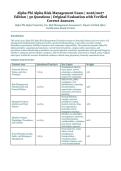
Alpha Phi Alpha Risk Management Exam | 2026/2027
Edition | 50 Questions | Original Evaluation with Verified
Correct Answers
Alpha Phi Alpha Fraternity, Inc. Risk Management Assessment | Expert-Verified Q&A |
Certification-Ready Format
Introduction
This 2026/2027 Alpha Phi Alpha Risk Management Evaluation focuses on fraternity history and core values, risk
management fundamentals, hazing prevention, alcohol and drug policies, event safety, member conduct,
disciplinary expectations, liability awareness, and community responsibility. The questions integrate Alpha Phi
Alpha principles, organizational standards, current fraternity policies, campus safety expectations, and
prevention-centered leadership so members can protect physical, emotional, reputational, and legal well-being for
members, aspirants, guests, families, campuses, and the broader community. Each item is original, policy-aligned,
and expert-verified for accurate Evaluation readiness without using proprietary fraternity assessment items.
Content Area Overview
Content Area Questions (Total 50) Key Topics Weight
Foundational identity,
Fraternity History, aims, motto, service
Values, and Core 7 of 50 orientation, scholarship, 15%
Principles leadership, brotherhood,
respect for community
Duty of care, policy
compliance, risk
Risk Management identification, reporting,
Fundamentals and 13 of 50 documentation, 25%
General Policies supervision, insurance
awareness, prevention
planning
Hazing definition,
consent, coercion,
Hazing Prevention, prohibited conduct,
Alcohol, and Drug 13 of 50 alcohol controls, drug- 25%
Policies free expectations,
bystander action,
emergency response
Member accountability,
investigations, sanctions,
Member Conduct,
reporting channels,
Disciplinary Procedures, 10 of 50 20%
confidentiality, retaliation
and Liability
prevention, individual
and chapter exposure
Event approval, venue
safety, crowd
Event Planning, Facility management,
Safety, and Emergency 7 of 50 transportation, 15%
Management emergency plans,
incident response, post-
event documentation
, Examination Questions
Domain: Fraternity History, Values, and Core Principles
1. Which statement best reflects the purpose of risk management within Alpha Phi Alpha
Fraternity, Inc.?
A. It exists only to complete paperwork after an incident.
B. It protects members, aspirants, guests, the fraternity, campuses, and communities through prevention and
accountability.
C. It allows chapters to ignore campus rules if an event is private.
D. It applies only to events with outside guests.
Correct Answer: B
Rationale: Risk management is a proactive system for preventing harm, reducing exposure, and aligning
conduct with fraternity values and governing policies. It protects people first while also protecting chapters,
officers, and the organization.
2. Which Alpha Phi Alpha aim most directly supports academic integrity and responsible member
development?
A. Scholarship
B. Secrecy at all costs
C. Informal pressure
D. Unrestricted social conduct
Correct Answer: A
Rationale: Scholarship reflects intellectual growth, academic responsibility, and disciplined excellence. Risk
management supports this aim by maintaining environments where members and aspirants can thrive
without coercion, fear, or unsafe behavior.
3. Which phrase best aligns with Alpha Phi Alpha's service-oriented identity?
A. Personal convenience above public responsibility
B. First of all, servants of all
C. Status before brotherhood
D. Tradition above safety
Correct Answer: B
Rationale: The fraternity's service-oriented identity emphasizes leadership, service, and transcendence. Risk
management is consistent with that identity because protecting people is a core expression of responsible
leadership.
4. A chapter officer says that risk management weakens brotherhood because it limits old
customs. Which response best reflects fraternity values?
A. Brotherhood is strengthened when members protect one another and reject harmful conduct.
B. Brotherhood requires silence whenever harm occurs.
C. Brotherhood allows dangerous conduct if alumni approve.
D. Brotherhood applies only after initiation.
Correct Answer: A
Rationale: True brotherhood is not based on harm, secrecy, or coercion. It is strengthened by care,
accountability, lawful conduct, and respect for the dignity of every person connected to the fraternity.
5. Which principle should guide decisions when tradition conflicts with safety or policy?
A. Continue the tradition if it has been done before.
B. Follow safety, law, and fraternity policies over unsafe custom.
C. Ask guests to assume all risk verbally.
D. Keep the conduct off written schedules.
Correct Answer: B
Rationale: No tradition overrides safety, law, or fraternity policy. Leaders are expected to preserve
meaningful heritage while eliminating conduct that creates harm or liability.
6. Which leadership behavior best demonstrates the fraternity's core values during an event?
A. Ignoring intoxicated guests to avoid conflict
B. Assigning sober monitors, enforcing entry controls, and stopping unsafe conduct promptly
C. Allowing unapproved activities because attendance is high
D. Waiting until after an injury to decide who is responsible
Correct Answer: B
Edition | 50 Questions | Original Evaluation with Verified
Correct Answers
Alpha Phi Alpha Fraternity, Inc. Risk Management Assessment | Expert-Verified Q&A |
Certification-Ready Format
Introduction
This 2026/2027 Alpha Phi Alpha Risk Management Evaluation focuses on fraternity history and core values, risk
management fundamentals, hazing prevention, alcohol and drug policies, event safety, member conduct,
disciplinary expectations, liability awareness, and community responsibility. The questions integrate Alpha Phi
Alpha principles, organizational standards, current fraternity policies, campus safety expectations, and
prevention-centered leadership so members can protect physical, emotional, reputational, and legal well-being for
members, aspirants, guests, families, campuses, and the broader community. Each item is original, policy-aligned,
and expert-verified for accurate Evaluation readiness without using proprietary fraternity assessment items.
Content Area Overview
Content Area Questions (Total 50) Key Topics Weight
Foundational identity,
Fraternity History, aims, motto, service
Values, and Core 7 of 50 orientation, scholarship, 15%
Principles leadership, brotherhood,
respect for community
Duty of care, policy
compliance, risk
Risk Management identification, reporting,
Fundamentals and 13 of 50 documentation, 25%
General Policies supervision, insurance
awareness, prevention
planning
Hazing definition,
consent, coercion,
Hazing Prevention, prohibited conduct,
Alcohol, and Drug 13 of 50 alcohol controls, drug- 25%
Policies free expectations,
bystander action,
emergency response
Member accountability,
investigations, sanctions,
Member Conduct,
reporting channels,
Disciplinary Procedures, 10 of 50 20%
confidentiality, retaliation
and Liability
prevention, individual
and chapter exposure
Event approval, venue
safety, crowd
Event Planning, Facility management,
Safety, and Emergency 7 of 50 transportation, 15%
Management emergency plans,
incident response, post-
event documentation
, Examination Questions
Domain: Fraternity History, Values, and Core Principles
1. Which statement best reflects the purpose of risk management within Alpha Phi Alpha
Fraternity, Inc.?
A. It exists only to complete paperwork after an incident.
B. It protects members, aspirants, guests, the fraternity, campuses, and communities through prevention and
accountability.
C. It allows chapters to ignore campus rules if an event is private.
D. It applies only to events with outside guests.
Correct Answer: B
Rationale: Risk management is a proactive system for preventing harm, reducing exposure, and aligning
conduct with fraternity values and governing policies. It protects people first while also protecting chapters,
officers, and the organization.
2. Which Alpha Phi Alpha aim most directly supports academic integrity and responsible member
development?
A. Scholarship
B. Secrecy at all costs
C. Informal pressure
D. Unrestricted social conduct
Correct Answer: A
Rationale: Scholarship reflects intellectual growth, academic responsibility, and disciplined excellence. Risk
management supports this aim by maintaining environments where members and aspirants can thrive
without coercion, fear, or unsafe behavior.
3. Which phrase best aligns with Alpha Phi Alpha's service-oriented identity?
A. Personal convenience above public responsibility
B. First of all, servants of all
C. Status before brotherhood
D. Tradition above safety
Correct Answer: B
Rationale: The fraternity's service-oriented identity emphasizes leadership, service, and transcendence. Risk
management is consistent with that identity because protecting people is a core expression of responsible
leadership.
4. A chapter officer says that risk management weakens brotherhood because it limits old
customs. Which response best reflects fraternity values?
A. Brotherhood is strengthened when members protect one another and reject harmful conduct.
B. Brotherhood requires silence whenever harm occurs.
C. Brotherhood allows dangerous conduct if alumni approve.
D. Brotherhood applies only after initiation.
Correct Answer: A
Rationale: True brotherhood is not based on harm, secrecy, or coercion. It is strengthened by care,
accountability, lawful conduct, and respect for the dignity of every person connected to the fraternity.
5. Which principle should guide decisions when tradition conflicts with safety or policy?
A. Continue the tradition if it has been done before.
B. Follow safety, law, and fraternity policies over unsafe custom.
C. Ask guests to assume all risk verbally.
D. Keep the conduct off written schedules.
Correct Answer: B
Rationale: No tradition overrides safety, law, or fraternity policy. Leaders are expected to preserve
meaningful heritage while eliminating conduct that creates harm or liability.
6. Which leadership behavior best demonstrates the fraternity's core values during an event?
A. Ignoring intoxicated guests to avoid conflict
B. Assigning sober monitors, enforcing entry controls, and stopping unsafe conduct promptly
C. Allowing unapproved activities because attendance is high
D. Waiting until after an injury to decide who is responsible
Correct Answer: B


