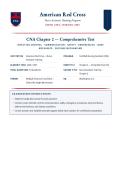
American Red Cross
2 RETPAHC · ANC
CNA
★
Nurse Assistant Training Program
EST. 1881
SAVING LIVES, CHANGING LIVES
CNA Chapter 2 — Final Examination
CO M M U N I C AT I O N · S A F E TY · I N F E CT I O N CO N T R O L · E M E R G E N C I E S · B O DY
M E C H A N I CS
INSTITUTION American Red Cross — Nurse PROGRAM Certified Nursing Assistant (CNA)
Assistant Training
ACADEMIC YEAR EXAM TITLE Chapter 2 — Final Examination
TOTAL QUESTIONS 50 Questions COURSE TITLE Nurse Assistant Training —
Chapter 2
FORMAT Multiple Choice — Select the HQ Washington, D.C.
Single Best Answer
EXAMINATION INSTRUCTIONS
▸ Select the single best answer for each question.
▸ Content covers communication, safety, infection control, emergency procedures, body mechanics, and
resident care.
▸ Correct answers and detailed rationales appear below each question for certification preparation.
, CNA CHAPTER 2 — COMMUNICATION, SAFETY &
Questions 1 – 30
INFECTION CONTROL
1. When should unsafe conditions be reported?
A. After an accident occurs
B. Before accidents occur
C. At the end of the shift
D. Only if a resident complains
CORRECT ANSWER B — Before accidents occur
RATIONALE Unsafe conditions must be reported proactively — BEFORE an accident occurs.
Prevention is the foundation of safety in healthcare. Waiting until after an
incident (A) defeats the purpose of hazard reporting. The NA should immediately
report any unsafe conditions such as wet floors, malfunctioning equipment, or
inadequate lighting to prevent resident and staff injuries.
2. What is an example of objective information?
A. "Mrs. Johnson seems sad today."
B. "There are raised, red marks the size of pinpricks on Mrs. Johnson's torso."
C. "Mrs. Johnson appears to be in pain."
D. "Mrs. Johnson looks uncomfortable."
CORRECT ANSWER B — "There are raised, red marks the size of pinpricks on Mrs. Johnson's
torso."
RATIONALE Objective information is factual, measurable, and based on what is seen, heard,
felt, or smelled — not on interpretation. Describing the exact appearance, size,
and location of marks is objective. Statements about seeming sad (A), appearing
in pain (C), or looking uncomfortable (D) are subjective interpretations, not
observable facts. CNAs must report objective observations accurately.
, 3. How should a nursing assistant respond if a resident does not hear or understand her?
A. Shout loudly to be heard
B. Speak slowly and clearly
C. Give up and walk away
D. Write everything down instead of speaking
CORRECT ANSWER B — The nursing assistant should speak slowly and clearly.
RATIONALE When a resident has difficulty hearing or understanding, the NA should speak
slowly, clearly, and at a normal volume (not shouting, which distorts sound). Face
the resident directly so they can see lip movements. Shouting (A) is disrespectful
and ineffective. Walking away (C) abandons the resident. Writing (D) may help but
is not the first approach — verbal communication with proper technique should
be attempted first.
4. What is a barrier to communication?
A. Using simple, clear language
B. Using medical terminology with the resident
C. Speaking at the resident's eye level
D. Listening actively
CORRECT ANSWER B — Using medical terminology with the resident can be a barrier to
communication.
RATIONALE Medical jargon creates a communication barrier because residents may not
understand specialized terms, leading to confusion, fear, or misunderstanding.
CNAs should use plain, simple language that residents can understand. Simple
language (A), speaking at eye level (C), and active listening (D) are
communication facilitators — not barriers.
2 RETPAHC · ANC
CNA
★
Nurse Assistant Training Program
EST. 1881
SAVING LIVES, CHANGING LIVES
CNA Chapter 2 — Final Examination
CO M M U N I C AT I O N · S A F E TY · I N F E CT I O N CO N T R O L · E M E R G E N C I E S · B O DY
M E C H A N I CS
INSTITUTION American Red Cross — Nurse PROGRAM Certified Nursing Assistant (CNA)
Assistant Training
ACADEMIC YEAR EXAM TITLE Chapter 2 — Final Examination
TOTAL QUESTIONS 50 Questions COURSE TITLE Nurse Assistant Training —
Chapter 2
FORMAT Multiple Choice — Select the HQ Washington, D.C.
Single Best Answer
EXAMINATION INSTRUCTIONS
▸ Select the single best answer for each question.
▸ Content covers communication, safety, infection control, emergency procedures, body mechanics, and
resident care.
▸ Correct answers and detailed rationales appear below each question for certification preparation.
, CNA CHAPTER 2 — COMMUNICATION, SAFETY &
Questions 1 – 30
INFECTION CONTROL
1. When should unsafe conditions be reported?
A. After an accident occurs
B. Before accidents occur
C. At the end of the shift
D. Only if a resident complains
CORRECT ANSWER B — Before accidents occur
RATIONALE Unsafe conditions must be reported proactively — BEFORE an accident occurs.
Prevention is the foundation of safety in healthcare. Waiting until after an
incident (A) defeats the purpose of hazard reporting. The NA should immediately
report any unsafe conditions such as wet floors, malfunctioning equipment, or
inadequate lighting to prevent resident and staff injuries.
2. What is an example of objective information?
A. "Mrs. Johnson seems sad today."
B. "There are raised, red marks the size of pinpricks on Mrs. Johnson's torso."
C. "Mrs. Johnson appears to be in pain."
D. "Mrs. Johnson looks uncomfortable."
CORRECT ANSWER B — "There are raised, red marks the size of pinpricks on Mrs. Johnson's
torso."
RATIONALE Objective information is factual, measurable, and based on what is seen, heard,
felt, or smelled — not on interpretation. Describing the exact appearance, size,
and location of marks is objective. Statements about seeming sad (A), appearing
in pain (C), or looking uncomfortable (D) are subjective interpretations, not
observable facts. CNAs must report objective observations accurately.
, 3. How should a nursing assistant respond if a resident does not hear or understand her?
A. Shout loudly to be heard
B. Speak slowly and clearly
C. Give up and walk away
D. Write everything down instead of speaking
CORRECT ANSWER B — The nursing assistant should speak slowly and clearly.
RATIONALE When a resident has difficulty hearing or understanding, the NA should speak
slowly, clearly, and at a normal volume (not shouting, which distorts sound). Face
the resident directly so they can see lip movements. Shouting (A) is disrespectful
and ineffective. Walking away (C) abandons the resident. Writing (D) may help but
is not the first approach — verbal communication with proper technique should
be attempted first.
4. What is a barrier to communication?
A. Using simple, clear language
B. Using medical terminology with the resident
C. Speaking at the resident's eye level
D. Listening actively
CORRECT ANSWER B — Using medical terminology with the resident can be a barrier to
communication.
RATIONALE Medical jargon creates a communication barrier because residents may not
understand specialized terms, leading to confusion, fear, or misunderstanding.
CNAs should use plain, simple language that residents can understand. Simple
language (A), speaking at eye level (C), and active listening (D) are
communication facilitators — not barriers.