
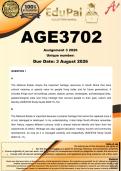
AGE3702
Assignment 3 2026
Unique number:
Due Date: 3 August 2026
QUESTION 1
a.
The National Estate means the important heritage resources in South Africa that have
cultural meaning or special value for people living today and for future generations. It
includes things such as buildings, places, objects, graves, landscapes, archaeological sites,
palaeontological sites and living heritage that connect people to their past, culture and
identity (AGE3702 Study Guide 2023:15–16).
b.
The National Estate is important because it protects heritage that cannot be replaced once it
is lost, damaged or destroyed. In my understanding, it also helps South Africans remember
their history, respect different cultures, build a shared national identity and learn from the
experiences of others. Heritage can also support education, healing, tourism and community
development, as long as it is managed carefully and respectfully (AGE3702 Study Guide
2023:15–17). Terms of use
By making use of this document you agree to:
Use this document as a guide for learning, comparison and reference purpose,
Terms of use
Not to duplicate, reproduce and/or misrepresent the contents of this document as your own work,
By making use of this document you agree to:
Use this document
Fully accept the consequences
solely as a guide forshould you plagiarise
learning, reference,or and
misuse this document.
comparison purposes,
Ensure originality of your own work, and fully accept the consequences should you plagiarise or misuse this document.
Comply with all relevant standards, guidelines, regulations, and legislation governing academic and written work.
Disclaimer
Great care has been taken in the preparation of this document; however, the contents are provided "as is" without any express or
implied representations or warranties. The author accepts no responsibility or liability for any actions taken based on the
information contained within this document. This document is intended solely for comparison, research, and reference purposes.
Reproduction, resale, or transmission of any part of this document, in any form or by any means, is strictly prohibited.
, +27 81 278 3372
QUESTION 1
a.
The National Estate means the important heritage resources in South Africa that
have cultural meaning or special value for people living today and for future
generations. It includes things such as buildings, places, objects, graves,
landscapes, archaeological sites, palaeontological sites and living heritage that
connect people to their past, culture and identity (AGE3702 Study Guide 2023:15–
16).
b.
The National Estate is important because it protects heritage that cannot be replaced
once it is lost, damaged or destroyed. In my understanding, it also helps South
Africans remember their history, respect different cultures, build a shared national
identity and learn from the experiences of others. Heritage can also support
education, healing, tourism and community development, as long as it is managed
carefully and respectfully (AGE3702 Study Guide 2023:15–17).
QUESTION 2
One criterion in NHRA section 3(3) is that a site may be important in the community
or in the pattern of South Africa’s history. This means a site can be significant when it
helps people understand important events, changes or experiences that shaped the
country and the lives of different communities (AGE3702 Study Guide 2023:47–48).
Another criterion is that a site may contain rare, uncommon or endangered parts of
South Africa’s natural or cultural heritage. This is important because some sites hold
special information or meaning that is not found in many other places, so losing such
a site would be a serious loss to the country’s heritage (AGE3702 Study Guide
2023:47–48).
A third criterion is that a site may have the potential to give information that helps
people understand South Africa’s natural or cultural heritage better. This is very
relevant to archaeological sites because objects, structures and remains from the
Disclaimer
Great care has been taken in the preparation of this document; however, the contents are provided "as is"
without any express or implied representations or warranties. The author accepts no responsibility or
liability for any actions taken based on the information contained within this document. This document is
intended solely for comparison, research, and reference purposes. Reproduction, resale, or transmission
of any part of this document, in any form or by any means, is strictly prohibited.
Assignment 3 2026
Unique number:
Due Date: 3 August 2026
QUESTION 1
a.
The National Estate means the important heritage resources in South Africa that have
cultural meaning or special value for people living today and for future generations. It
includes things such as buildings, places, objects, graves, landscapes, archaeological sites,
palaeontological sites and living heritage that connect people to their past, culture and
identity (AGE3702 Study Guide 2023:15–16).
b.
The National Estate is important because it protects heritage that cannot be replaced once it
is lost, damaged or destroyed. In my understanding, it also helps South Africans remember
their history, respect different cultures, build a shared national identity and learn from the
experiences of others. Heritage can also support education, healing, tourism and community
development, as long as it is managed carefully and respectfully (AGE3702 Study Guide
2023:15–17). Terms of use
By making use of this document you agree to:
Use this document as a guide for learning, comparison and reference purpose,
Terms of use
Not to duplicate, reproduce and/or misrepresent the contents of this document as your own work,
By making use of this document you agree to:
Use this document
Fully accept the consequences
solely as a guide forshould you plagiarise
learning, reference,or and
misuse this document.
comparison purposes,
Ensure originality of your own work, and fully accept the consequences should you plagiarise or misuse this document.
Comply with all relevant standards, guidelines, regulations, and legislation governing academic and written work.
Disclaimer
Great care has been taken in the preparation of this document; however, the contents are provided "as is" without any express or
implied representations or warranties. The author accepts no responsibility or liability for any actions taken based on the
information contained within this document. This document is intended solely for comparison, research, and reference purposes.
Reproduction, resale, or transmission of any part of this document, in any form or by any means, is strictly prohibited.
, +27 81 278 3372
QUESTION 1
a.
The National Estate means the important heritage resources in South Africa that
have cultural meaning or special value for people living today and for future
generations. It includes things such as buildings, places, objects, graves,
landscapes, archaeological sites, palaeontological sites and living heritage that
connect people to their past, culture and identity (AGE3702 Study Guide 2023:15–
16).
b.
The National Estate is important because it protects heritage that cannot be replaced
once it is lost, damaged or destroyed. In my understanding, it also helps South
Africans remember their history, respect different cultures, build a shared national
identity and learn from the experiences of others. Heritage can also support
education, healing, tourism and community development, as long as it is managed
carefully and respectfully (AGE3702 Study Guide 2023:15–17).
QUESTION 2
One criterion in NHRA section 3(3) is that a site may be important in the community
or in the pattern of South Africa’s history. This means a site can be significant when it
helps people understand important events, changes or experiences that shaped the
country and the lives of different communities (AGE3702 Study Guide 2023:47–48).
Another criterion is that a site may contain rare, uncommon or endangered parts of
South Africa’s natural or cultural heritage. This is important because some sites hold
special information or meaning that is not found in many other places, so losing such
a site would be a serious loss to the country’s heritage (AGE3702 Study Guide
2023:47–48).
A third criterion is that a site may have the potential to give information that helps
people understand South Africa’s natural or cultural heritage better. This is very
relevant to archaeological sites because objects, structures and remains from the
Disclaimer
Great care has been taken in the preparation of this document; however, the contents are provided "as is"
without any express or implied representations or warranties. The author accepts no responsibility or
liability for any actions taken based on the information contained within this document. This document is
intended solely for comparison, research, and reference purposes. Reproduction, resale, or transmission
of any part of this document, in any form or by any means, is strictly prohibited.



