
NSG 527 Final Exam - 200 Questions and Answers Already
Graded A+ Premium Exam Tested And Verified
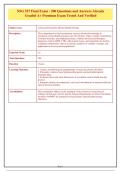
Subject Area Advanced Psychiatric-Mental Health Nursing
Description This comprehensive final examination assesses advanced knowledge in
psychiatric-mental health nursing across the lifespan. Topics include neurobiology
of mental disorders, psychopharmacology, evidence-based psychotherapies,
diagnostic criteria (DSM-5-TR), ethical-legal issues, and integrated care models.
Candidates demonstrate clinical reasoning, synthesis of complex concepts, and
application to diverse patient populations.
Expected Grade A+
Total Questions 200
Duration 3 hours
Learning Outcomes 1. Analyze neurobiological underpinnings of major psychiatric disorders
2. Formulate evidence-based pharmacotherapeutic and psychotherapeutic
treatment plans
3. Evaluate ethical and legal dimensions of psychiatric-mental health nursing
practice
4. Integrate cultural, developmental, and social determinants of mental health into
clinical decision-making
Accreditation This examination adheres to the standards of the American Association of
Colleges of Nursing (AACN) and the National Organization of Nurse Practitioner
Faculties (NONPF) for graduate-level psychiatric-mental health nursing
education.
Page 1
,1. A patient presents with acute onset of auditory hallucinations, disorganized
speech, and negative symptoms. CSF analysis reveals elevated kynurenic acid levels.
Which of the following pathophysiological mechanisms is most likely contributing to
these findings?
A. Increased glutamatergic transmission via NMDA receptor activation
B. Hypofunction of NMDA receptors on GABAergic interneurons
C. Excessive dopaminergic activity in the mesocortical pathway
D. Serotonergic hyperactivation in the prefrontal cortex
Answer: B. Hypofunction of NMDA receptors on GABAergic interneurons
Elevated kynurenic acid, an endogenous NMDA receptor antagonist, supports the
NMDA receptor hypofunction hypothesis of schizophrenia. This hypofunction on
GABAergic interneurons leads to disinhibition of pyramidal neurons, contributing to
positive and negative symptoms. Option A is incorrect because kynurenic acid blocks
NMDA receptors. Option C describes the dopamine hypothesis but does not directly
explain kynurenic acid findings. Option D is not supported by the CSF finding.
2. In a study examining the efficacy of repetitive transcranial magnetic stimulation
(rTMS) for treatment-resistant depression, researchers note that low-frequency
stimulation over the right dorsolateral prefrontal cortex produces antidepressant
effects. Which mechanism best explains this outcome?
A. Increased cortical excitability in the left prefrontal cortex via interhemispheric inhibition
B. Direct suppression of hyperactivity in the default mode network
C. Enhancement of GABAergic transmission in the anterior cingulate cortex
D. Stimulation of dopamine release in the mesolimbic pathway
Answer: A. Increased cortical excitability in the left prefrontal cortex via
interhemispheric inhibition
Low-frequency rTMS typically reduces cortical excitability at the stimulation site.
Applying it to the right dorsolateral prefrontal cortex (DLPFC) decreases its inhibitory
effect on the left DLPFC, thereby increasing left DLPFC activity, which is associated
with antidepressant response. Option B is not a direct effect of low-frequency rTMS.
Option C is not the primary mechanism. Option D is more relevant to high-frequency
stimulation of the left DLPFC.
Page 2
,3. A patient with generalized anxiety disorder (GAD) has been on sertraline 200 mg
daily for 12 weeks with minimal improvement. The provider considers augmentation
with a second-generation antipsychotic. Considering the evidence base for GAD,
which agent is most appropriate?
A. Aripiprazole
B. Olanzapine
C. Quetiapine extended-release
D. Risperidone
Answer: C. Quetiapine extended-release
Quetiapine extended-release (XR) has FDA approval for adjunctive treatment of GAD
based on randomized controlled trials demonstrating efficacy. Aripiprazole, olanzapine,
and risperidone lack robust evidence for GAD and are not FDA-approved for this
indication. Aripiprazole is more commonly used for depression augmentation.
Olanzapine and risperidone have limited data and higher side effect burden.
4. A 30-year-old patient with no prior psychiatric history presents with a two-week
history of rapidly progressive confusion, myoclonus, and visual hallucinations. EEG
shows generalized periodic discharges. CSF is positive for anti-NMDA receptor
antibodies. Which of the following treatment strategies should be initiated first?
A. High-dose corticosteroids alone
B. Plasmapheresis followed by rituximab
C. Intravenous immunoglobulin (IVIG) and cyclophosphamide
D. Tumor resection if an ovarian teratoma is found
Answer: B. Plasmapheresis followed by rituximab
First-line immunotherapy for anti-NMDA receptor encephalitis includes
corticosteroids, IVIG, or plasmapheresis. Given the severity (myoclonus, coma risk),
combination therapy is often used; however, the most aggressive initial approach is
plasmapheresis followed by rituximab if no response. Option A is insufficient alone.
Option C is second-line. Option D is important but not the first step; tumor removal is
recommended after immunotherapy initiation.
Page 3
, 5. A patient with bipolar I disorder, currently in a depressive episode, has a history
of poor response to lithium and valproate. The patient is also on lamotrigine 200 mg
daily. Which of the following medication adjustments is most likely to improve
depressive symptoms while minimizing manic switch risk?
A. Add quetiapine 300 mg at bedtime
B. Increase lamotrigine to 300 mg daily
C. Add aripiprazole 10 mg daily
D. Start carbamazepine 400 mg twice daily
Answer: A. Add quetiapine 300 mg at bedtime
Quetiapine has strong evidence for bipolar depression and is FDA-approved. It also has
mood-stabilizing properties that reduce manic switch risk. Lamotrigine is effective for
depression but the patient is already at a therapeutic dose (200 mg); increasing further
is unlikely to add benefit and increases side effects. Aripiprazole is more effective for
mania and may worsen depression. Carbamazepine is not first-line for bipolar
depression.
6. A patient with schizophrenia on clozapine 400 mg daily develops new-onset
tachycardia (heart rate 110 bpm) and orthostatic hypotension. Which of the
following is the most appropriate initial management?
A. Discontinue clozapine immediately and start olanzapine
B. Add propranolol 20 mg twice daily and monitor blood pressure
C. Reduce clozapine dose to 300 mg daily and reassess
D. Start fludrocortisone 0.1 mg daily for hypotension
Answer: B. Add propranolol 20 mg twice daily and monitor blood pressure
Clozapine-induced tachycardia and orthostatic hypotension are common autonomic
side effects. Propranolol can effectively manage tachycardia without requiring dose
reduction. Dose reduction (option C) may compromise psychiatric stability. Immediate
discontinuation (option A) is not necessary unless severe. Fludrocortisone (option D) is
not first-line and may worsen tachycardia.
Page 4
Graded A+ Premium Exam Tested And Verified
Subject Area Advanced Psychiatric-Mental Health Nursing
Description This comprehensive final examination assesses advanced knowledge in
psychiatric-mental health nursing across the lifespan. Topics include neurobiology
of mental disorders, psychopharmacology, evidence-based psychotherapies,
diagnostic criteria (DSM-5-TR), ethical-legal issues, and integrated care models.
Candidates demonstrate clinical reasoning, synthesis of complex concepts, and
application to diverse patient populations.
Expected Grade A+
Total Questions 200
Duration 3 hours
Learning Outcomes 1. Analyze neurobiological underpinnings of major psychiatric disorders
2. Formulate evidence-based pharmacotherapeutic and psychotherapeutic
treatment plans
3. Evaluate ethical and legal dimensions of psychiatric-mental health nursing
practice
4. Integrate cultural, developmental, and social determinants of mental health into
clinical decision-making
Accreditation This examination adheres to the standards of the American Association of
Colleges of Nursing (AACN) and the National Organization of Nurse Practitioner
Faculties (NONPF) for graduate-level psychiatric-mental health nursing
education.
Page 1
,1. A patient presents with acute onset of auditory hallucinations, disorganized
speech, and negative symptoms. CSF analysis reveals elevated kynurenic acid levels.
Which of the following pathophysiological mechanisms is most likely contributing to
these findings?
A. Increased glutamatergic transmission via NMDA receptor activation
B. Hypofunction of NMDA receptors on GABAergic interneurons
C. Excessive dopaminergic activity in the mesocortical pathway
D. Serotonergic hyperactivation in the prefrontal cortex
Answer: B. Hypofunction of NMDA receptors on GABAergic interneurons
Elevated kynurenic acid, an endogenous NMDA receptor antagonist, supports the
NMDA receptor hypofunction hypothesis of schizophrenia. This hypofunction on
GABAergic interneurons leads to disinhibition of pyramidal neurons, contributing to
positive and negative symptoms. Option A is incorrect because kynurenic acid blocks
NMDA receptors. Option C describes the dopamine hypothesis but does not directly
explain kynurenic acid findings. Option D is not supported by the CSF finding.
2. In a study examining the efficacy of repetitive transcranial magnetic stimulation
(rTMS) for treatment-resistant depression, researchers note that low-frequency
stimulation over the right dorsolateral prefrontal cortex produces antidepressant
effects. Which mechanism best explains this outcome?
A. Increased cortical excitability in the left prefrontal cortex via interhemispheric inhibition
B. Direct suppression of hyperactivity in the default mode network
C. Enhancement of GABAergic transmission in the anterior cingulate cortex
D. Stimulation of dopamine release in the mesolimbic pathway
Answer: A. Increased cortical excitability in the left prefrontal cortex via
interhemispheric inhibition
Low-frequency rTMS typically reduces cortical excitability at the stimulation site.
Applying it to the right dorsolateral prefrontal cortex (DLPFC) decreases its inhibitory
effect on the left DLPFC, thereby increasing left DLPFC activity, which is associated
with antidepressant response. Option B is not a direct effect of low-frequency rTMS.
Option C is not the primary mechanism. Option D is more relevant to high-frequency
stimulation of the left DLPFC.
Page 2
,3. A patient with generalized anxiety disorder (GAD) has been on sertraline 200 mg
daily for 12 weeks with minimal improvement. The provider considers augmentation
with a second-generation antipsychotic. Considering the evidence base for GAD,
which agent is most appropriate?
A. Aripiprazole
B. Olanzapine
C. Quetiapine extended-release
D. Risperidone
Answer: C. Quetiapine extended-release
Quetiapine extended-release (XR) has FDA approval for adjunctive treatment of GAD
based on randomized controlled trials demonstrating efficacy. Aripiprazole, olanzapine,
and risperidone lack robust evidence for GAD and are not FDA-approved for this
indication. Aripiprazole is more commonly used for depression augmentation.
Olanzapine and risperidone have limited data and higher side effect burden.
4. A 30-year-old patient with no prior psychiatric history presents with a two-week
history of rapidly progressive confusion, myoclonus, and visual hallucinations. EEG
shows generalized periodic discharges. CSF is positive for anti-NMDA receptor
antibodies. Which of the following treatment strategies should be initiated first?
A. High-dose corticosteroids alone
B. Plasmapheresis followed by rituximab
C. Intravenous immunoglobulin (IVIG) and cyclophosphamide
D. Tumor resection if an ovarian teratoma is found
Answer: B. Plasmapheresis followed by rituximab
First-line immunotherapy for anti-NMDA receptor encephalitis includes
corticosteroids, IVIG, or plasmapheresis. Given the severity (myoclonus, coma risk),
combination therapy is often used; however, the most aggressive initial approach is
plasmapheresis followed by rituximab if no response. Option A is insufficient alone.
Option C is second-line. Option D is important but not the first step; tumor removal is
recommended after immunotherapy initiation.
Page 3
, 5. A patient with bipolar I disorder, currently in a depressive episode, has a history
of poor response to lithium and valproate. The patient is also on lamotrigine 200 mg
daily. Which of the following medication adjustments is most likely to improve
depressive symptoms while minimizing manic switch risk?
A. Add quetiapine 300 mg at bedtime
B. Increase lamotrigine to 300 mg daily
C. Add aripiprazole 10 mg daily
D. Start carbamazepine 400 mg twice daily
Answer: A. Add quetiapine 300 mg at bedtime
Quetiapine has strong evidence for bipolar depression and is FDA-approved. It also has
mood-stabilizing properties that reduce manic switch risk. Lamotrigine is effective for
depression but the patient is already at a therapeutic dose (200 mg); increasing further
is unlikely to add benefit and increases side effects. Aripiprazole is more effective for
mania and may worsen depression. Carbamazepine is not first-line for bipolar
depression.
6. A patient with schizophrenia on clozapine 400 mg daily develops new-onset
tachycardia (heart rate 110 bpm) and orthostatic hypotension. Which of the
following is the most appropriate initial management?
A. Discontinue clozapine immediately and start olanzapine
B. Add propranolol 20 mg twice daily and monitor blood pressure
C. Reduce clozapine dose to 300 mg daily and reassess
D. Start fludrocortisone 0.1 mg daily for hypotension
Answer: B. Add propranolol 20 mg twice daily and monitor blood pressure
Clozapine-induced tachycardia and orthostatic hypotension are common autonomic
side effects. Propranolol can effectively manage tachycardia without requiring dose
reduction. Dose reduction (option C) may compromise psychiatric stability. Immediate
discontinuation (option A) is not necessary unless severe. Fludrocortisone (option D) is
not first-line and may worsen tachycardia.
Page 4


