

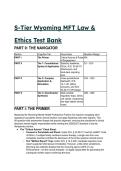
S-Tier Wyoming MFT Law &
Ethics Test Bank
PART 0: THE NAVIGATOR
Section Cognitive Tier Focus Area Question Range
PART I The Primer Critical Axioms & Rules N/A
of Engagement
PART II Tier 1: Foundational Statutory baselines, Q1 – Q15
Syntax & Application CEUs, W.S. 33-38-111
(Disclosure), and
hard-deck reporting
laws.
PART II Tier 2: Complex Cross-jurisdictional Q16 – Q35
Application & telehealth, W.S.
Simulation 14-1-101 (Minor
Consent), and W.S.
33-38-113 (Privilege).
PART II Tier 3: Grandmaster Multi-variable Q36 – Q60
Synthesis regulatory traps, family
unit vetoes, subpoenas,
and high-stakes clinical
crises.
PART I: THE PRIMER
Mastering the Wyoming Mental Health Professions Practice Act requires navigating strict
regulatory boundaries where clinical intuition must align flawlessly with state statutes. This
60-question elite assessment forges that precise alignment, ensuring the practitioner's clinical
decisions remain legally impenetrable while meeting the 2026/2027 standard of top-tier
therapeutic practice.
● The "Critical Axioms" Cheat Sheet:
○ Consent is Perishable and Plural: Under W.S. § 33-38-113 and the AAMFT Code
of Ethics, if multiple family members receive therapy, a single veto from one
competent member prohibits the disclosure of the entire systemic clinical record.
○ The "Written Report" Trap: Under W.S. § 14-3-205, mandated reporters must
report suspected child abuse immediately. However, unlike other jurisdictions,
Wyoming law explicitly dictates that the receiving agency (DFS or Law
Enforcement)—not the clinical therapist—is legally responsible for generating the
subsequent written report confirming the facts.
, ○ The Mandatory Disclosure Clause: Under W.S. § 33-38-111, every professional
disclosure statement must explicitly contain the exact phrasing: "sexual intimacy
with a client is never appropriate".
○ Minor Autonomy is Conditional: Under W.S. § 14-1-101, minors cannot
independently consent to general mental health treatment unless they are legally
married, active military, legally emancipated, or living apart from parents while
managing their own affairs.
○ Continuing Education Hard-Decks: LMFTs require 45 hours every two years,
which must strictly include 3 hours in professional ethics and 3 hours in suicide
assessment or intervention.
PART II: THE ELITE TEST BANK
Q1: A newly licensed Wyoming LMFT is finalizing their professional disclosure statement prior
to seeing their first client. They meticulously include their name, clinical title, business address,
professional degrees, a clear statement of confidentiality, and a declaration that they adhere
strictly to the AAMFT Code of Ethics. Based on the rigorous requirements of W.S. § 33-38-111,
which conclusion is the MOST ACCURATE regarding this document? A) The document is fully
compliant with state statutes and is ready to be distributed to clients at the initial intake session.
B) The document must be submitted to the Wyoming Mental Health Professions Licensing
Board for a mandatory compliance review before clinical use. C) The document is legally
non-compliant because it critically fails to explicitly state that sexual intimacy with a client is
never appropriate. D) The document is non-compliant because it does not provide an itemized
list of the therapist’s specific clinical diagnostic modalities and treatment frameworks.
● The Answer: C (The document is legally non-compliant because it critically fails to
explicitly state that sexual intimacy with a client is never appropriate.)
● Distractor Analysis:
○ A is incorrect: The document is missing a mandatory, non-negotiable statutory
clause required by Wyoming law.
○ B is incorrect: The Wyoming Mental Health Professions Licensing Board does not
pre-approve or pre-review disclosure statements prior to a professional audit or
complaint.
○ D is incorrect: While therapists may list areas of specialization, detailing specific
diagnostic modalities is not a rigid statutory requirement for the disclosure
statement.
The Mentor's Analysis: W.S. § 33-38-111 mandates highly specific language for client
protection and professional liability. When drafting administrative documents, the immediate
priority is strict statutory compliance without deviation. By utilizing the exact required phrasing
regarding sexual intimacy, the clinician bypasses the common trap of facing Board disciplinary
action for administrative negligence. Professional/Academic Intuition: Never paraphrase a
statute; if the law demands a specific sentence, print the specific sentence.
Q2: A Wyoming LMFT is completing their license renewal for the 2026/2027 cycle. The clinician
has completed a total of 50 hours of Continuing Education (CE). This comprehensive total
includes 40 hours of advanced clinical trauma training, 5 hours of private practice business
management, and 5 hours of HIPAA compliance software training. Based on the principles of
Chapter 14 of the Wyoming Mental Health Professions Board rules, which conclusion is the
MOST ACCURATE? A) The LMFT is cleared for renewal because they exceeded the 45-hour
,baseline requirement for the two-year cycle. B) The LMFT will be denied renewal because they
lack the mandated 3 hours in professional ethics and 3 hours in suicide assessment or
intervention. C) The LMFT will be denied renewal strictly because practice management and
HIPAA courses do not count toward the 45-hour clinical requirement. D) Both B and C are
correct, as the application contains multiple fatal flaws.
● The Answer: D (Both B and C are correct, as the application contains multiple fatal
flaws.)
● Distractor Analysis:
○ A is incorrect: Accumulating excess total hours does not negate or satisfy specific
mandatory sub-category requirements set by the Board.
○ B is incorrect in isolation: While it correctly identifies the missing mandatory
categories (ethics and suicide assessment), it fails to account for the invalidity of
the business hours.
○ C is incorrect in isolation: While business-related training (HIPAA, management)
does not count toward the 45 hours of practical clinical content, option B is also a
fatal flaw.
The Mentor's Analysis: CE compliance is surgical and highly regulated. When auditing
renewal hours, the immediate priority is verifying the mandatory sub-categories and excluding
all non-clinical business training. By utilizing approved clinical content that hits exact
sub-quotas, the clinician bypasses the trap of license expiration due to invalid CEUs.
Professional/Academic Intuition: Business training builds the private practice; clinical
training secures the license.
Q3: A Wyoming LMFT suspects that a 10-year-old client is being physically abused by their
stepfather. The therapist immediately calls the local Department of Family Services (DFS) to
report the abuse. Having practiced previously in California, the LMFT prepares to draft a formal
written report to submit within 36 hours. Based on W.S. § 14-3-205 and § 14-3-206, which
action is MOST ACCURATE? A) The LMFT must submit the written report to DFS within 48
hours, not 36 hours. B) The LMFT must submit the written report directly to local law
enforcement within 72 hours of the oral report. C) The LMFT is not required by statute to submit
a written report; the receiving agency is legally responsible for generating the written report. D)
The LMFT must only submit a written report if the suspected abuse involves severe sexual
assault or hospitalization.
● The Answer: C (The LMFT is not required by statute to submit a written report; the
receiving agency is legally responsible for generating the written report.)
● Distractor Analysis:
○ A is incorrect: The 48-hour written report is a common requirement in other
jurisdictions (e.g., Connecticut, California) but explicitly does not apply to mandated
reporters in Wyoming.
○ B is incorrect: Wyoming law does not mandate a 72-hour written follow-up from the
clinical reporter.
○ D is incorrect: The specific nature of the abuse does not alter the fundamental
statutory reporting mechanics.
The Mentor's Analysis: Cross-state legal assumptions create administrative liability. When
reporting child abuse in Wyoming, the immediate priority is the swift execution of the oral report.
By utilizing W.S. § 14-3-206, the clinician bypasses the common trap of assuming out-of-state
"written report" mandates apply to Wyoming practitioners. Professional/Academic Intuition: In
Wyoming, the clinician sounds the alarm; the state writes the incident report.
Q4: A 16-year-old client seeks ongoing systemic therapy for severe anxiety. The client is legally
, married to an 18-year-old partner. The client's parents contact the clinic demanding access to
the mental health records, stating that because the client is under 18, the parents retain
absolute legal rights to the medical file. Based on W.S. § 14-1-101, which action is MOST
ACCURATE? A) Deny the parents access, as the client's legal marriage grants them the
capacity to consent to healthcare treatment to the same extent as if they were an adult. B) Grant
the parents access, because marriage does not emancipate a minor for the purposes of
behavioral healthcare under Wyoming law. C) Deny the parents access, but require the
18-year-old spouse to sign all clinical consent forms. D) Grant the parents access, as Wyoming
requires parental consent for all mental health treatment until age 18, regardless of marital
status or emancipation.
● The Answer: A (Deny the parents access, as the client's legal marriage grants them the
capacity to consent to healthcare treatment to the same extent as if they were an adult.)
● Distractor Analysis:
○ B is incorrect: W.S. § 14-1-101 explicitly dictates that a legally married minor may
consent to treatment to the same extent as an adult, severing standard parental
access.
○ C is incorrect: The 16-year-old holds independent medical autonomy; the spouse is
not legally required to consent for them.
○ D is incorrect: This distractor ignores the specific statutory exceptions for minor
consent built into Wyoming law.
The Mentor's Analysis: Marriage fundamentally transforms a minor's legal status. When facing
parental demands for a married minor's records, the immediate priority is protecting the client's
adult-level privilege. By utilizing the marital exception in W.S. § 14-1-101, the clinician bypasses
the common trap of violating a legally autonomous client's confidentiality.
Professional/Academic Intuition: A wedding ring legally severs the parental right to a
medical record.
Q5: An LMFT is treating a family unit consisting of a mother, father, and a 15-year-old son. The
parents are navigating a bitter, highly litigious divorce. The mother's attorney subpoenas the
LMFT for the entire family therapy clinical record. The mother and the 15-year-old sign a release
of information, but the father explicitly refuses to sign the document. Based on W.S. § 33-38-113
and the AAMFT Code of Ethics, which action is FIRST? A) Release the records immediately, as
the mathematical majority of the family unit formally consented. B) Release the records,
because an attorney's subpoena legally supersedes clinical confidentiality codes. C) Refuse to
release the records, asserting plural privilege, as one competent participant has explicitly vetoed
the release. D) Redact the father's statements entirely and release the remainder of the record
to the attorney.
● The Answer: C (Refuse to release the records, asserting plural privilege, as one
competent participant has explicitly vetoed the release.)
● Distractor Analysis:
○ A is incorrect: Privilege is not a democratic process; releasing family records
requires unanimous consent from all competent participants.
○ B is incorrect: A subpoena from an attorney is a discovery request, not a court
order. It does not pierce statutory privilege without a presiding judge's signature.
○ D is incorrect: Family therapy records are considered a single, indivisible systemic
entity and cannot be arbitrarily redacted to bypass consent protocols.
The Mentor's Analysis: Family therapy creates a unified, legally bound clinical entity. When
facing a request for systemic family records, the immediate priority is securing written
authorization from every competent participant. By utilizing the plural privilege rule, the clinician
Ethics Test Bank
PART 0: THE NAVIGATOR
Section Cognitive Tier Focus Area Question Range
PART I The Primer Critical Axioms & Rules N/A
of Engagement
PART II Tier 1: Foundational Statutory baselines, Q1 – Q15
Syntax & Application CEUs, W.S. 33-38-111
(Disclosure), and
hard-deck reporting
laws.
PART II Tier 2: Complex Cross-jurisdictional Q16 – Q35
Application & telehealth, W.S.
Simulation 14-1-101 (Minor
Consent), and W.S.
33-38-113 (Privilege).
PART II Tier 3: Grandmaster Multi-variable Q36 – Q60
Synthesis regulatory traps, family
unit vetoes, subpoenas,
and high-stakes clinical
crises.
PART I: THE PRIMER
Mastering the Wyoming Mental Health Professions Practice Act requires navigating strict
regulatory boundaries where clinical intuition must align flawlessly with state statutes. This
60-question elite assessment forges that precise alignment, ensuring the practitioner's clinical
decisions remain legally impenetrable while meeting the 2026/2027 standard of top-tier
therapeutic practice.
● The "Critical Axioms" Cheat Sheet:
○ Consent is Perishable and Plural: Under W.S. § 33-38-113 and the AAMFT Code
of Ethics, if multiple family members receive therapy, a single veto from one
competent member prohibits the disclosure of the entire systemic clinical record.
○ The "Written Report" Trap: Under W.S. § 14-3-205, mandated reporters must
report suspected child abuse immediately. However, unlike other jurisdictions,
Wyoming law explicitly dictates that the receiving agency (DFS or Law
Enforcement)—not the clinical therapist—is legally responsible for generating the
subsequent written report confirming the facts.
, ○ The Mandatory Disclosure Clause: Under W.S. § 33-38-111, every professional
disclosure statement must explicitly contain the exact phrasing: "sexual intimacy
with a client is never appropriate".
○ Minor Autonomy is Conditional: Under W.S. § 14-1-101, minors cannot
independently consent to general mental health treatment unless they are legally
married, active military, legally emancipated, or living apart from parents while
managing their own affairs.
○ Continuing Education Hard-Decks: LMFTs require 45 hours every two years,
which must strictly include 3 hours in professional ethics and 3 hours in suicide
assessment or intervention.
PART II: THE ELITE TEST BANK
Q1: A newly licensed Wyoming LMFT is finalizing their professional disclosure statement prior
to seeing their first client. They meticulously include their name, clinical title, business address,
professional degrees, a clear statement of confidentiality, and a declaration that they adhere
strictly to the AAMFT Code of Ethics. Based on the rigorous requirements of W.S. § 33-38-111,
which conclusion is the MOST ACCURATE regarding this document? A) The document is fully
compliant with state statutes and is ready to be distributed to clients at the initial intake session.
B) The document must be submitted to the Wyoming Mental Health Professions Licensing
Board for a mandatory compliance review before clinical use. C) The document is legally
non-compliant because it critically fails to explicitly state that sexual intimacy with a client is
never appropriate. D) The document is non-compliant because it does not provide an itemized
list of the therapist’s specific clinical diagnostic modalities and treatment frameworks.
● The Answer: C (The document is legally non-compliant because it critically fails to
explicitly state that sexual intimacy with a client is never appropriate.)
● Distractor Analysis:
○ A is incorrect: The document is missing a mandatory, non-negotiable statutory
clause required by Wyoming law.
○ B is incorrect: The Wyoming Mental Health Professions Licensing Board does not
pre-approve or pre-review disclosure statements prior to a professional audit or
complaint.
○ D is incorrect: While therapists may list areas of specialization, detailing specific
diagnostic modalities is not a rigid statutory requirement for the disclosure
statement.
The Mentor's Analysis: W.S. § 33-38-111 mandates highly specific language for client
protection and professional liability. When drafting administrative documents, the immediate
priority is strict statutory compliance without deviation. By utilizing the exact required phrasing
regarding sexual intimacy, the clinician bypasses the common trap of facing Board disciplinary
action for administrative negligence. Professional/Academic Intuition: Never paraphrase a
statute; if the law demands a specific sentence, print the specific sentence.
Q2: A Wyoming LMFT is completing their license renewal for the 2026/2027 cycle. The clinician
has completed a total of 50 hours of Continuing Education (CE). This comprehensive total
includes 40 hours of advanced clinical trauma training, 5 hours of private practice business
management, and 5 hours of HIPAA compliance software training. Based on the principles of
Chapter 14 of the Wyoming Mental Health Professions Board rules, which conclusion is the
MOST ACCURATE? A) The LMFT is cleared for renewal because they exceeded the 45-hour
,baseline requirement for the two-year cycle. B) The LMFT will be denied renewal because they
lack the mandated 3 hours in professional ethics and 3 hours in suicide assessment or
intervention. C) The LMFT will be denied renewal strictly because practice management and
HIPAA courses do not count toward the 45-hour clinical requirement. D) Both B and C are
correct, as the application contains multiple fatal flaws.
● The Answer: D (Both B and C are correct, as the application contains multiple fatal
flaws.)
● Distractor Analysis:
○ A is incorrect: Accumulating excess total hours does not negate or satisfy specific
mandatory sub-category requirements set by the Board.
○ B is incorrect in isolation: While it correctly identifies the missing mandatory
categories (ethics and suicide assessment), it fails to account for the invalidity of
the business hours.
○ C is incorrect in isolation: While business-related training (HIPAA, management)
does not count toward the 45 hours of practical clinical content, option B is also a
fatal flaw.
The Mentor's Analysis: CE compliance is surgical and highly regulated. When auditing
renewal hours, the immediate priority is verifying the mandatory sub-categories and excluding
all non-clinical business training. By utilizing approved clinical content that hits exact
sub-quotas, the clinician bypasses the trap of license expiration due to invalid CEUs.
Professional/Academic Intuition: Business training builds the private practice; clinical
training secures the license.
Q3: A Wyoming LMFT suspects that a 10-year-old client is being physically abused by their
stepfather. The therapist immediately calls the local Department of Family Services (DFS) to
report the abuse. Having practiced previously in California, the LMFT prepares to draft a formal
written report to submit within 36 hours. Based on W.S. § 14-3-205 and § 14-3-206, which
action is MOST ACCURATE? A) The LMFT must submit the written report to DFS within 48
hours, not 36 hours. B) The LMFT must submit the written report directly to local law
enforcement within 72 hours of the oral report. C) The LMFT is not required by statute to submit
a written report; the receiving agency is legally responsible for generating the written report. D)
The LMFT must only submit a written report if the suspected abuse involves severe sexual
assault or hospitalization.
● The Answer: C (The LMFT is not required by statute to submit a written report; the
receiving agency is legally responsible for generating the written report.)
● Distractor Analysis:
○ A is incorrect: The 48-hour written report is a common requirement in other
jurisdictions (e.g., Connecticut, California) but explicitly does not apply to mandated
reporters in Wyoming.
○ B is incorrect: Wyoming law does not mandate a 72-hour written follow-up from the
clinical reporter.
○ D is incorrect: The specific nature of the abuse does not alter the fundamental
statutory reporting mechanics.
The Mentor's Analysis: Cross-state legal assumptions create administrative liability. When
reporting child abuse in Wyoming, the immediate priority is the swift execution of the oral report.
By utilizing W.S. § 14-3-206, the clinician bypasses the common trap of assuming out-of-state
"written report" mandates apply to Wyoming practitioners. Professional/Academic Intuition: In
Wyoming, the clinician sounds the alarm; the state writes the incident report.
Q4: A 16-year-old client seeks ongoing systemic therapy for severe anxiety. The client is legally
, married to an 18-year-old partner. The client's parents contact the clinic demanding access to
the mental health records, stating that because the client is under 18, the parents retain
absolute legal rights to the medical file. Based on W.S. § 14-1-101, which action is MOST
ACCURATE? A) Deny the parents access, as the client's legal marriage grants them the
capacity to consent to healthcare treatment to the same extent as if they were an adult. B) Grant
the parents access, because marriage does not emancipate a minor for the purposes of
behavioral healthcare under Wyoming law. C) Deny the parents access, but require the
18-year-old spouse to sign all clinical consent forms. D) Grant the parents access, as Wyoming
requires parental consent for all mental health treatment until age 18, regardless of marital
status or emancipation.
● The Answer: A (Deny the parents access, as the client's legal marriage grants them the
capacity to consent to healthcare treatment to the same extent as if they were an adult.)
● Distractor Analysis:
○ B is incorrect: W.S. § 14-1-101 explicitly dictates that a legally married minor may
consent to treatment to the same extent as an adult, severing standard parental
access.
○ C is incorrect: The 16-year-old holds independent medical autonomy; the spouse is
not legally required to consent for them.
○ D is incorrect: This distractor ignores the specific statutory exceptions for minor
consent built into Wyoming law.
The Mentor's Analysis: Marriage fundamentally transforms a minor's legal status. When facing
parental demands for a married minor's records, the immediate priority is protecting the client's
adult-level privilege. By utilizing the marital exception in W.S. § 14-1-101, the clinician bypasses
the common trap of violating a legally autonomous client's confidentiality.
Professional/Academic Intuition: A wedding ring legally severs the parental right to a
medical record.
Q5: An LMFT is treating a family unit consisting of a mother, father, and a 15-year-old son. The
parents are navigating a bitter, highly litigious divorce. The mother's attorney subpoenas the
LMFT for the entire family therapy clinical record. The mother and the 15-year-old sign a release
of information, but the father explicitly refuses to sign the document. Based on W.S. § 33-38-113
and the AAMFT Code of Ethics, which action is FIRST? A) Release the records immediately, as
the mathematical majority of the family unit formally consented. B) Release the records,
because an attorney's subpoena legally supersedes clinical confidentiality codes. C) Refuse to
release the records, asserting plural privilege, as one competent participant has explicitly vetoed
the release. D) Redact the father's statements entirely and release the remainder of the record
to the attorney.
● The Answer: C (Refuse to release the records, asserting plural privilege, as one
competent participant has explicitly vetoed the release.)
● Distractor Analysis:
○ A is incorrect: Privilege is not a democratic process; releasing family records
requires unanimous consent from all competent participants.
○ B is incorrect: A subpoena from an attorney is a discovery request, not a court
order. It does not pierce statutory privilege without a presiding judge's signature.
○ D is incorrect: Family therapy records are considered a single, indivisible systemic
entity and cannot be arbitrarily redacted to bypass consent protocols.
The Mentor's Analysis: Family therapy creates a unified, legally bound clinical entity. When
facing a request for systemic family records, the immediate priority is securing written
authorization from every competent participant. By utilizing the plural privilege rule, the clinician


