
The Global Distribution of Hazards: 1.1
Distribution of Hazards
Earthquakes
About 95% occur close to or at a plate boundary.
They are usually associated with convergent or conservative plate
boundaries.
Intra-plate earthquakes are often linked to hot spots or are at old
fault lines.
Volcanoes
Most occur near to or at a plate boundary.
They are found at convergent and divergent plate boundaries.
Tsunamis
Over 70% occur around the Pacific Ocean.
They are caused by tectonic activity mostly at convergent
boundaries.
Intra-Plate Earthquakes
- Tectonic stresses cause ancient fault lines to reactivate.
- The plates are moving over a spherical surface, and this causes
zones of weakness.
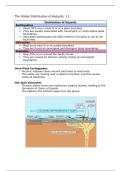
Hot Spot Volcanoes
- Tectonic plates move over stationary magma plumes, leading to the
formation of chains of islands.
- The oldest is the furthest away from the plume.
, Theory of Plate Tectonics: 1.2A
The Earth’s Structure
Crust o Continental: a thicker, less dense layer.
o Oceanic: a thinner, more dense layer.
o Consists of seven major and seven minor tectonic plates.
Mantle o The widest layer
o The upper mantle has two layers:
- The upper layer is rigid and together with the rust makes up the
lithosphere.
- The layer below is a semi-molten, plastic type layer, which moves
under high pressure.
o The lower mantle is hotter and denser than the upper mantle – the
intense pressure keeps this solid.
Core o Inner Core – solid centre, mostly composed of iron.
o Outer Core – semi-molten, mostly liquid iron and nickel
The Theory of Plate Tectonics
Convection The heat from radioactive decay in the core moves upwards
into the mantle.
It creates convection currents which causes the plates to
move.
Subduction Oceanic plates are forced under continental ones at a
convergent plate boundary.
Ridge Push Newly formed, less dense
crust at mid-ocean ridges
pushes older, heavier crust
away.
Slab Pull Older, denser tectonic
plates sink into the mantle
at subduction zones.
Sea Floor Tectonic plates move away from each other, allowing magma
Spreading from the mantle to rise and form new crust which moves away
from the ridge.
This essentially widens the ocean floor.
Palaeomagnetism Magnetic patterns of cooled magma.
Magnetic patterns arranged in the direction of the Earth’s
magnetic field which switch every millions of years.
This helps identify the age of the oceanic crust, by studying the
youngest rocks at ridges, and proves that the Earth did once fit
together.
, Plate Boundaries: 1.2B
Convergent Plate Boundaries
Continenta Denser and heavier
l and oceanic plate is subducted
oceanic under the less dense
continental plate.
Both violent volcanic
eruptions and earthquakes
occur at this boundary.
Deep sea trenches –
formed in the subduction
zone.
Fold mountains – formed
when continental plate is
compressed as oceanic
plate is subducted.
Oceanic The heavier oceanic plate is subducted.
and Deep sea trenches
oceanic Island arcs – submarine volcanic eruptions lead to crust building up
and rising above sea level.
Divergent Plate Boundary
Oceanic Both volcanic eruptions
and and earthquakes occur at
oceanic this type of boundary.
Ocean ridge: forms when
the diverging plates are
under the ocean – as the
plates move apart, magma
rises up to fill the gap and
this accumulates over time
to become taller and wider.
Continent Rift valley: forms when the diverging plates are beneath the land –
al and as the plates move apart, the crust stretches and fractures, with areas
continent of the crust dropping down between faults to create a valley.
al Volcanoes form where the magma rises.
Distribution of Hazards
Earthquakes
About 95% occur close to or at a plate boundary.
They are usually associated with convergent or conservative plate
boundaries.
Intra-plate earthquakes are often linked to hot spots or are at old
fault lines.
Volcanoes
Most occur near to or at a plate boundary.
They are found at convergent and divergent plate boundaries.
Tsunamis
Over 70% occur around the Pacific Ocean.
They are caused by tectonic activity mostly at convergent
boundaries.
Intra-Plate Earthquakes
- Tectonic stresses cause ancient fault lines to reactivate.
- The plates are moving over a spherical surface, and this causes
zones of weakness.
Hot Spot Volcanoes
- Tectonic plates move over stationary magma plumes, leading to the
formation of chains of islands.
- The oldest is the furthest away from the plume.
, Theory of Plate Tectonics: 1.2A
The Earth’s Structure
Crust o Continental: a thicker, less dense layer.
o Oceanic: a thinner, more dense layer.
o Consists of seven major and seven minor tectonic plates.
Mantle o The widest layer
o The upper mantle has two layers:
- The upper layer is rigid and together with the rust makes up the
lithosphere.
- The layer below is a semi-molten, plastic type layer, which moves
under high pressure.
o The lower mantle is hotter and denser than the upper mantle – the
intense pressure keeps this solid.
Core o Inner Core – solid centre, mostly composed of iron.
o Outer Core – semi-molten, mostly liquid iron and nickel
The Theory of Plate Tectonics
Convection The heat from radioactive decay in the core moves upwards
into the mantle.
It creates convection currents which causes the plates to
move.
Subduction Oceanic plates are forced under continental ones at a
convergent plate boundary.
Ridge Push Newly formed, less dense
crust at mid-ocean ridges
pushes older, heavier crust
away.
Slab Pull Older, denser tectonic
plates sink into the mantle
at subduction zones.
Sea Floor Tectonic plates move away from each other, allowing magma
Spreading from the mantle to rise and form new crust which moves away
from the ridge.
This essentially widens the ocean floor.
Palaeomagnetism Magnetic patterns of cooled magma.
Magnetic patterns arranged in the direction of the Earth’s
magnetic field which switch every millions of years.
This helps identify the age of the oceanic crust, by studying the
youngest rocks at ridges, and proves that the Earth did once fit
together.
, Plate Boundaries: 1.2B
Convergent Plate Boundaries
Continenta Denser and heavier
l and oceanic plate is subducted
oceanic under the less dense
continental plate.
Both violent volcanic
eruptions and earthquakes
occur at this boundary.
Deep sea trenches –
formed in the subduction
zone.
Fold mountains – formed
when continental plate is
compressed as oceanic
plate is subducted.
Oceanic The heavier oceanic plate is subducted.
and Deep sea trenches
oceanic Island arcs – submarine volcanic eruptions lead to crust building up
and rising above sea level.
Divergent Plate Boundary
Oceanic Both volcanic eruptions
and and earthquakes occur at
oceanic this type of boundary.
Ocean ridge: forms when
the diverging plates are
under the ocean – as the
plates move apart, magma
rises up to fill the gap and
this accumulates over time
to become taller and wider.
Continent Rift valley: forms when the diverging plates are beneath the land –
al and as the plates move apart, the crust stretches and fractures, with areas
continent of the crust dropping down between faults to create a valley.
al Volcanoes form where the magma rises.


