

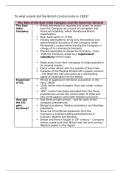
To what extent did the British Control India in 1829?
The Role of the East India Company and the Governor General
The East British attempted to regulate and assert its power
India over the Company as a result of corruption and
Company financial instability, which threatened British
stakeholders
Near bankruptcy in 1770s
Initially attempted to bring only the political and
administrative functions of the Company under
Parliament’s control while leaving the Company in
charge of its commercial interests
Proved impossible to divide the functions – from
1786 the Company acted as a regularised
subsidiary of the Crown
Made many from their monopoly of trade granted in
its original charter
Came under attack with the growth of free trade
Collapse of the Mughal Empire left a power vacuum
– EIC filled this role and acted as a self-funding
agent of imperialism for the British
Expansion Period of aggressive territorial acquisition in the
of EIC early 1800s
1818: entire Indo-Gangetic Plain was under control
of EIC
1857: control had been extended from the three
presidencies across the central plain of India and
into north-eastern and north-western provinces
How did Had three private armies – one for each of the
the EIC company presidencies
gain Bengal presidency, Madras presidency and Bombay
territory? presidency
Grew out of territorial expansion from the
Company’s original trading posts/factories in
Calcutta, Madras and Bombay
British and French fought in 18th century – Company
armies made sure that Britain was the only serious
Western power in the region
, Regulating Huge fortunes were made by the Company, but poor
Acts management and corruption forced British
intervention
1773: created a governing council of 5 – two from
the Company and 3 nominated by Parliament,
therefore ensuring a parliamentary majority.
Appointment of governor generals was made
subject to the approval by a council of four –
nominated by the Crown
1784: made EIC subordinate to the Crown in all its
political functions and a further regulatory body
(Board of Control), was set up to achieve this –
Chancellor of the Exchequer, Secretary of State for
India, four privy councillors appointed by the king
1786: enabled the governor general in special cases
to override his council
Charter 1813: renewed the Company’s charter for another
Acts 20 years, but removed its trade monopoly on
everything except for tea and trade with China
1833: ended the Company’s commercial activities
completely and reorganised the administrative
system of the territories
EIC became increasingly involved in the civil
administration and tax collection of Britain’s
territories in India
Changing British reps in India now saw themselves as ruling
Role of the territories, rather than simply engaging in and
the EIC protecting their commercial interests
Involved in local tax collection and administration
Had strong private armies that were often stronger
than those of local rulers
Local rulers allied with the British to ensure
protection from other rulers and to ensure smooth
collection of taxes from their subjects
Company hired civil servants to oversee tax
collection – supported by armies if necessary
The Role Governor initially chosen by EIC
of the 1773 onwards: British government had to approve
Governor – council of 4 Crown appointments
Presidents in Madras, Bencoolen and Bombay could
not make war or accept a peace from an Indian
prince without the approval of the governor in Fort
William (Bengal)
Power centralised in Bengal
1784 India Act: strengthened executive power of
The Role of the East India Company and the Governor General
The East British attempted to regulate and assert its power
India over the Company as a result of corruption and
Company financial instability, which threatened British
stakeholders
Near bankruptcy in 1770s
Initially attempted to bring only the political and
administrative functions of the Company under
Parliament’s control while leaving the Company in
charge of its commercial interests
Proved impossible to divide the functions – from
1786 the Company acted as a regularised
subsidiary of the Crown
Made many from their monopoly of trade granted in
its original charter
Came under attack with the growth of free trade
Collapse of the Mughal Empire left a power vacuum
– EIC filled this role and acted as a self-funding
agent of imperialism for the British
Expansion Period of aggressive territorial acquisition in the
of EIC early 1800s
1818: entire Indo-Gangetic Plain was under control
of EIC
1857: control had been extended from the three
presidencies across the central plain of India and
into north-eastern and north-western provinces
How did Had three private armies – one for each of the
the EIC company presidencies
gain Bengal presidency, Madras presidency and Bombay
territory? presidency
Grew out of territorial expansion from the
Company’s original trading posts/factories in
Calcutta, Madras and Bombay
British and French fought in 18th century – Company
armies made sure that Britain was the only serious
Western power in the region
, Regulating Huge fortunes were made by the Company, but poor
Acts management and corruption forced British
intervention
1773: created a governing council of 5 – two from
the Company and 3 nominated by Parliament,
therefore ensuring a parliamentary majority.
Appointment of governor generals was made
subject to the approval by a council of four –
nominated by the Crown
1784: made EIC subordinate to the Crown in all its
political functions and a further regulatory body
(Board of Control), was set up to achieve this –
Chancellor of the Exchequer, Secretary of State for
India, four privy councillors appointed by the king
1786: enabled the governor general in special cases
to override his council
Charter 1813: renewed the Company’s charter for another
Acts 20 years, but removed its trade monopoly on
everything except for tea and trade with China
1833: ended the Company’s commercial activities
completely and reorganised the administrative
system of the territories
EIC became increasingly involved in the civil
administration and tax collection of Britain’s
territories in India
Changing British reps in India now saw themselves as ruling
Role of the territories, rather than simply engaging in and
the EIC protecting their commercial interests
Involved in local tax collection and administration
Had strong private armies that were often stronger
than those of local rulers
Local rulers allied with the British to ensure
protection from other rulers and to ensure smooth
collection of taxes from their subjects
Company hired civil servants to oversee tax
collection – supported by armies if necessary
The Role Governor initially chosen by EIC
of the 1773 onwards: British government had to approve
Governor – council of 4 Crown appointments
Presidents in Madras, Bencoolen and Bombay could
not make war or accept a peace from an Indian
prince without the approval of the governor in Fort
William (Bengal)
Power centralised in Bengal
1784 India Act: strengthened executive power of


