GRADE 10 MATHEMATICS
HYPERBOLIC FUNCTION
The absolute best way to spot a hyperbolic function in an algebraic equation is to look
for the input variable (𝑥) in the denominator (at the bottom of a fraction).
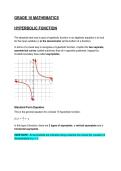
In terms of a visual way to recognise a hyperbolic function, it splits into two separate,
symmetrical curves (called branches) that sit in opposite quadrants, trapped by
invisible boundary lines called asymptotes.
Standard Form Equation
This is the general equation for a Grade 10 hyperbolic function:
𝑎
𝑓(𝑥) = 𝑥
+ 𝑞
In this type of function, there are 2 types of asymptote, a vertical asymptote and a
horizontal asymptote.
TAKE NOTE : All asymptotes are indicated using a dashed line unless the equation of
the asymptote is 𝑞 = 0
, GLOSSARY
TERM/SYMBOL WHAT IT MEANS How to find it (The
/REPRESENTS exact algebraic
step)
𝑎 This represents the shape If the value of 𝑎 > 0
of the function. The shape (positive shape), one of the
can either be positive or 2 curves will be on the 1st
negative. quadrant and the other
curve will be on the 3rd
quadrant. If the value of
𝑎 < 0 (negative shape),
one of the 2 curves will be
on the 2nd quadrant and
the other curve will be on
the 4th quadrant.
𝑞 This value represents the Look at your graph and
horizontal asymptote and identify a horizontal
the vertical shift. dashed line (this is the
horizontal asymptote), the
exact point this line cuts
through the y-axis will be
your value of the 𝑞.
Vertical Shift It is the up and down The value of q indicates
movement of the function. how much it has moved up
or down.
Asymptote This is an invisible line that Vertical asymptote− In
the graph moves closer grade 10, the vertical
to but never actually asymptote is always
touches it (We indicate present where 𝑥 = 0
the presence of this line because if you go to the
through the use of dashed equation for a hyperbola
lines). It represents the and replace 𝑥 with 0, your
point in which the graph answer will be undefined
does not exist (the 𝑥 or 𝑦 (In this grade we don’t use
for that point does not a dashed line to indicate
work) It consists of 2 types: this asymptote because
1. Vertical asymptote the 𝑦-axis is already where
(The 𝑥-value does 𝑥 = 0).
not exist) Horizontal asymptote−
2. Horizontal The value of 𝑞 always
asymptote (The 𝑦 represents this asymptote
HYPERBOLIC FUNCTION
The absolute best way to spot a hyperbolic function in an algebraic equation is to look
for the input variable (𝑥) in the denominator (at the bottom of a fraction).
In terms of a visual way to recognise a hyperbolic function, it splits into two separate,
symmetrical curves (called branches) that sit in opposite quadrants, trapped by
invisible boundary lines called asymptotes.
Standard Form Equation
This is the general equation for a Grade 10 hyperbolic function:
𝑎
𝑓(𝑥) = 𝑥
+ 𝑞
In this type of function, there are 2 types of asymptote, a vertical asymptote and a
horizontal asymptote.
TAKE NOTE : All asymptotes are indicated using a dashed line unless the equation of
the asymptote is 𝑞 = 0
, GLOSSARY
TERM/SYMBOL WHAT IT MEANS How to find it (The
/REPRESENTS exact algebraic
step)
𝑎 This represents the shape If the value of 𝑎 > 0
of the function. The shape (positive shape), one of the
can either be positive or 2 curves will be on the 1st
negative. quadrant and the other
curve will be on the 3rd
quadrant. If the value of
𝑎 < 0 (negative shape),
one of the 2 curves will be
on the 2nd quadrant and
the other curve will be on
the 4th quadrant.
𝑞 This value represents the Look at your graph and
horizontal asymptote and identify a horizontal
the vertical shift. dashed line (this is the
horizontal asymptote), the
exact point this line cuts
through the y-axis will be
your value of the 𝑞.
Vertical Shift It is the up and down The value of q indicates
movement of the function. how much it has moved up
or down.
Asymptote This is an invisible line that Vertical asymptote− In
the graph moves closer grade 10, the vertical
to but never actually asymptote is always
touches it (We indicate present where 𝑥 = 0
the presence of this line because if you go to the
through the use of dashed equation for a hyperbola
lines). It represents the and replace 𝑥 with 0, your
point in which the graph answer will be undefined
does not exist (the 𝑥 or 𝑦 (In this grade we don’t use
for that point does not a dashed line to indicate
work) It consists of 2 types: this asymptote because
1. Vertical asymptote the 𝑦-axis is already where
(The 𝑥-value does 𝑥 = 0).
not exist) Horizontal asymptote−
2. Horizontal The value of 𝑞 always
asymptote (The 𝑦 represents this asymptote