

HESI Pediatric Exam 3 | Atcual Questions
and Answers with Verified Solutions | Latest
Updated 2026
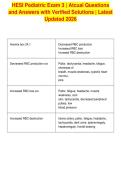
Anemia box 24.1 Decreased RBC production
Increased RBC loss
Increaed RBC destruction
Decreased RBC production s/s Pallor, tachycardia, headache, fatigue,
shortness of
breath, muscle weakness, systolic heart
murmur,
pica
Increased RBC loss s/s Pallor, fatigue, headache, muscle
weakness, cool
skin, tachycardia, decreased peripheral
pulses, low
blood pressure
Increased RBC destruction Icteris sclera, pallor, fatigue, headache,
tachycardia, dark urine, splenomegaly,
hepatomegaly, frontal bossing
,Causes of decreased RBC Nutritional deficiency: iron, folate, vitamin
production B12,
copper, chronic diseases, chronic blood
loss
Bone marrow failure: aplastic anemia,
RBC aplasia,
malignancy, ALL or neuroblastoma,
infection
Causes of increased RBC loss Epistaxis, hemophilia, hypersplenism, ITP,
DIC
Causes of increased RBC Intracorpuscular: hemoglobinopathies
destruction (SCD,
thalassemia), enzymopathies, membranes
defects
Extracorpuscular: immunologic, drugs or
toxic
substances
Diagnostic evaluation of anemia History and physical findings
Lack of energy, easily fatigued, pallor,
headache,
pica
Iron deficiency anemia therapeutic Iron-fortified cereal and formula
management for infants Iron supplementation in breastfed infants
by 4
months and premature infants
Breast milk is low iron source
, Iron deficiency anemia therapeutic Absorption facilitated by acidic
management for children environment
12-36 months at risk due to cow milk
Nursing management for iron Recheck levels after 1 months of treatment
deficiency anemia -
increased Hgb within 1 month, anemia
resolved
within 6 months
Iron supplement with vitamin C
Diet education
Safe storage - away from reach and keep
only one
month at time
Tarry green/black stools
Sickle cell anemia HbA is replaced with HbS
Pathophysiology Alters morphology of RBC: vascular
obstruction,
vascular inflammation, increased RBC
destruction
Large tissue infarctions occur damaging
organs
leading to impaired function
splenic sequestration Sickle cell anemia
Large pooling of blood in spleen causes
decreased circulating blood volume that
can lead
to shock
May require splenectomy at young age
Results in immunity problems
and Answers with Verified Solutions | Latest
Updated 2026
Anemia box 24.1 Decreased RBC production
Increased RBC loss
Increaed RBC destruction
Decreased RBC production s/s Pallor, tachycardia, headache, fatigue,
shortness of
breath, muscle weakness, systolic heart
murmur,
pica
Increased RBC loss s/s Pallor, fatigue, headache, muscle
weakness, cool
skin, tachycardia, decreased peripheral
pulses, low
blood pressure
Increased RBC destruction Icteris sclera, pallor, fatigue, headache,
tachycardia, dark urine, splenomegaly,
hepatomegaly, frontal bossing
,Causes of decreased RBC Nutritional deficiency: iron, folate, vitamin
production B12,
copper, chronic diseases, chronic blood
loss
Bone marrow failure: aplastic anemia,
RBC aplasia,
malignancy, ALL or neuroblastoma,
infection
Causes of increased RBC loss Epistaxis, hemophilia, hypersplenism, ITP,
DIC
Causes of increased RBC Intracorpuscular: hemoglobinopathies
destruction (SCD,
thalassemia), enzymopathies, membranes
defects
Extracorpuscular: immunologic, drugs or
toxic
substances
Diagnostic evaluation of anemia History and physical findings
Lack of energy, easily fatigued, pallor,
headache,
pica
Iron deficiency anemia therapeutic Iron-fortified cereal and formula
management for infants Iron supplementation in breastfed infants
by 4
months and premature infants
Breast milk is low iron source
, Iron deficiency anemia therapeutic Absorption facilitated by acidic
management for children environment
12-36 months at risk due to cow milk
Nursing management for iron Recheck levels after 1 months of treatment
deficiency anemia -
increased Hgb within 1 month, anemia
resolved
within 6 months
Iron supplement with vitamin C
Diet education
Safe storage - away from reach and keep
only one
month at time
Tarry green/black stools
Sickle cell anemia HbA is replaced with HbS
Pathophysiology Alters morphology of RBC: vascular
obstruction,
vascular inflammation, increased RBC
destruction
Large tissue infarctions occur damaging
organs
leading to impaired function
splenic sequestration Sickle cell anemia
Large pooling of blood in spleen causes
decreased circulating blood volume that
can lead
to shock
May require splenectomy at young age
Results in immunity problems


